
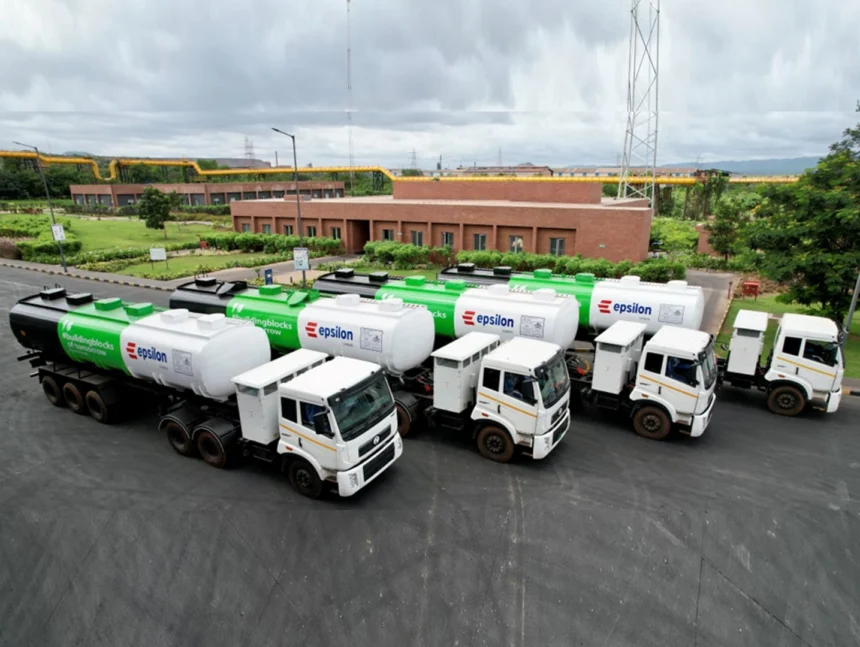
MUMBAI, Aug 5 ( ESG World News) – Epsilon Carbon Pvt Ltd said on Wednesday it had reduced carbon dioxide equivalent (CO₂e) emissions from its upstream transportation operations by 10% in the financial year ended March 2026, after switching part of its freight fleet to electric and liquefied natural gas (LNG)-powered vehicles.
The Indian carbon black and specialty carbon producer said the reduction, achieved during FY2025-26, was independently verified by a third party and was equivalent to the environmental benefit of planting about 29,000 trees.
The company said the verified reduction could also support supply chain partners’ Scope 3 emissions reporting and sustainability disclosures under recognised ESG reporting frameworks, helping customers strengthen their own decarbonisation efforts.
“Decarbonising logistics is central to our climate strategy,” Gaurav Mathur, chief executive officer of Epsilon Carbon, said in a statement. “What makes this milestone meaningful is that the results are independently verified with a 10% reduction in CO₂e emissions within the upstream transportation category over a single financial year, driven by the adoption of Electric and LNG fleets.”
“These carbon reductions strengthen our own sustainability disclosures and those of our customers, and we intend to scale this model across our supply chain,” Mathur said.
The company said it plans to further expand its electric and LNG-powered freight fleet in FY2026-27, building on the first phase of the programme.
With a full year of independently certified emissions data, Epsilon Carbon said it was among a small group of companies in India’s carbon industry operating a diversified, verified low-carbon freight model.
Founded in 2010 and formerly known as Avh Private Limited, Epsilon Carbon is one of India’s largest producers of carbon black, with manufacturing capacity of about 215,000 tonnes a year, alongside 600,000 tonnes of annual specialty carbon production used in industries ranging from tyres and rubber to aluminium, graphite and construction chemicals. The company reported revenue of 27.33 billion rupees ($287 million) in the financial year ended March 2025, up 6% from a year earlier.
The announcement comes as Indian manufacturers face growing pressure from global customers, particularly in the tyre and automotive supply chains, to demonstrate verified emissions reductions across Scope 3, or value-chain, categories as international buyers tighten sustainability disclosure requirements.
Reporting by ESG World News Bureau; Editing by Entrepreneur News Network Desk