
Every discarded car, phone, newspaper, and steel beam in India eventually passes through a trade with no stock exchange listing, no unified regulator, and an estimated four million workers — most of whom the formal economy still doesn’t count. Here’s what the numbers say about how big it actually is, and where it’s headed.
An Industry Bigger Than It Looks — Because No One’s Counting It Properly
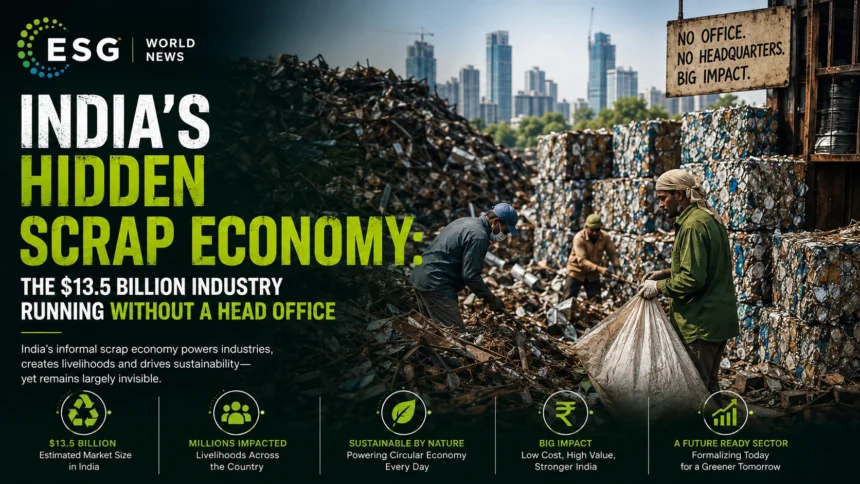
India’s scrap and recycling trade is valued at roughly $13.5 billion, though estimates vary depending on what’s included — some place the narrower scrap-metal-and-recycling market closer to $11 billion as of 2023, growing 8-10% year on year since. What’s not in dispute is the workforce underneath that number: somewhere between 1.5 million and 4 million people work in India’s informal scrap economy, spanning waste pickers, itinerant kabadiwalas who buy household scrap door to door, local aggregators, junkyard operators, and the dealers who move material up the chain to processors and mills. Almost none of them appear in a company registry, a labor ministry database, or a GST filing — which is exactly why this economy is described as “hidden”: it’s enormous, it’s essential to how Indian industry gets its raw material, and it runs almost entirely outside formal economic measurement.
INDIA’S SCRAP AND RECYCLING INDUSTRY, ESTIMATED VALUE ~$13.5 billion
INFORMAL WORKFORCE (WASTE PICKERS, KABADIWALAS, DEALERS) 1.5-4 million people
SECTOR GROWTH RATE 8-10% year on year
The Biggest Piece: Steel Scrap
Steel dwarfs every other category in this economy by sheer tonnage. India’s ferrous scrap consumption hit a record 41 million tonnes in FY2025-26, up 17% from 35 million tonnes the year before — and the growth is increasingly domestic, not imported. Domestic scrap generation jumped 22% year on year to 32 million tonnes in the same period, which is why ferrous scrap imports actually fell roughly 20% even as total consumption rose: India is generating more of its own steel scrap than it’s importing, for the first time at this scale. Western India remains the largest import hub despite an 18% year-on-year decline, while northern India saw the steepest drop, down 27%.
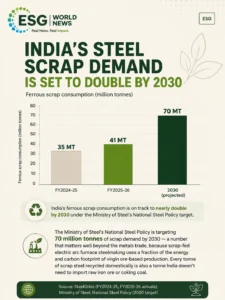
India’s ferrous scrap consumption is on track to nearly double by 2030 under the Ministry of Steel’s National Steel Policy target.
The Ministry of Steel’s National Steel Policy is targeting 70 million tonnes of scrap demand by 2030 — a number that matters well beyond the metals trade, because scrap-fed electric arc furnace steelmaking uses a fraction of the energy and carbon footprint of virgin ore-based production. Every tonne of scrap steel recycled domestically is also a tonne India doesn’t need to import raw iron ore or coking coal for, tying this informal trade directly to the country’s industrial and climate strategy, whether policymakers frame it that way or not.
E-Waste: The Fastest-Growing, Least-Controlled Stream
India generated 14.14 lakh tonnes (1.41 million tonnes) of e-waste in FY2025-26, and generation has surged 73% over just five years — driven by shrinking device replacement cycles, rising smartphone and appliance penetration, and a growing middle class upgrading electronics faster than ever. Of that FY2025-26 total, roughly 9.79 lakh tonnes were recycled through formal, registered channels — about 69% — leaving nearly a third of the country’s e-waste stream unaccounted for through official routes.
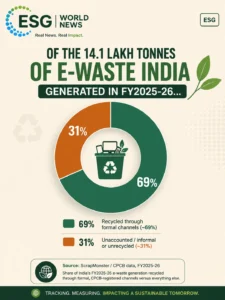
Share of India’s FY2025-26 e-waste generation recycled through formal, CPCB-registered channels versus everything else.
India now has 322 registered formal e-waste recycling units with a combined annual capacity of 2.2 million tonnes — comfortably enough capacity, on paper, to handle the entire generated volume. The gap isn’t capacity; it’s collection. Much of India’s e-waste still flows to informal scrap markets, where components are manually stripped for valuable metals like copper, gold, and palladium, often without protective equipment or environmental controls, because the informal channel frequently pays collectors more, faster, and with fewer questions than a formal registered recycler will.
Vehicles: A Policy That’s Just Getting Started
India’s Vehicle Scrappage Policy, in effect since April 2022, requires passenger vehicles older than 20 years and commercial vehicles older than 15 years to pass a fitness and emissions test or lose their registration and be scrapped through a certified Registered Vehicle Scrapping Facility (RVSF). Nearly 4 lakh (400,000) vehicles had been formally scrapped under the policy as of December 2025 — a meaningful start, but a small fraction of India’s estimated tens of millions of vehicles that already exceed the age thresholds, most of which are still being informally cannibalized for parts and metal rather than processed through the certified RVSF network the policy was built around.
Why this matters for the informal trade
End-of-life vehicles are exactly the kind of high-value scrap stream the informal sector has always handled well — engines, batteries, and body panels have obvious resale value — which means the formal RVSF network is competing directly with a faster, more flexible informal buyer network that doesn’t need paperwork. Closing that gap is less a technology problem than an incentive one.
Paper and Textile: The Quietly Efficient Corners
Not every scrap stream in India is under-recycled. India imports about 7 million tonnes of recovered paper annually to feed domestic paper mills, which is itself a sign of a well-functioning market — mills pay a premium for clean, sorted, baled paper scrap, so collection infrastructure has grown to meet that demand, and the packaging sector’s growth is projected to drive a further 30% increase in scrap paper consumption.
Textiles show an even stronger recovery rate: of the 7.8 million tonnes of textile waste India manages annually, more than 70% is recovered and channelled into recycling, with pre-consumer factory scrap recovery running as high as 95% because it’s cleaner, better sorted, and cheaper to process than mixed post-consumer clothing waste. Both examples point to the same underlying rule across every scrap category in India: recovery rates track resale value and sorting cost, not environmental policy.
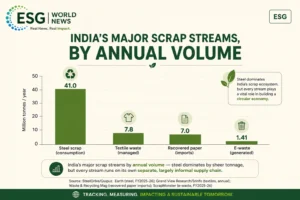
India’s major scrap streams by annual volume — steel dominates by sheer tonnage, but every stream runs on its own separate, largely informal supply chain.
The Kabadiwala Is Getting a Tech Upgrade
The most consequential recent shift in this industry isn’t a new regulation — it’s software. Platforms like MetalMandi, launched by battery and e-waste recycler Attero in 2025, are trying to turn the fragmented, cash-and-handshake scrap trade into something closer to a transparent digital marketplace, connecting scrap generators, kabadiwalas, aggregators, and processors through a single platform with visible pricing rather than opaque, negotiated rates that favor whoever has the most local market knowledge. Similar formalization pushes are underway across e-waste, where the same informal collection networks that formal recyclers technically compete against are increasingly being contracted directly, rather than bypassed — a pattern that mirrors how India’s plastic recycling sector is being pulled toward formal supply chains under Extended Producer Responsibility rules.
None of this replaces the kabadiwala. If anything, digitization is validating the informal network’s core function — hyperlocal, flexible, fast collection — while trying to fix its worst features: price opacity, no safety standards, and complete invisibility to policymakers and tax authorities. Whether that upgrade actually reaches the waste picker at the bottom of the chain, rather than just the aggregator layer above them, is the open question the entire formalization push in India’s scrap economy is still working through.
The Bottom Line
India’s scrap economy is not a shadow of the formal economy — in raw material terms, it’s a supplier to it. Steel mills, paper mills, textile manufacturers, and electronics recyclers all depend on a supply chain that starts with someone informally sorting waste for cash, well before any of that material shows up in a corporate sustainability report. The direction of travel is toward formalization — through digital marketplaces, EPR-style policy pressure, and rising scrap demand that simply outstrips what the informal sector alone can reliably supply at industrial scale. But formalization that doesn’t extend past the aggregator layer risks just relabeling the same invisible workforce under a new platform, rather than actually recognizing it. The real measure of progress in India’s scrap economy over the next five years won’t be how many tonnes get processed — it’ll be whether the people doing the sorting finally show up in the numbers.
Sources: SteelOrbis, “India’s ferrous scrap imports slide 20% in FY2026”; Dialogue Earth, “India needs more scrap to boost green steelmaking”; Ministry of Steel National Steel Policy; ScrapMonster, “India Generates 14 Lakh Tonnes of E-Waste in 2025-26”; Down To Earth, “India’s E-Waste Generation Soars by 73% in Five Years”; PIB press releases on the Vehicle Scrappage Policy; NITI Aayog, “Enhancing Circular Economy of End-of-Life Vehicles (ELVs) in India”; Waste & Recycling Mag on recovered paper imports; Grand View Research and The Shillong Times on textile recycling; The Week, “From kabadiwalas to AI: How India’s scrap metal trade is getting a Zepto-like makeover.” Compiled August 2026.
Inside India’s Plastic Recycling Business: Where Does Your Plastic Actually Go?