
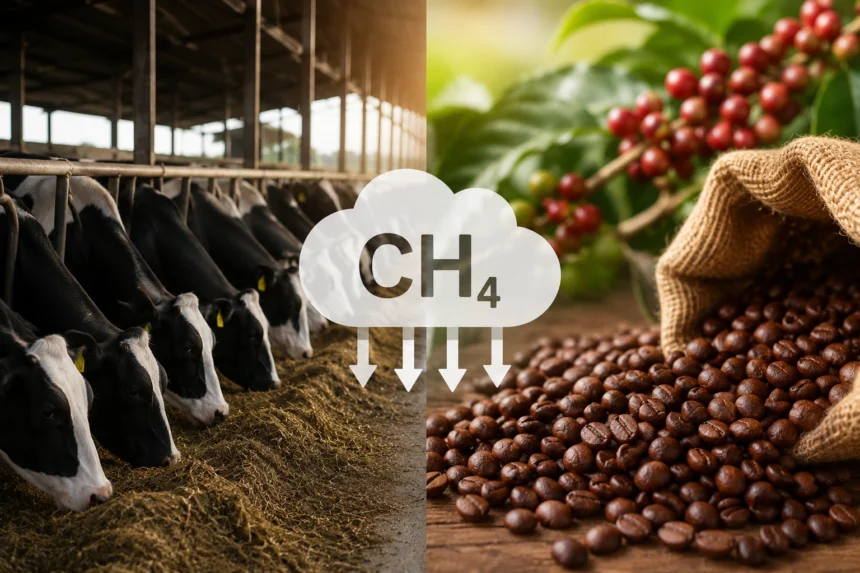
A new analysis of leading dairy and coffee companies has revealed a significant gap between climate commitments and action on methane emissions, one of the most potent contributors to global warming.
- Methane Remains an Overlooked Climate Challenge
- Only Three Companies Have Specific Methane Reduction Targets
- Starbucks Leads Coffee Sector Reporting Efforts
- Major Brands Face Criticism for Limited Transparency
- Retail Sector Also Falls Behind
- Growing Investor and Regulatory Pressure
- Risks of Delayed Action
- Industry Initiatives Supporting Methane Reduction
- ESG World News Perspective
The assessment, conducted by environmental nonprofit Changing Markets Foundation, found that while the vast majority of major food and beverage companies acknowledge the connection between livestock production and climate change, only a handful have established specific methane reduction targets.
The findings underscore growing concerns among climate experts and investors that corporate action on methane is lagging despite increasing scientific evidence highlighting its critical role in addressing near-term global warming.
Methane Remains an Overlooked Climate Challenge
Methane is considered one of the most powerful greenhouse gases, with a significantly higher warming potential than carbon dioxide over shorter timeframes.
Scientists estimate that methane and other short-lived climate pollutants are responsible for nearly half of the global temperature increase experienced so far. Because methane remains in the atmosphere for a shorter period than carbon dioxide, reducing emissions can deliver faster climate benefits.
Despite this, the report suggests many companies within the dairy and coffee sectors have yet to make methane management a central part of their climate strategies.
Only Three Companies Have Specific Methane Reduction Targets
The foundation evaluated 23 major dairy and coffee companies based on four key criteria:
- Methane emissions disclosure
- Target setting
- Action plans
- Progress toward emissions reduction goals
According to the assessment, only three companies have established methane-related reduction targets for 2030:
- Danone
- FrieslandCampina
- General Mills
Among these, Danone emerged as the strongest performer.
The French food giant is currently the only company in the group aligned with the Global Methane Pledge, an international initiative supported by more than 150 countries that aims to reduce global methane emissions by 30% by 2030.
The report noted that Danone has already made substantial progress toward its methane reduction objectives and is approaching its target several years ahead of schedule.
Meanwhile, General Mills and Dutch dairy cooperative FrieslandCampina have incorporated methane reductions within broader dairy emissions strategies, although they do not maintain standalone methane-specific targets.
Starbucks Leads Coffee Sector Reporting Efforts
Within the coffee industry, progress remains uneven.
The report identified Starbucks as the leading performer among coffee chains due to its disclosure of methane emissions and publication of a methane reduction action plan.
However, the company continues to face challenges in reducing emissions linked to dairy sourcing, with methane-related emissions from its dairy supply chain showing little measurable decline in recent years.
The findings highlight the broader difficulties many food and beverage companies face in reducing emissions associated with agricultural supply chains.
Major Brands Face Criticism for Limited Transparency
Several prominent companies received low scores in the assessment due to a lack of methane disclosure, target setting, and reduction planning.
Among the notable names highlighted was Unilever.
Although the company has earned recognition for sustainability initiatives such as reducing deforestation and promoting climate-related advocacy, the report found that it does not separately disclose methane emissions or establish dedicated methane reduction goals.
Unilever has stated that methane management is addressed through its sustainable agriculture principles, which provide guidance to suppliers on methane capture technologies and livestock feed interventions aimed at reducing emissions.
The report also identified Dunkin’ as the lowest-ranked company in the assessment, receiving no points across the evaluated categories.
Retail Sector Also Falls Behind
The foundation conducted a separate review of 20 supermarket chains across six countries and found similarly limited progress.
According to the analysis, none of the retailers assessed had publicly disclosed methane emissions or established methane reduction targets.
The findings suggest that methane management remains largely absent from climate strategies across significant portions of the food and retail sectors.
Growing Investor and Regulatory Pressure
Climate experts argue that methane reductions represent one of the most effective opportunities to slow near-term warming and demonstrate credible climate leadership.
Investors are increasingly paying attention.
Large institutional investors, including Norway’s sovereign wealth fund manager, have incorporated agricultural methane into their climate expectations and encourage portfolio companies to align with global methane reduction initiatives.
As climate disclosure standards continue to evolve, businesses may face growing scrutiny regarding their methane management practices and progress.
Risks of Delayed Action
Experts warn that companies that fail to address methane emissions could face a range of challenges, including:
- Increased reputational risks
- Greater exposure to greenwashing allegations
- Rising investor scrutiny
- Future regulatory compliance pressures
- Higher transition costs as climate policies tighten
Organizations that move early on methane reduction may be better positioned to strengthen stakeholder confidence and adapt to future climate-related regulations.
Industry Initiatives Supporting Methane Reduction
Companies seeking to improve methane management can participate in collaborative industry programs such as the Dairy Methane Action Alliance.
The initiative, supported by climate organizations including the Environmental Defense Fund and Ceres, encourages dairy companies to measure, disclose, and reduce methane emissions while developing long-term mitigation strategies.
Such collaborations are increasingly viewed as important tools for accelerating progress across the agricultural sector.
ESG World News Perspective
The latest findings highlight a critical challenge in corporate climate action: while many companies have announced net-zero ambitions and broader sustainability commitments, methane remains a major blind spot across food and agriculture supply chains.
As governments, investors, and consumers place greater emphasis on measurable climate outcomes, methane reduction is likely to become an increasingly important benchmark for evaluating corporate sustainability performance.
For dairy producers, coffee companies, and retailers, addressing methane emissions may not only help mitigate climate risks but also strengthen resilience and credibility in a rapidly evolving ESG landscape.