
Every water bottle, shampoo pouch, and biscuit wrapper you throw away in India enters one of the world’s largest, least visible industries: an informal-but-massive recycling economy built on waste pickers, scrap dealers, and small shredding units, layered under a new government policy trying to formalize it. Here’s what the numbers actually say about where it goes.
The Scale of the Problem
India generated an estimated 41.36 lakh tonnes (4.136 million tonnes) of plastic waste in FY 2022-23, according to figures the Ministry of Environment, Forest and Climate Change gave Parliament — equivalent to roughly 11,300 tonnes every single day. That number has nearly doubled in five years: from 23.83 lakh tonnes in FY 2017-18, through 33.60 lakh tonnes in FY 2018-19 and 34.70 lakh tonnes in FY 2019-20, to today’s total. Per-capita generation has moved even faster, rising from about 700 grams a year in 2016-17 to more than 2.5 kilograms by 2020 — a near-tripling in four years, driven largely by the explosion of single-use packaging in e-commerce and food delivery.
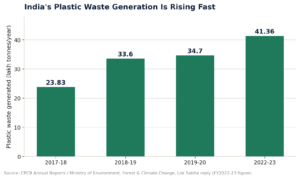
India’s official plastic waste generation figures, by financial year.
PLASTIC WASTE GENERATED, FY2022-23 41.36 lakh tonnes (~11,300 tonnes/day)
PER-CAPITA GENERATION, 2016-17 → 2020 ~0.7 kg → 2.5+ kg per year
GROWTH SINCE FY2017-18 +73%
Where Does It Actually Go?
The official estimate is that around 60% of India’s plastic waste gets recycled — a relatively high figure by global standards, and one driven almost entirely by the economics of scrap value rather than environmental policy. The remaining roughly 40%, translating to well over 1.6 million tonnes a year, is landfilled, incinerated, or leaks directly into rivers, drains, and the ocean. It’s worth treating the 60% figure with some caution: CPCB itself notes these are estimates built from state pollution board reporting, not physical audits of every tonne, and independent researchers argue the real recycling rate — accounting for multi-layered and low-value flexible plastic that collectors won’t touch — is likely lower.
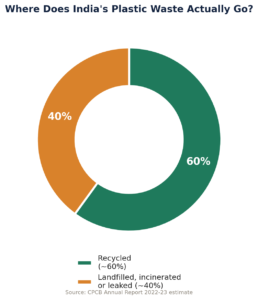
Estimated fate of India’s annual plastic waste stream.
The plastics that do get recycled are overwhelmingly the ones with the clearest resale value: PET bottles, rigid HDPE containers (think shampoo and detergent bottles), and clean industrial scrap. Multi-layered packaging — the metallized chip packet, the toothpaste tube, the shampoo sachet — is structurally difficult and commercially unrewarding to recycle, which is exactly the category most likely to end up landfilled, burned, or in a drain.
The Invisible Workforce Running the Chain
Ask where a plastic bottle actually goes after the bin, and the honest answer is: into an economy that barely appears in any government org chart. An estimated 2.2 million people work as waste pickers in India, and 76.2% of them are informally employed — no contracts, no fixed wages, no safety equipment, working directly with unsorted waste for a living. Collectively, waste pickers are estimated to collect 15-20% of all municipal solid waste in Indian cities, but their role in plastic specifically is far larger: the informal sector handles an estimated 80% of plastic waste collection and processes more than 70% of the plastic that actually gets recycled.
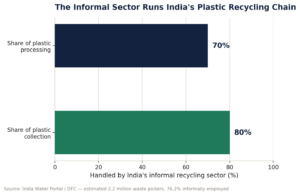
India’s formal recycling industry sits on top of an overwhelmingly informal collection and processing base.
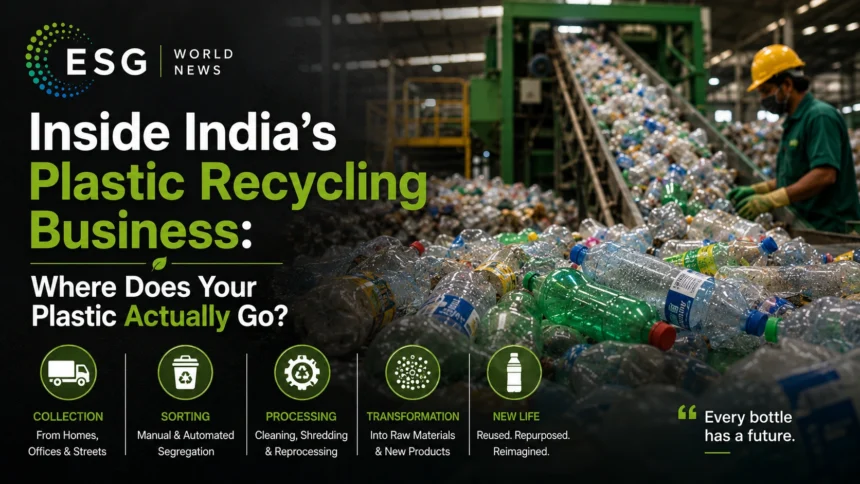
In practice, the chain looks like this: a waste picker or kabadiwala collects and roughly sorts plastic from households, streets, and dumpsites, then sells it up to a local scrap aggregator by weight and material type. The aggregator bulks material from dozens of collectors and sells it on to a shredding or washing unit, which turns it into clean flakes. Those flakes go to a pelletizing plant that melts and extrudes them into raw material pellets, which finally get sold to a manufacturer to become a new product. Almost every step of that chain, until the pelletizing stage, sits in the informal economy — which is efficient at collection but largely outside any safety regulation, environmental compliance, or labor protection framework.
The Policy Layer: Extended Producer Responsibility
The government’s attempt to formalize this chain is the Plastic Waste Management (Amendment) Rules, 2022, which introduced Extended Producer Responsibility (EPR) as a legal obligation. Under EPR, every Producer, Importer, and Brand Owner (PIBO) that puts plastic packaging into the Indian market — from a bottled water company to an e-commerce platform — is legally responsible for ensuring a government-set percentage of that packaging is collected and recycled each year.
The mechanism is a tradeable EPR certificate: one certificate equals one tonne of plastic packaging waste responsibly processed by a CPCB-registered recycler. A PIBO that doesn’t run its own collection infrastructure simply buys enough certificates from registered recyclers to cover its obligation and files them with CPCB as proof of compliance. The rules split packaging into four categories — rigid plastic, flexible plastic, multi-layered plastic, and compostable plastic sheet — each with its own recycling targets, specifically because those categories have very different real-world recyclability and, so far, very different actual recovery rates.
Why this matters for the informal sector
EPR’s biggest long-term effect may not be on producers at all — it’s the pressure it puts on formalizing the collection chain underneath it. Because certificates require traceable, auditable tonnage, PIBOs and registered recyclers increasingly need to contract directly with organized collection networks rather than relying on anonymous scrap-market flows, which is slowly pulling parts of the waste-picker economy into formal, documented supply chains for the first time.
Who’s Actually Recycling at Scale
At the formal, industrial end of the chain, a small number of large players dominate. Ganesha Ecosphere is India’s largest PET bottle recycler, recycling an estimated 16-18% of the country’s total PET bottle waste — a share it’s targeting to push to 25% by 2026. The company has been in PET recycling since 1994, runs six production sites across India and Nepal, processes roughly 9.4 billion PET bottles a year, and has bottle-grade recycled PET (rPET) capacity of about 42,000 tonnes annually, including a newer line at its Warangal, Telangana facility.
Below that scale sit specialist recyclers tackling harder categories: Banyan Nation focuses on producing high-quality, traceable recycled plastic for FMCG brand packaging, while Lucro Plastecycle specializes specifically in flexible plastic — the sachets and multi-layer films that most of the industry avoids because they’re commercially unrewarding to process. The broader domestic plastic recycling industry is estimated at around ₹30,000 crore today, with third-party market forecasts for the recycled plastics segment ranging from roughly $5 billion to $11.5 billion in value by the early 2030s depending on how the market is scoped — a wide range that itself reflects how fragmented and under-measured this industry still is.
Which States Generate the Most Plastic Waste
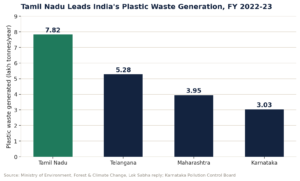
Waste generation isn’t evenly spread. Tamil Nadu is India’s single largest generator at 7.82 lakh tonnes a year, followed by Telangana at 5.28 lakh tonnes, Maharashtra at 3.95 lakh tonnes, and Karnataka at roughly 3.03 lakh tonnes (Bengaluru Urban alone accounts for about 317 tonnes of Karnataka’s daily total of 830 tonnes). These four states combine dense urban populations, large packaged-goods manufacturing bases, and — not coincidentally — some of India’s most active organized recycling clusters, since collection infrastructure tends to concentrate wherever waste volumes make it commercially viable.
Top plastic-waste-generating states, FY 2022-23.
What Recycled Plastic Actually Becomes
The plastic that does make it through the recycling chain ends up in a surprisingly wide range of second-life products. PET flakes and pellets are respun into polyester fibre for clothing, carpets, and non-woven fabric, or reprocessed into automotive parts, battery casings, and storage containers. A more visible use is roads: India has built plastic-modified roads using shredded waste mixed into bitumen since the National Rural Road Development Agency’s early trials laid roughly 7,500 km using the technique in 2015-16, with total plastic-road length estimates now running from the tens of thousands into the hundreds of thousands of kilometres depending on the source and how conservatively “plastic road” is defined. Proponents point to the roads’ better resistance to heat and waterlogging; critics note that grinding plastic into road surfaces is a one-way trip that forecloses future recycling and can shed microplastics as the road wears — a genuinely unresolved trade-off rather than a clean win.
A smaller but growing stream goes to waste-to-fuel processing, where low-value mixed plastics like milk pouches and multi-layer wrappers are pyrolyzed into a crude poly-fuel blend usable as a diesel substitute in industrial furnaces — a use of last resort for material too degraded to mechanically recycle again.
The Gaps That Remain
- Multi-layered and flexible plastic — the fastest-growing packaging category thanks to sachets and single-serve packets — remains the hardest and least profitable to recycle, and is where most of the uncollected 40% likely concentrates.
- Informal workers who do most of the physical collection and sorting work largely without safety equipment, fixed income, or legal recognition, even as EPR formalizes the money flowing through the system above them.
- Recycling data itself is an estimate stacked on estimates — state boards self-report generation figures to CPCB, and there is no independent physical audit verifying either the 41.36 lakh tonne generation figure or the 60% recycling rate.
- Downcycling is common: much “recycled” PET becomes fibre or non-food-grade product rather than being turned back into a bottle, which is a lower-value, often terminal use rather than a closed loop.
The Bottom Line
India’s plastic recycling rate looks respectable next to the US or UK largely because millions of waste pickers do, by hand, what those countries pay for with expensive municipal sorting infrastructure — not because India has built a more advanced recycling system. EPR is the first real attempt to put legal and financial weight behind formalizing that chain, but its success will be measured less by how many EPR certificates get traded among producers and recyclers, and more by whether the people actually doing the collecting end up with better pay, safety, and recognition than they have today. Until then, the honest answer to “where does your plastic go” is: mostly into the hands of someone the formal economy still doesn’t count.
Sources: CPCB Annual Reports on Plastic Waste Management; Ministry of Environment, Forest & Climate Change (Lok Sabha reply, FY2022-23 generation data); India Water Portal / International Alliance of Waste Pickers; U.S. DFC (“Expanding Plastic Recycling in India”); Plastic Waste Management (Amendment) Rules, 2022 and CPCB EPR guidelines; Ganesha Ecosphere company disclosures and PETplanet coverage; The News Minute (state-wise generation data); Karnataka Pollution Control Board; Borgen Project and Dialogue Earth on plastic roads. Compiled August 2026.
HCLTech Named Among TIME’s World’s Most Sustainable Companies 2026, Tops India-Headquartered Firms