

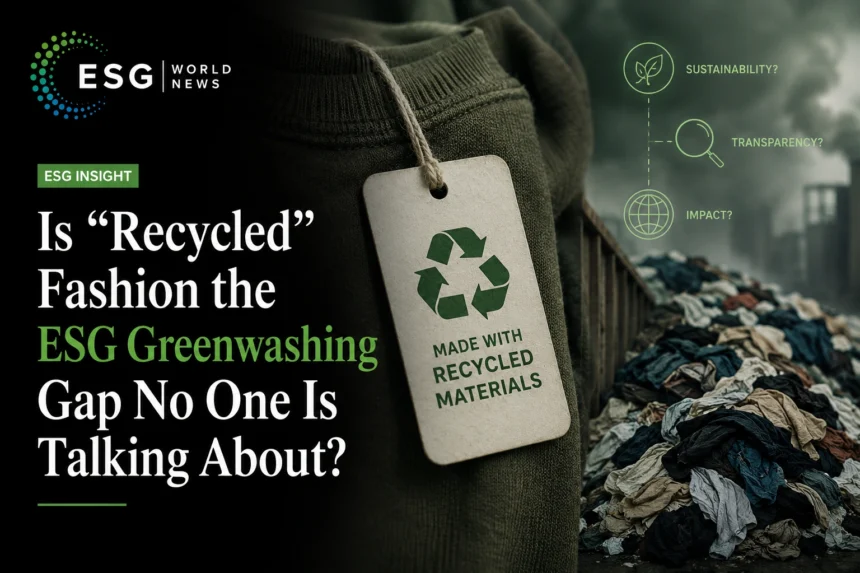
Is “recycled” fashion’s biggest ESG greenwashing gap?
For a decade, “recycled polyester” has functioned as the fashion industry’s easiest sustainability win. It requires no change to a garment’s look, feel or price point, it slots into an existing supply chain built for virgin polyester, and it lets a brand print a number on a swing tag that sounds unambiguously good. Adidas says 99% of the polyester it uses is recycled. H&M has reported that 94% of the polyester it sources is recycled. Almost every major apparel brand now runs a “conscious,” “circular” or “renewed” collection built substantially around the material.
The trouble is what “recycled” is actually doing once you follow the numbers past the swing tag — where the polyester comes from, what happens when it’s washed, and whether the industry’s growing reliance on it is reducing fashion’s footprint at all. Three data points, drawn from a new microplastics study and the textile industry’s own market data, suggest the answer is more complicated than the marketing.
1. Almost none of it comes from old clothes
The near-universal assumption behind a “recycled polyester” label is that a garment has been rescued from the waste stream — that last year’s t-shirt became this year’s jacket. In practice, that is close to false. According to Textile Exchange, the nonprofit that sets the industry’s material-sourcing benchmarks, roughly 98–99% of recycled polyester currently comes from PET plastic bottles, not from textile waste. Textile-to-textile recycling — genuinely closing fashion’s own loop — accounts for less than 1% of recycled polyester supply.
That matters for two reasons. First, it means the “recycled” claim on a garment is, in the overwhelming majority of cases, a story about the beverage industry’s bottle stream, not the fashion industry’s own waste problem. Second, it puts fashion’s raw-material demand into direct competition with the packaging industry’s own closed-loop recycling goals — beverage brands increasingly want their own bottles turned back into bottles, not into fleece jackets that are far harder to recycle again. The EU’s Green Claims Directive has flagged this tension explicitly, noting that bottle-to-textile recycling undercuts closed-loop, bottle-to-bottle recycling rather than complementing it.
Meanwhile, the textile waste that recycled polyester is popularly assumed to be solving keeps growing largely untouched. The fashion industry generates an estimated 92 million tonnes of textile waste annually, a figure on track to exceed 134 million tonnes by 2030 on current trends. Global fibre-to-fibre recycling — turning old textiles into new ones, polyester included — sits below 1%. Roughly 73–80% of discarded textiles are landfilled or incinerated. Recycled polyester, as currently sourced, does almost nothing to move that number.
2. The “recycled” share of polyester is shrinking, not growing
The second gap is one of scale. Even as individual brands tout near-100% recycled claims on specific product lines, the overall share of recycled material in global polyester production is going in the wrong direction.
Per Textile Exchange’s Materials Market Report, recycled polyester’s share of total polyester output fell from roughly 13.6% to 12.5% in a single year, before settling at around 12% of the polyester market by the end of 2024 — down half a percentage point year-on-year even as the absolute tonnage of recycled polyester rose slightly, from about 8.9 million tonnes to 9.3 million tonnes. The reason isn’t a slowdown in recycling; it’s that virgin polyester production is growing faster than recycled capacity can keep up. Global polyester output climbed from roughly 71 million tonnes in 2023 to about 78 million tonnes in 2024, out of a total global fibre market of 132 million tonnes — polyester alone now accounts for more than half of everything the world’s textile industry produces, with the large majority of that fossil-based.
In other words: the fashion industry is not substituting virgin polyester with recycled polyester at any meaningful pace. It is producing more of both, with virgin material still expanding output faster than recycled material can dilute it. A shopper reading “94% recycled polyester” on a single H&M garment has no way of knowing that, industry-wide, recycled content’s share of the category it belongs to is shrinking.
This is precisely the gap that has drawn US and European litigation. H&M is facing a proposed class action in the US alleging its “Conscious Choice” collection misleads consumers about the sustainability of recycled-polyester garments, arguing that mechanically recycled PET fibres are weakened in processing and are themselves difficult to recycle a second time — “a one-way street to landfill or incineration,” in the plaintiff’s framing. Norway’s Consumer Authority separately warned H&M in 2022 that its use of the Higg Materials Sustainability Index to market recycled polyester “easily will be considered misleading” under Norwegian law.
3. Recycling doesn’t fix the carbon math — or the microplastics
The carbon case for recycled polyester is real but narrower than marketing suggests. Producing virgin polyester yarn or staple fibre emits between roughly 3.96 and 4.76 kg of CO2-equivalent per kilogram, according to recent Textile Exchange and SCS Consulting Services analysis — with some older benchmarks citing figures as high as 9.5 kg CO2e/kg depending on energy inputs and system boundaries. Recycled polyester’s production footprint is generally lower, since it skips virgin petrochemical feedstock extraction. But because almost all of that recycled material comes from bottle-grade PET rather than textile waste, the carbon “saving” is really being borrowed from the packaging supply chain’s recycling infrastructure, not created new within fashion — and it does nothing to address the 92 million tonnes of textile waste fashion generates on its own.
More strikingly, the newest research suggests recycled polyester may be worse than virgin polyester on a different environmental metric entirely: microplastic pollution. A study commissioned by the Changing Markets Foundation and carried out by the Microplastic Research Group at Çukurova University — published as the report “Spinning Greenwash” — tested 51 garments from Adidas, H&M, Nike, Shein and Zara using standardised ISO 105C06 wash-test methodology. Recycled polyester items shed an average of roughly 12,000 microfibres per gram during washing, about 55% more than the 8,028 fibres per gram shed by virgin polyester equivalents — and the recycled fibres shed were also the finest, and therefore the hardest to filter out of wastewater. The mechanical recycling process that turns a bottle into a fibre appears to weaken and roughen the polymer structure in ways that make it shed more readily once it becomes a garment.
That finding directly undercuts the industry’s implicit pitch: that switching a garment’s fibre content from virgin to recycled polyester is close to a straightforward environmental upgrade. On carbon, the benefit is real but overstated by how little of it is fashion’s own waste being closed-looped. On microplastics — arguably the more directly visible harm, given plastic fibres are now found in human blood, lungs and placentas — recycled polyester may be making the problem measurably worse, not better.
The bottom line
None of this means recycled polyester is worthless. Diverting bottles from landfill into any secondary use has value, and some brands are now explicitly shifting sourcing toward genuine textile-to-textile recycling in response to exactly these criticisms — Trellis has reported H&M itself moving away from bottle-derived polyester for this reason. But the gap between what “recycled polyester” is marketed to mean — closing fashion’s own waste loop, meaningfully cutting the industry’s footprint — and what the underlying sourcing, market-share and microplastics data actually show is wide enough that regulators, litigants and increasingly the industry’s own researchers are treating it as one of fashion’s most consequential greenwashing claims. As the EU’s Green Claims Directive and a wave of green-marketing litigation move from debate to enforcement, “recycled” may be the single word in fashion’s ESG vocabulary facing the most scrutiny in 2026 and beyond.
Sources: Changing Markets Foundation, “Spinning Greenwash” (2025); Textile Exchange, Materials Market Report; ESG Dive; Trellis; WWD/Sourcing Journal; theroundup.org textile waste statistics; Just Style and ClassAction.org H&M litigation coverage; Norwegian Consumer Authority correspondence with H&M.
India’s Hidden Scrap Economy: The $13.5 Billion Industry Running Without a Head Office