
ESG World News, India, Article by- Ankitt Y – A numbers-led look at how far the National Green Hydrogen Mission has to run before Phase II extends it to railways and aviation.
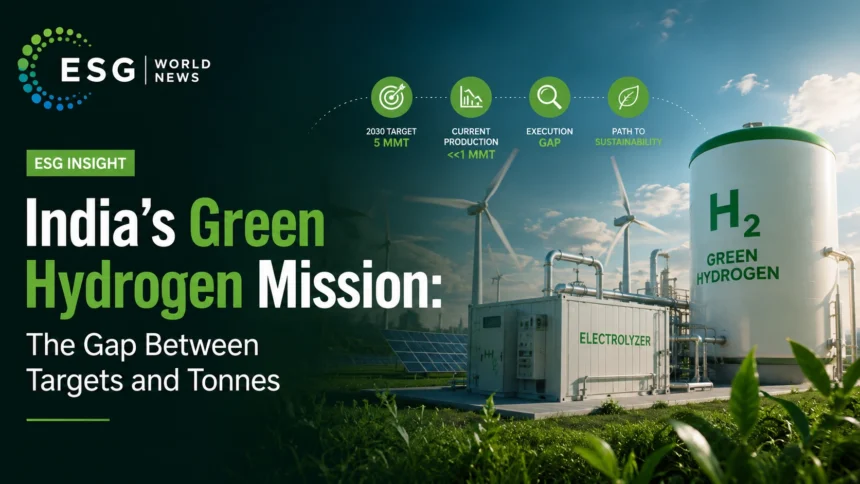
India’s National Green Hydrogen Mission is one of the most ambitious industrial-policy bets in the country’s energy transition — a plan to turn India into both a domestic decarbonisation engine and a global green hydrogen export hub. Cabinet approved it in January 2023 with an initial outlay of ₹19,744 crore. Three years in, with Phase II (2026–2030) set to extend the mission into railways and aviation, the gap between what the mission has promised and what has actually been contracted and built is large enough to be the real story.
The target: 5 MMT, ₹8 lakh crore, 125 GW
The mission’s headline goal is production capacity of at least 5 million metric tonnes per annum (MMTPA) of green hydrogen by 2030 — with an official upside scenario of up to 10 MMTPA if export demand materialises. Achieving that is expected to require roughly 125 GW of additional renewable energy capacity dedicated to hydrogen production, attract cumulative investment of about ₹8 lakh crore (roughly $88 billion), create over 600,000 jobs, cut an estimated 50 MMTPA of CO2 emissions, and reduce fossil fuel import costs by around ₹1 lakh crore annually.
The financial architecture behind that target rests on the SIGHT programme — Strategic Interventions for Green Hydrogen Transition — which carries ₹17,490 crore of the mission’s ₹19,744 crore initial outlay. SIGHT runs two incentive tracks: one subsidising domestic electrolyser manufacturing, the other subsidising green hydrogen production itself. A further ₹1,466 crore is earmarked for pilot projects, ₹400 crore for R&D, and ₹388 crore for other mission components. Under the electrolyser manufacturing incentive, the government has already awarded a cumulative capacity of 3,000 MW per annum to 15 companies, working toward a longer-term ambition of 15 GW of domestic electrolyser manufacturing capacity by 2030.
The reality: 8,000 tonnes commissioned, 30,000 tonnes contracted
Against a 5-million-tonne target, India had commissioned roughly 8,000 tonnes per annum of actual green hydrogen production capacity as of February 2026, according to the Ministry of New and Renewable Energy. That is not a typo relative to the target — it is 0.16% of the 2030 goal, achieved a little over three years into a seven-year mission.
The pipeline behind that number is bigger than what’s running. The government has awarded green hydrogen production capacity of 862,000 tonnes per annum (roughly 17% of the 5 MMT target) to 18 companies under SIGHT — meaning the vast majority of the mission’s contracted capacity exists on paper, as awarded projects, rather than as commissioned plants. The most concrete recent step is the award of 30,000 tonnes per year of green hydrogen supply contracts to India’s state-run oil refiners, spread across four projects, intended to displace fossil-based grey hydrogen currently used in refining. That is real, contracted offtake — but it is 6 tonnes for every 1,000 tonnes the mission needs annually by 2030.
The clearer sign of demand is on the ammonia side. The Solar Energy Corporation of India (SECI) ran a reverse-auction tender under SIGHT Mode 2A that allocated all of its planned 724,000 tonnes per year of green ammonia supply to fertiliser plants, at winning bids ranging roughly ₹50–65 per kg (about $568–740 per tonne) fixed for a 10-year offtake period — displacing imported grey ammonia used in non-urea fertiliser production. A further tender targeting close to another million tonnes of green hydrogen-based ammonia supply has since been reported. Green ammonia, unlike hydrogen itself, is easier to transport and store, which is one reason it has attracted more advanced offtake commitments than hydrogen has so far.
Why the gap exists: cost, not ambition
The distance between 8,000 tonnes commissioned and 5 million tonnes targeted is fundamentally a cost problem, not a policy or demand-signalling one. Green hydrogen in India currently costs an estimated $3.5–4 per kg to produce, against roughly $2–2.2 per kg for conventional grey hydrogen made from natural gas or coal — meaning green hydrogen remains 60–80% more expensive than the fuel it is meant to replace. The mission’s own cost-reduction trajectory is ambitious: officials, including former NITI Aayog CEO Amitabh Kant, have floated a target of cutting green hydrogen costs to around $1 per kg by 2030, while more conservative industry and government estimates put realistic 2030 costs closer to $1.50–2 per kg, and some analyses see costs falling only to $3–3.75 per kg in a best-case near-term scenario. Even the more optimistic of these numbers would only bring green hydrogen to rough parity with today’s grey hydrogen price — not below it — which is why large-scale industrial buyers have been slow to sign firm, long-dated offtake agreements outside of subsidised, reverse-auctioned tenders like SECI’s.
That cost gap is precisely what SIGHT’s production-linked incentives are designed to close, and why the mission’s structure leans so heavily on subsidy in its early years rather than assuming market-driven uptake. It is also why the contracted volumes that do exist — the refiners’ 30,000 tonnes, SECI’s 724,000 tonnes of ammonia — are concentrated in sectors India’s government can directly influence through state-owned refiners and fertiliser plants, rather than in open-market industrial demand.
What Phase II changes
Phase II, running 2026 to 2030, is explicitly framed around closing the cost-parity gap rather than simply adding capacity. Its priorities are: driving green hydrogen uptake in steel, mobility and shipping, where cost parity with fossil alternatives is the binding constraint; building out hydrogen storage, transport and refuelling infrastructure, including hydrogen hubs and bulk pipelines; and launching pilot projects in new sectors — railways and aviation among them — that had no meaningful presence in Phase I.
That sequencing matters for interpreting the mission’s trajectory. Phase I (2023–2026) was largely about standing up manufacturing incentives, awarding electrolyser and production capacity, and running the first offtake auctions — the 862,000-tonne awarded pipeline and the SECI ammonia tender are its signature outputs. Phase II is where the mission is supposed to convert awarded, subsidised capacity into commissioned, commercially self-sustaining plants, and to extend beyond the refining and fertiliser sectors that have absorbed most contracted volume so far into harder-to-abate transport applications like rail traction and aviation fuel, where pilot-stage R&D — not commercial offtake — is still the primary activity.
The bottom line
India’s National Green Hydrogen Mission is not behind on ambition, policy design or capital commitment — the ₹19,744 crore outlay, the 862,000-tonne awarded pipeline and the fully subscribed 724,000-tonne green ammonia tender all point to a programme that has moved faster on paper than most comparable national hydrogen strategies globally. Where it is behind is on the metric that ultimately matters: tonnes of green hydrogen actually being produced and used. At roughly 8,000 tonnes commissioned against a 5-million-tonne target, with the largest slice of near-term real offtake going to fertiliser (via ammonia) and oil refining rather than the steel, shipping, rail and aviation sectors Phase II is meant to unlock, the mission’s success by 2030 will be decided less by how many more incentive schemes are announced and more by how fast India can close a cost gap that currently sits at roughly 60–80% above the fossil fuel it is trying to replace.
Sources: Ministry of New and Renewable Energy, National Green Hydrogen Mission; PIB Cabinet approval release; Indian Chemical News; Energetica India; Deccan Herald; Hydrogen Insight; Mercom India; ChemAnalyst; Renewables Now; Green Hydrogen Organisation (GH2) India country page; Tribune India; New Kerala.
Is “Recycled” Fashion the ESG Greenwashing Gap No One Is Talking About?