

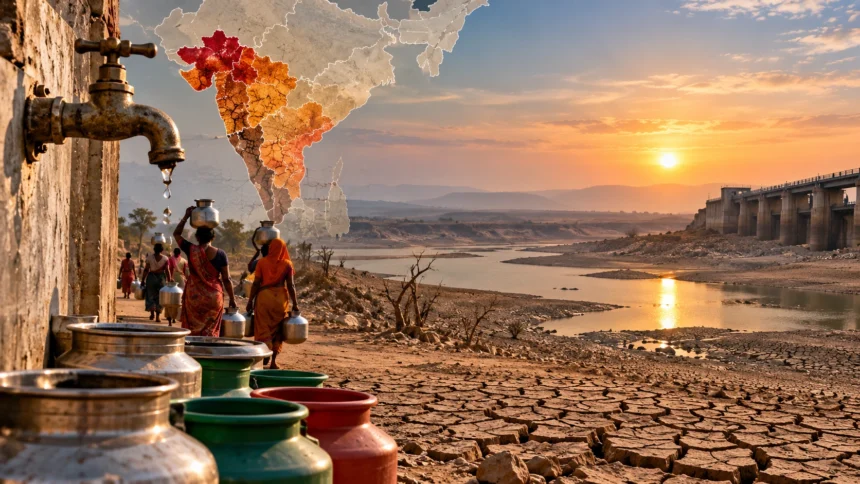
ESG World News | New Delhi | Monday, 13 October 2026- India’s monsoon ended only about 13% short this year. That sounds manageable. It isn’t. Drought conditions persist across parts of Maharashtra, Karnataka, Rajasthan, Andhra Pradesh and Telangana, and IIT Gandhinagar’s India Drought Monitor put 70.6% of the country’s area under dry or drought conditions.
- How bad is the drought in Maharashtra?
- Statewide 10% water cut from October 16
- Pune: no water on Thursdays
- Nagpur: borewell drilling banned
- Marathwada: drinking water first, irrigation last
- Why this matters beyond farms
- Drought in other states
- Karnataka: 217 of 240 taluks hit
- Andhra Pradesh: 388 mandals declared
- Telangana: 320 mandals under assessment
- Rajasthan: fodder becomes the flashpoint
- At a glance
- A modest national deficit hides a severe regional crisis
- What happens next
- FAQs
Maharashtra is now where the shortage is turning into daily rules for households, farms and factories.
How bad is the drought in Maharashtra?
The state has declared drought in 265 of its 358 tehsils, nearly three-quarters of its area, under the Drought Management Code, 2016. The declaration followed the application of the Trigger-1 criterion during the 2026 kharif season.
The rainfall gap explains why. Between 1 June and 26 September, the state got 798.2 mm against a normal of 970.9 mm, an 18% shortfall, and only five districts, including Mumbai City, Mumbai Suburban, Pune, Nashik and Satara, recorded surplus rain. Marathwada ended the season roughly 40% below normal, while Solapur and Beed were short by about 58% and 51% respectively.
Statewide 10% water cut from October 16
Water Resources Minister Girish Mahajan said his department has mapped available stocks dam by dam and by end use up to August 31, 2027, factoring in El Niño and the risk of drought. The outcome is a minimum 10% cut in supply across municipal corporations, municipalities and gram panchayats from October 16.
The priority order is clear. Irrigation water will be released only after drinking water, livestock and fodder needs are covered, perennial crops will get water only if enough remains, and local bodies must run drives to find and plug leaks. Industries have to recycle or reuse at least 30% of the water they consume.
Pune: no water on Thursdays
The Pune Municipal Corporation will shut supply across the city every Thursday starting October 15. The aim is to make current reserves last until August 2027.
The Khadakwasla dam system, Pune’s main source, held 38.78 TMC as of October 13, against storage of around 95% at the same point last year.
Alongside the weekly shutdown, the PMC has told residents not to use drinking water for construction and to fix leaking taps, pipes and flush tanks promptly. Hotels, restaurants, hostels and colleges must cut water use for bathing, dishwashing and laundry. Households are being nudged to reuse greywater for gardening and cleaning.
Nagpur: borewell drilling banned
Nagpur’s District Disaster Management Authority has stopped all new borewell and tubewell drilling, and the deepening of existing ones, across urban and rural parts of the district until further notice.
The ban covers farmers, housing societies, builders, industries, commercial establishments and drilling contractors. Government departments are exempt, and existing borewells can still be used. Violators face action under Section 51 of the Disaster Management Act, 2005, with tehsildars, police, local bodies and the Groundwater Surveys and Development Agency tasked with enforcement.
Marathwada: drinking water first, irrigation last
In Chhatrapati Sambhajinagar, the administration has ordered a buffer of at least 10% of live storage in major reservoirs, reserved for drinking water. Irrigation releases are allowed only when unavoidable.
Other measures include:
- Industries must reuse 30% of the water they consume
- Sewage treatment plants must run at full capacity
- Farmers will be advised to switch to less water-hungry rabi crops
- Illegal drawing of water from dams, rivers and wells will be curbed
- Rural water conditions will be reviewed every 15 days, with private wells taken over for public use where needed
Marathwada dam levels: this year vs last year
| Project type (Chh. Sambhajinagar region) | Oct 13, 2026 | Same time, 2025 |
|---|---|---|
| Major projects | 58.34% | 97.30% |
| Medium projects | 21.12% | 76.23% |
| Minor projects | 15.42% | 66.70% |
Source: Maharashtra Water Resources Department storage report, October 13, 2026
Elsewhere in the region, five of Beed’s eight dams are empty. In Dharashiv, seven of nine irrigation schemes have run dry and the Lower Terna project stands at 20.21%. In Nanded, six of nine projects are either dry or below 10%. Outside Marathwada, Raigad in the Konkan region is at 41.08%.
Why this matters beyond farms
Maharashtra accounts for close to 14% of India’s economic output, and recent reporting has flagged water risk for large employers such as Reliance Industries, the Tata Group and Mahindra & Mahindra, as well as Mumbai’s financial sector, which relies on the same stressed reservoir system. For agri-input companies, the drought points to weak rabi sowing in rain-fed talukas, slower collections and longer credit cycles across Marathwada and Vidarbha.
Drought in other states
Maharashtra is not alone. Three states have formally declared drought so far, all at the taluk or mandal level, and others are assessing whether they meet the criteria.
Karnataka: 217 of 240 taluks hit
Karnataka moved first, declaring 101 taluks drought-hit on August 27, then adding more in phases until 217 of its 240 taluks were covered by October 2. A central team is in the state assessing damage. The state recorded a 35% rainfall deficit from June to September, its weakest southwest monsoon in 55 years.
The shortage has reopened the Cauvery dispute. Karnataka has asked the Cauvery Water Management Authority to halve the ordered release to Tamil Nadu from 4,000 to 2,000 cusecs a day, citing drought in 47 Cauvery-basin taluks and the need to protect drinking water until June 2027.
Andhra Pradesh: 388 mandals declared
Andhra Pradesh has declared drought in 388 of its 688 mandals across 21 districts for kharif 2026, with 283 classed as severe and 105 as moderate. The state received 197.6 mm of rain between June 1 and August 31 against a normal of 424.3 mm, a 53.4% deficit. Rayalaseema accounts for 186 of the affected mandals.
Telangana: 320 mandals under assessment
Preliminary assessments show severe drought conditions in 320 mandals across 18 of Telangana’s 33 districts. The Chief Secretary has asked for a full report by the end of October, after which the state will seek central assistance. Telangana ended the monsoon with a 17% shortfall.
Rajasthan: fodder becomes the flashpoint
Rajasthan closed the monsoon 17.33% below normal, with western districts worst hit: Pali was short by 58.44%, Jaisalmer by 54.17% and Jalore by 50.26%. The Revenue Department has ordered girdawari crop surveys in 117 tehsils. The state has asked Punjab, Haryana and Madhya Pradesh to send paddy straw instead of burning it, after classifying nine districts as critical and 22 as semi-critical for fodder.
At a glance
| State | Status | Scale |
|---|---|---|
| Maharashtra | Declared | 265 of 358 talukas |
| Karnataka | Declared | 217 of 240 taluks |
| Andhra Pradesh | Declared | 388 of 688 mandals |
| Telangana | Under assessment | ~320 mandals |
| Rajasthan | Under assessment | Girdawari in 117 tehsils |
A modest national deficit hides a severe regional crisis
India’s worst drought years, 1987 and 2002, ended 19% below normal, and 2015 ended 14% short. This year’s figure sits close to that range, but the damage is concentrated. June 2026 opened with a 40% deficit, July briefly recovered, and August slipped again to 16.3% below normal.
That uneven pattern raises a harder question. Government data shows Rs 1.353 lakh crore was spent on water-related works under the rural jobs scheme between 2023-24 and mid-2026-27, yet large farming regions still fall into severe water stress quickly when the rains fail. The answer may lie in where these structures were built and whether they were maintained.
What happens next
States usually have until October 31 to declare kharif drought, and until March 31 for rabi. Expect more declarations, more central assessment teams and, in Maharashtra, possible deeper cuts. Officials have not ruled out tighter restrictions if reservoir levels keep falling through winter.
For residents, the practical message is simple: plan storage around supply days, fix leaks, and reuse greywater wherever possible.
FAQs
When does Maharashtra’s water cut begin?
A minimum 10% cut applies across urban and rural local bodies from October 16, 2026.
Which day will Pune have no water supply?
Every Thursday, starting October 15.
Can I use my existing borewell in Nagpur?
Yes. The ban covers only new drilling and deepening of existing borewells.
Which states have declared drought in 2026?
Maharashtra, Karnataka and Andhra Pradesh have formally declared drought. Telangana and Rajasthan are assessing affected areas.