


Europe has spent this summer arguing about air conditioning as a culture war — cast as a fight between “climate-conscious” restraint and “American-style” comfort. India doesn’t have that luxury of abstraction. Here, the AC question isn’t ideological. It’s a hard collision between rising heat, a coal-heavy grid, and the uncomfortable fact that most Indians still can’t afford to stay cool.
- The Numbers Nobody’s Culture-Warring About
- The Adoption Curve Is Already Steep — And About to Get Steeper
- Why This Is a Bigger Emissions Problem in India Than in Europe
- The Efficiency Gap Makes It Worse
- Heat Is Already Killing People — We Just Don’t Know How Many
- Where the Heat Actually Hits Hardest
- Ahmedabad Shows the Alternative to “Just Add More AC”
- The Actual Policy Tension India Faces
- Sources
The Numbers Nobody’s Culture-Warring About
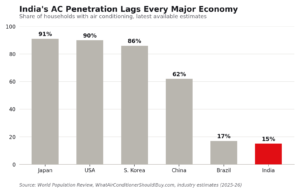
Only around 15% of Indian households own an air conditioner, according to recent industry estimates — a figure BloombergNEF projects will rise to 35% by 2030. That’s a fraction of ownership rates in the United States (90%), Japan (91%), South Korea (86%), or even China (60-65%).
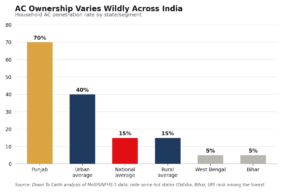
But the national average conceals an even starker internal divide. Punjab has AC in roughly 70% of households, while West Bengal and Bihar sit at around just 5% — and ironically, several of India’s hottest states, including Odisha, Jharkhand, Gujarat, Bihar, and Uttar Pradesh, rank among the lowest for AC ownership. Urban households own AC at roughly 40%, versus 15% in rural India — though rural households (around 200 million) actually outnumber urban ones (88 million) more than two to one, meaning low-penetration rural India represents the larger absolute population still without reliable cooling.
The Adoption Curve Is Already Steep — And About to Get Steeper
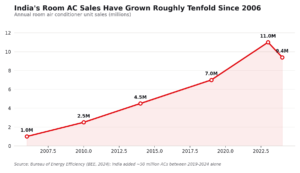
This isn’t a slow-moving market. Annual room AC sales in India have grown roughly tenfold since 2006 — from about 1 million units to more than 11 million units by 2023 — and between 2019 and 2024 alone, India added nearly 50 million new air conditioners, contributing an estimated 25-30 gigawatts (GW) to national peak electricity demand.
Put together, room ACs already account for nearly one-quarter of India’s peak electricity demand (in the 60-70 GW range), according to a working paper from the India Energy and Climate Center (IECC) at UC Berkeley — a striking figure given that the majority of Indian households haven’t bought their first AC unit yet. One analysis projects that if AC adoption reaches 70% of households, cooling alone could account for 18% of India’s total electricity demand.
Why This Is a Bigger Emissions Problem in India Than in Europe
Carbon Brief’s reporting on Europe notes that AC’s climate impact depends heavily on a country’s electricity mix — in France, where nuclear power supplies 67% of electricity, expanding AC barely moves the emissions needle. India is the opposite case. With coal still dominating the power mix, especially overnight when solar isn’t generating, each new air conditioner added in India carries a heavier carbon cost than one added in a cleaner grid like France’s. Today, India’s cooling-related emissions remain modest in absolute terms — around 202,000 tonnes of CO2 based on current usage patterns — but that number is on a clear upward trajectory as ownership climbs from 15% toward the projected 35% by 2030, unless the electricity powering those units gets cleaner at the same time.
There is a genuine opportunity here that Europe doesn’t have in the same way: India’s solar and battery storage economics have shifted dramatically in the last few years, meaning new AC demand could be paired with clean, dispatchable power from day one — rather than retrofitted onto a fossil grid later, the way much of the West’s cooling infrastructure was built.
The Efficiency Gap Makes It Worse
India’s AC efficiency standards have improved more slowly than the technology allows. Room ACs fall under the Bureau of Energy Efficiency’s (BEE) star labeling program, but the minimum efficiency standard (the 1-star threshold) has improved at only 2-2.5% per year on average over the past decade — far behind the pace of available technology — and the last major revision was in 2021, with the next one not due until 2026-2028. That’s a slow-moving regulatory ratchet for a market adding tens of millions of new, often inefficient units every year.
Heat Is Already Killing People — We Just Don’t Know How Many
If Europe’s heatwaves expose gaps in adaptation policy, India’s expose something more basic: the country doesn’t even have a reliable count of how many people heat is killing. Four different official sources — the National Crime Records Bureau (NCRB), the National Disaster Management Authority (NDMA), the Ministry of Earth Sciences (MoES), and the India Meteorological Department (IMD) — each publish their own heatwave mortality figures, and they routinely disagree by a factor of two or more.
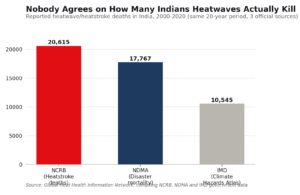
Over the 2000-2020 period alone, NCRB recorded 20,615 heatstroke deaths, NDMA recorded 17,767, and IMD recorded just 10,545 — all describing the same two decades. More recent research suggests even these numbers dramatically understate the real toll: a 2026 study published in Frontiers in Environmental Health estimated that a single day of extreme heat causes approximately 3,400 excess deaths nationally in India, and a five-day heatwave is linked to nearly 30,000 excess deaths — with Uttar Pradesh alone accounting for roughly 8,100 of those during a single five-day event, and individual districts like Ahmedabad, Jaipur, and Surat each exceeding 250 excess deaths in one heatwave. That framing suggests India’s true heat mortality burden may run into the tens of thousands annually — an order of magnitude above what any of the four official tracking systems currently capture.
Where the Heat Actually Hits Hardest
Unlike Europe, where the emerging worry is that traditionally cool northern regions are now facing unfamiliar heat, India’s hardest-hit geography has always been hot — the difference now is intensity and duration. Recent summers have pushed Rajasthan’s Churu district past 50°C, with Delhi crossing 49°C, and Ahmedabad, Nagpur, Jaipur, and Lucknow all regularly exceeding 46-48°C. Coastal cities like Chennai, Kolkata, Mumbai, and Bengaluru see comparatively lower peak temperatures (36-42°C) but face a different problem — extreme humidity that makes even moderate heat far more dangerous to the human body than dry-heat regions of similar temperature.
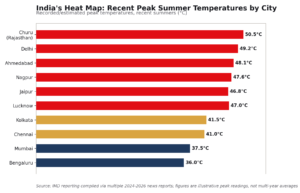
City-Wise Snapshot: Heat and Cooling Access
| City / Region | Recent Peak Temperature | AC Access Context |
|---|---|---|
| Churu, Rajasthan | 50.5°C | Rural desert region; among India’s lowest AC penetration states |
| Delhi | ~49.2°C | High urban AC penetration, but outdoor/informal workers remain highly exposed |
| Ahmedabad, Gujarat | ~48.1°C | First South Asian city to implement a Heat Action Plan (since 2013) |
| Nagpur, Maharashtra | ~47.6°C | Central India heat corridor; moderate AC access |
| Lucknow, Uttar Pradesh | ~47.0°C | UP has one of the lowest state-wide AC penetration rates despite extreme heat |
| Jaipur, Rajasthan | ~46.8°C | High heat, historically low AC ownership outside affluent areas |
| Kolkata, West Bengal | ~41.5°C | West Bengal has ~5% household AC penetration, among India’s lowest |
| Chennai, Tamil Nadu | ~41.0°C | High humidity compounds moderate temperatures |
| Mumbai, Maharashtra | ~37.5°C | Coastal humidity; among India’s most economically able to afford AC |
| Bengaluru, Karnataka | ~36.0°C | Historically mild climate now seeing rising cooling demand |
(Temperatures reflect recent peak/record readings, not multi-year averages; compiled from IMD-linked reporting, 2024-2026.)
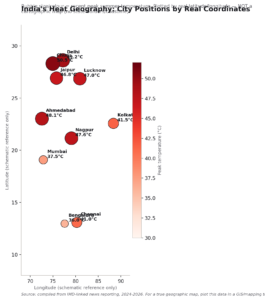
Note on the map above: this is a data scatter plotted using each city’s real latitude/longitude — it is not a cartographic map, since no offline India shapefile/boundary data was available to generate one. The relative positions of the cities are accurate; there is no coastline, state border, or basemap underneath. For a publication-ready map, this same coordinate data can be dropped into a GIS tool or a mapping service like Datawrapper or Flourish.
Ahmedabad Shows the Alternative to “Just Add More AC”
India actually has a two-decade head start on the kind of heat-adaptation planning Europe is only now debating. Ahmedabad became the first city in South Asia to implement a formal Heat Action Plan, back in 2013, following a deadly 2010 heatwave. Its plan combined early-warning alerts, cool public spaces, targeted outreach to outdoor workers and slum residents, and hospital preparedness — not primarily AC rollout. Research on heat mortality trends elsewhere backs this “beyond AC” approach: studies in the US and Spain found that rising AC ownership explained only 16.7% and 14.3% respectively of the long-term decline in heat mortality, with public health measures, urban planning, and behavioural change doing most of the remaining work. India’s own Heat Action Plans, now adopted by multiple states, lean on this same evidence — because for the roughly 85% of Indian households without AC, early warnings, shaded public spaces, and workplace heat protections are the only realistic near-term protection available.
The Actual Policy Tension India Faces
Strip away the framing, and India’s version of the “AC debate” comes down to three things happening at once, none of which map neatly onto a left-right culture war the way Europe’s does:
- Demand is rising fast and will keep rising — 15% penetration heading to 35% by 2030 is not a matter of if, but how fast, driven by rising incomes, urbanization, and genuinely worsening heat.
- The grid powering that demand is still coal-heavy, meaning each new AC unit currently carries a real emissions cost that a cleaner grid (like France’s) would not impose.
- Millions of the most heat-exposed Indians — outdoor workers, rural households, residents of India’s hottest but AC-poorest states — are the least likely to have access to cooling at all, making this fundamentally a question of equitable access, not cultural resistance.
The path forward that most researchers point to isn’t “less AC” or “more AC” — it’s faster efficiency standards so each new unit draws less power, accelerated clean power and storage buildout so new cooling demand doesn’t lock in more coal, and continued investment in the non-AC side of heat resilience (Heat Action Plans, worker protections, urban shading, better mortality data) for the large share of India that won’t have access to AC any time soon regardless of policy.
Sources
Data and reporting referenced in this piece draws on the Bureau of Energy Efficiency (BEE), the India Energy and Climate Center (IECC) at UC Berkeley, Down To Earth, the Global Heat Health Information Network, Frontiers in Environmental Health (Narang & Gadgil, 2026), World Population Review, BloombergNEF estimates cited via WorldMetrics, NCRB, NDMA, MoES, and IMD-linked reporting compiled by Factly and Dataful.
Can Google and Meta Really Claim ‘AI for Climate’ While Their Own Emissions Soar?