

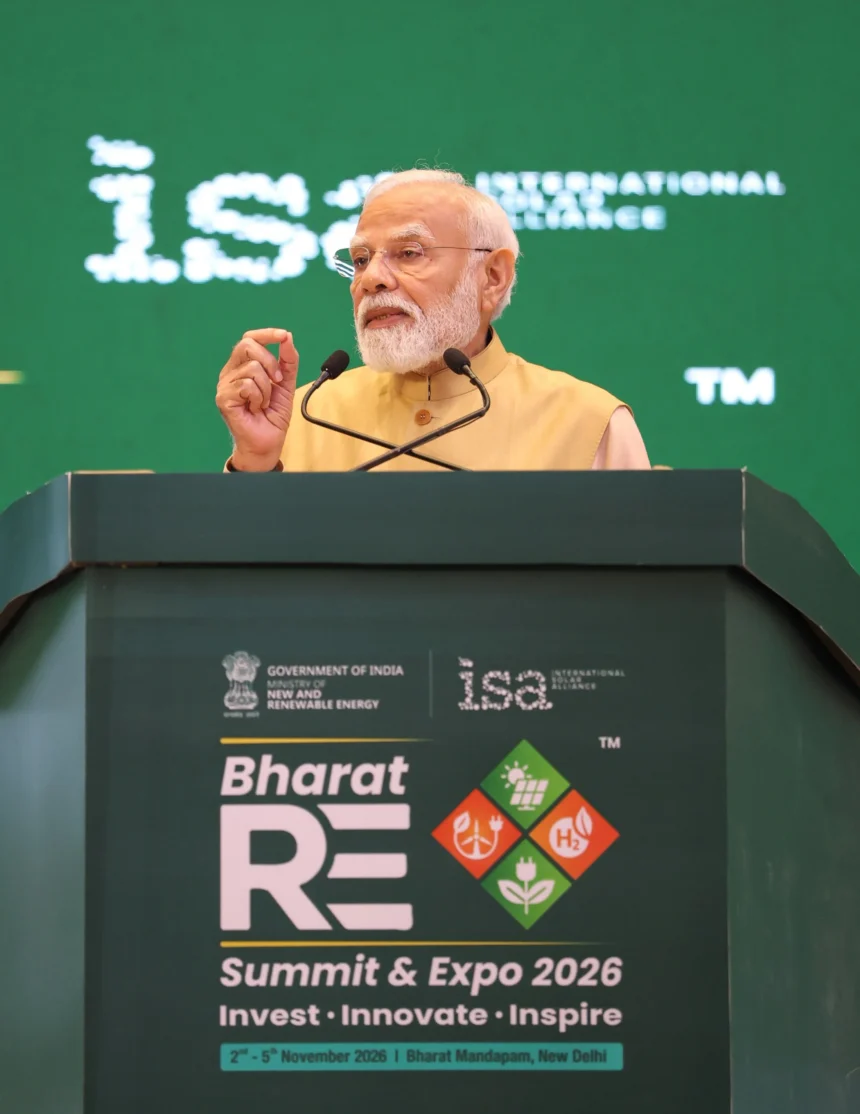
New Delhi | November 2, 2026 – India has stepped up its push to attract global capital into renewable energy, with Prime Minister Narendra Modi inaugurating the Bharat Renewable Energy Summit & Expo (BRESE) 2026 at Bharat Mandapam in New Delhi. The four-day event, running from November 2 to 5, brings together policymakers, investors, manufacturers, technology providers and international delegations as India seeks to mobilise approximately $220 billion in clean energy investment between 2027 and 2030.
- Bharat Renewable Energy Summit 2026: Key Highlights
- Why India Is Targeting $220 Billion in Clean Energy Investment
- Three Clean Energy Platforms, One Global Gathering
- 1. Bharat Renewable Energy Summit & Expo
- 2. International Solar Alliance Assembly
- 3. International Conference on Green Hydrogen
- Energy Storage and Grid Infrastructure Move Into Focus
- Domestic Manufacturing Could Strengthen India’s Clean Energy Supply Chain
- What the Summit Means for ESG and Sustainable Finance
- What to Watch Through November 5
- Conclusion: Can India Turn Its Clean Energy Ambitions Into Investment?
Organised by the Ministry of New and Renewable Energy (MNRE), the summit is designed to connect India’s growing renewable energy market with international capital, emerging technologies and manufacturing partnerships. It is taking place alongside the 9th Session of the International Solar Alliance (ISA) Assembly and the 4th International Conference on Green Hydrogen (ICGH), bringing three major clean energy platforms together in the national capital.
The investment target comes as India expands renewable power generation, strengthens electricity transmission infrastructure and develops domestic manufacturing capabilities. The government says the next phase of the transition will require investment not only in generating capacity, but also in energy storage, grid infrastructure and emerging clean energy technologies.
Bharat Renewable Energy Summit 2026: Key Highlights
The summit’s headline figures underline the scale of India’s ambitions:
- $220 billion: Investment India aims to mobilise between 2027 and 2030.
- 308 GW: India’s installed non-fossil fuel capacity, as cited by the Ministry of New and Renewable Energy ahead of the summit.
- 500 GW: India’s target for non-fossil fuel capacity by 2030.
- 130+ countries: Expected international participation.
- 400+ exhibitors: Manufacturers, developers, technology providers, startups and research institutions.
- November 2–5, 2026: Dates of the four-day summit at Bharat Mandapam, New Delhi.
The $220 billion figure represents an investment requirement and opportunity for the 2027–2030 period. It should not be interpreted as money already secured or disbursed.
Why India Is Targeting $220 Billion in Clean Energy Investment
India’s renewable energy ambitions extend beyond installing more solar panels and wind turbines. Meeting the country’s 2030 goals will require coordinated investment across power generation, electricity transmission, energy storage, manufacturing and newer technologies such as green hydrogen.
Renewable power generation can grow rapidly, but integrating larger volumes of variable solar and wind electricity requires grid infrastructure capable of moving power from generation centres to demand hubs. Storage technologies can help shift electricity availability across different times of day, while stronger transmission networks can reduce bottlenecks between renewable energy projects and consumers.
Domestic manufacturing is another priority. Building capacity across the clean energy supply chain can strengthen industrial capabilities, create opportunities for Indian manufacturers and reduce exposure to imported components.
The government has therefore positioned the summit as a platform for investment facilitation, business partnerships and technology collaboration—not simply as an exhibition of renewable energy products.
Three Clean Energy Platforms, One Global Gathering
One of the defining features of the Bharat Renewable Energy Summit 2026 is its combination of a domestic industry expo with two international forums.
1. Bharat Renewable Energy Summit & Expo
The main summit focuses on investment, technology, policy and industrial development across India’s clean energy sector. The accompanying exhibition features more than 400 participants from across the renewable energy ecosystem, creating opportunities for manufacturers, developers, investors and technology companies to explore partnerships.
The programme includes ministerial discussions, executive roundtables, country sessions and state-level presentations designed to connect investment opportunities with potential partners.
2. International Solar Alliance Assembly
The 9th Session of the International Solar Alliance Assembly adds an international cooperation dimension to the gathering. Launched by India and France in 2015, the ISA works to accelerate solar energy deployment, improve access to finance and strengthen institutional capacity across member countries.
The Assembly gives participating governments and organisations a forum to discuss solar deployment, financing and international cooperation, particularly in emerging markets and the Global South.
3. International Conference on Green Hydrogen
The 4th International Conference on Green Hydrogen focuses on a technology that could help decarbonise sectors where direct electrification is difficult.
Green hydrogen, produced using renewable electricity, has potential applications in industries such as fertilisers and steel, as well as selected transport and energy applications. However, commercial expansion depends on production costs, infrastructure, storage, safety standards and reliable demand from industrial buyers.
Bringing the hydrogen conference alongside the renewable energy summit creates opportunities to discuss how clean electricity, hydrogen production and industrial demand can develop together.
Energy Storage and Grid Infrastructure Move Into Focus
As renewable generation expands, investment in storage and transmission becomes increasingly important.
Solar generation is concentrated during daylight hours, while electricity demand can rise during the evening. Battery energy storage systems can help shift some electricity from periods of surplus generation to periods of higher demand, subject to project economics, storage duration and grid requirements.
Transmission infrastructure is equally important. Renewable energy resources are often located far from major industrial and population centres, making new transmission lines, substations and grid-management systems necessary to deliver electricity reliably.
These investments can help improve renewable energy integration and reduce constraints that prevent available clean electricity from reaching consumers.
For investors, the opportunity extends across the entire ecosystem: renewable power projects, battery manufacturing, energy storage systems, grid equipment, power electronics, transmission infrastructure and digital technologies for energy management.
Domestic Manufacturing Could Strengthen India’s Clean Energy Supply Chain
India’s clean energy strategy also places emphasis on expanding domestic manufacturing.
Solar modules, solar cells, power electronics, wind energy equipment, battery systems and electrolyser technology are all relevant to the broader transition. Increasing manufacturing capacity could create opportunities for domestic companies while supporting the deployment of renewable energy infrastructure.
The summit provides a platform for manufacturers and technology providers to engage with policymakers, potential customers and investors. Its exhibition and business-to-business discussions are intended to encourage commercial partnerships and investment in India’s clean energy ecosystem.
However, manufacturing expansion will depend on competitive costs, technological capabilities, supply-chain resilience, access to finance and sustained demand. Announced projects and proposed investments will need to translate into operating capacity to deliver their intended economic and environmental benefits.
What the Summit Means for ESG and Sustainable Finance
The clean energy investment push has important implications for environmental, social and governance (ESG) priorities.
For investors, the proposed investment pipeline creates opportunities to evaluate renewable energy assets, energy storage, grid infrastructure and clean technology businesses.
For companies, access to reliable renewable electricity can support decarbonisation strategies, reduce exposure to fossil fuel price volatility and help address emissions across operations and supply chains.
For manufacturers, the expansion of clean energy infrastructure can create demand for equipment, components, engineering services and technology solutions.
For policymakers, the challenge is to ensure that investment translates into reliable infrastructure, measurable emissions reductions and responsible development.
The quality of implementation will matter as much as the size of the investment target. Project execution, grid readiness, financial viability, environmental safeguards and transparent reporting will help determine whether new capital delivers long-term value.
What to Watch Through November 5
With the summit running until November 5, attention will turn to concrete outcomes from discussions among governments, investors and industry participants.
Key developments to watch include:
- Investment announcements: Whether proposed projects attract firm financing and reach implementation milestones.
- Manufacturing partnerships: New collaborations involving solar components, batteries, grid equipment and hydrogen technologies.
- Energy storage projects: Progress on battery deployment and other solutions needed to integrate variable renewable generation.
- International cooperation: Partnerships emerging from the ISA Assembly and the Green Hydrogen Conference.
- Policy and financing developments: Measures that could improve access to capital and support project execution.
The distinction between announced investment opportunities and actual capital deployment will be important when assessing the summit’s longer-term impact.
Conclusion: Can India Turn Its Clean Energy Ambitions Into Investment?
The Bharat Renewable Energy Summit 2026 arrives at a pivotal stage in India’s energy transition. The country is seeking to expand non-fossil fuel capacity, strengthen domestic manufacturing and attract international investment while building the infrastructure required to integrate more renewable electricity into the grid.
The $220 billion investment target for 2027–2030 signals the scale of the financial mobilisation India believes will be needed. But the ultimate test will be whether capital commitments become operating projects, stronger supply chains and dependable infrastructure.
For renewable energy companies, manufacturers, investors and ESG-focused businesses, the summit offers a window into the policy priorities and commercial opportunities shaping India’s clean energy market.
The next phase of India’s energy transition will depend not only on how much capital it attracts, but on how effectively that capital is converted into clean power, resilient infrastructure and measurable progress.
Source: Ministry of New and Renewable Energy, Government of India; Prime Minister’s Office; India Brand Equity Foundation (IBEF).
India’s 12 Largest Mutual Fund Houses Score Zero on Climate Stress Testing