

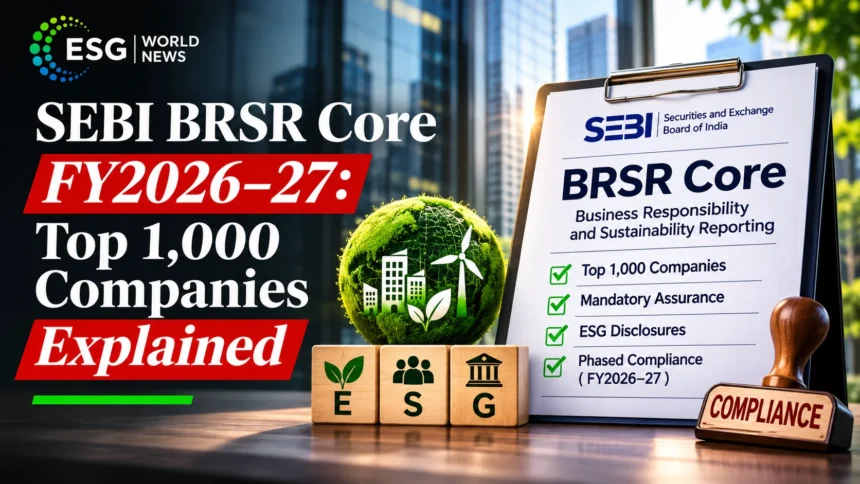
GOVERNANCE | INDIA, ESG World News Desk – India’s corporate sustainability reporting landscape is entering a new phase as the Securities and Exchange Board of India (SEBI) extends the BRSR Core framework to the country’s top 1,000 listed companies by market capitalisation in FY2026–27.
- What Is SEBI’s BRSR Core Framework?
- BRSR Core Rollout: From 150 to 1,000 Listed Companies
- SEBI’s March 2025 Circular: Assessment or Reasonable Assurance?
- Why Mid-Cap Companies Could Face Greater Compliance Challenges
- What About Value-Chain ESG Disclosures?
- Key Numbers: India’s BRSR Core Expansion
- Why the BRSR Core Expansion Matters for India’s ESG Landscape
- What to Watch in FY2026–27
The latest expansion brings approximately 500 companies ranked between 500th and 1,000th by market capitalisation into the framework for the first time. These businesses must prepare for the assessment or reasonable-assurance requirements applicable to their BRSR Core disclosures, adding new compliance responsibilities for companies that may have comparatively limited ESG reporting infrastructure.
The expansion completes a four-stage rollout that began with the top 150 listed companies in FY2023–24, increased to the top 250 in FY2024–25 and reached the top 500 in FY2025–26.
For companies newly covered by the framework, the September–November 2026 preparation period is an important window to confirm their market-capitalisation ranking, obtain board approval for the chosen compliance route, select an eligible provider, complete conflict-of-interest checks and finalise engagement arrangements.
The transition signals a broader shift in India’s capital markets towards more structured, measurable and independently assessed corporate sustainability disclosures.
What Is SEBI’s BRSR Core Framework?
The Business Responsibility and Sustainability Report (BRSR) is SEBI’s sustainability disclosure framework for listed companies. BRSR Core represents a focused set of approximately 30 key performance indicators drawn from the broader reporting framework.
These indicators cover important environmental, social and governance parameters, including:
- Greenhouse gas emissions intensity
- Water consumption
- Waste generation
- Employee wellbeing
- Board diversity
- Other measurable sustainability performance indicators
The purpose of BRSR Core is to make important ESG information more consistent, comparable and verifiable. Unlike broader qualitative disclosures, its selected indicators are designed to be supported by measurable data and underlying records.
The framework’s assessment and assurance requirements are intended to strengthen confidence in the information reported by companies, helping investors and other stakeholders evaluate sustainability performance using more reliable disclosures.
BRSR Core Rollout: From 150 to 1,000 Listed Companies
SEBI has expanded the applicability of BRSR Core in phases, progressively bringing more listed companies into the reporting and assessment framework.
| Financial year | Companies covered by market capitalisation |
|---|---|
| FY2023–24 | Top 150 |
| FY2024–25 | Top 250 |
| FY2025–26 | Top 500 |
| FY2026–27 | Top 1,000 |
With the latest expansion, approximately 500 additional companies are entering the framework. Many are mid-cap businesses and other listed firms that may not have the same level of dedicated sustainability reporting resources as the largest corporations.
For these companies, establishing clear internal accountability for ESG information and maintaining supporting documentation will be important parts of the compliance process.
SEBI’s March 2025 Circular: Assessment or Reasonable Assurance?
A regulatory development that companies need to consider is SEBI’s circular dated March 28, 2025.
The circular introduced flexibility in the compliance approach by allowing companies to choose between a reasonable-assurance engagement and an assessment under standards developed by the Industry Standards Forum in consultation with SEBI.
The distinction is important for companies planning their reporting budgets and internal processes.
Reasonable assurance involves a more rigorous evidence-based engagement. The assurance provider examines relevant records and supporting information to form an opinion on whether the reported data is materially accurate.
An assessment offers an alternative route under the applicable standards. The choice between the two approaches can have implications for the level of scrutiny, documentation requirements, engagement scope and cost.
For companies entering the framework for the first time, the decision should be considered alongside their reporting maturity, available evidence, internal controls and stakeholder expectations.
The choice does not remove the need for reliable data. Companies still need processes that can support the disclosures they make.
Why Mid-Cap Companies Could Face Greater Compliance Challenges
The expansion to the top 1,000 listed companies brings a different set of operational challenges compared with the earlier phases.
Many large corporations already have dedicated sustainability teams, established ESG reporting processes and relationships with external assurance providers. A number of newly covered companies may have to build these capabilities more substantially.
Key challenges could include:
1. Identifying ESG data owners
Companies need clear accountability for individual BRSR Core indicators. An internal attribute register can help assign named owners to specific metrics and establish responsibility for collecting and validating information.
2. Strengthening documentation and evidence trails
Reported figures should be supported by source records and consistent data-collection processes. This can require coordination across finance, human resources, operations, procurement and sustainability teams.
3. Selecting an assessment or assurance provider
Companies must evaluate their reporting requirements and select an appropriate provider for the chosen route. Board approval and conflict-of-interest checks are important parts of the preparation process.
4. Managing compliance costs and timelines
First-time reporting and assurance arrangements can involve additional expenditure, internal coordination and external-provider capacity. Early planning can help reduce the risk of delays as the reporting cycle progresses.
What About Value-Chain ESG Disclosures?
Value-chain disclosures are a separate component of the broader BRSR framework.
According to the regulatory timeline outlined in the supplied material, value-chain disclosure remains voluntary for the top 250 companies from FY2025–26. Third-party assessment or assurance of value-chain information is also voluntary from FY2026–27.
This approach recognises the practical difficulty of collecting and verifying sustainability information across suppliers, vendors and other business partners.
While companies can face challenges in establishing reliable value-chain data, the distinction between their own BRSR Core disclosures and wider value-chain information remains important for compliance planning.
Key Numbers: India’s BRSR Core Expansion
- Top 1,000: Listed companies covered by the BRSR Core framework in FY2026–27.
- Approximately 500: Additional companies entering the framework for the first time in the latest phase.
- Around 30: Key performance indicators in the BRSR Core subset.
- March 28, 2025: Date of the SEBI circular introducing the assessment-or-assurance option.
- Four financial years: The phased expansion from the top 150 companies in FY2023–24 to the top 1,000 in FY2026–27.
Why the BRSR Core Expansion Matters for India’s ESG Landscape
The expansion of BRSR Core has implications beyond regulatory compliance.
For investors and lenders, more structured and independently assessed sustainability information can improve the availability of comparable ESG data. Such information can support due diligence for ESG-screened investment portfolios, green bonds and sustainability-linked financing.
For companies, the framework places greater emphasis on internal data governance. Sustainability reporting increasingly requires coordination between business functions rather than being treated as a standalone communications exercise.
For mid-cap businesses, the latest phase could accelerate investment in ESG reporting systems, internal controls and accountability structures.
The quality of the resulting disclosures will depend on how effectively companies establish reliable data processes and implement the applicable assessment or assurance requirements.
What to Watch in FY2026–27
One important issue will be the capacity of India’s assurance and assessment ecosystem to support the approximately 500 companies entering the framework.
Demand for qualified providers, the availability of experienced ESG professionals and the cost of engagements could influence how companies approach their first reporting cycle.
Another development worth watching is whether SEBI publishes aggregate compliance information after the FY2026–27 cycle. Such information could provide insight into the number of companies opting for assessment rather than reasonable assurance, as well as the overall level of compliance across the top 1,000 listed firms.
As the framework reaches its full planned coverage, the focus will increasingly move from regulatory adoption to the quality, consistency and credibility of corporate ESG disclosures.
For India’s listed companies, BRSR Core is becoming an important part of the governance and reporting landscape. The challenge now is to ensure that sustainability information is not only disclosed, but also supported by robust data and accountable internal processes.
About ESG World News
ESG World News covers developments in sustainability, environmental policy, corporate governance, climate finance, renewable energy and responsible business.
Sources:
- The Footnotes – BRSR Core Assurance for FY2026–27
- Benchmark Gensuite – BRSR Core Assurance for Top 1,000 Companies
- Sustainability101 – BRSR Core Coverage of India’s Top 1,000 Listed Companies
- Relific – BRSR Core FY2026–27 Explained
This article is based on the supplied source material. Companies should refer to the applicable SEBI circulars and regulatory guidance for their specific compliance obligations.