
By using this site, you agree to the Privacy Policy and Terms of Use.
Accept

Esgworldnews logo
  • About Us
  • Disclaimer
  • Contact Us
  • Advertise With Us
  • Privacy Policy
Reading: AI-Powered EV Charging Technology Could Extend Battery Life by 23%: What It Means for India’s Electric Vehicle Push
Share

Login
  • Home
  • TOP STORIES
    • News
    • Articles
    • Interviews
    • TOP 10
    • Industry Events
  • MAGAZINES
    • Sustainability Magazine
  • Reports & Whitepapers
    • Company Reports
    • Top 250 Reports
    • White Papers
  • NEWS FEED
    • AI in Sustainability
    • Circularity & Recycling
    • Decarbonisation
    • Green Mobility
    • Energy Transition
    • ESG
    • Nature-Based Solutions
    • Net Zero
    • Plastics & Packaging
    • Regulation & Reporting
    • Renewable & Green Energy
    • Sustainability
    • Sustainable Finance
    • Sustainable Supply Chains
    • Technology
    • Water Positivity
  • Webinars
    • Top Voices
    • Expert Column
Reading: AI-Powered EV Charging Technology Could Extend Battery Life by 23%: What It Means for India’s Electric Vehicle Push
Share
EsgworldnewsEsgworldnews
Font ResizerAa
  • Home
  • TOP STORIES
  • MAGAZINES
  • Reports & Whitepapers
  • NEWS FEED
  • Webinars
Search
  • Home
  • TOP STORIES
    • News
    • Articles
    • Interviews
    • TOP 10
    • Industry Events
  • MAGAZINES
    • Sustainability Magazine
  • Reports & Whitepapers
    • Company Reports
    • Top 250 Reports
    • White Papers
  • NEWS FEED
    • AI in Sustainability
    • Circularity & Recycling
    • Decarbonisation
    • Green Mobility
    • Energy Transition
    • ESG
    • Nature-Based Solutions
    • Net Zero
    • Plastics & Packaging
    • Regulation & Reporting
    • Renewable & Green Energy
    • Sustainability
    • Sustainable Finance
    • Sustainable Supply Chains
    • Technology
    • Water Positivity
  • Webinars
    • Top Voices
    • Expert Column
Have an existing account? Sign In
Follow US
  • Advertise

AI-Powered EV Charging Technology Could Extend Battery Life by 23%: What It Means for India’s Electric Vehicle Push

Ankitt Y
Last updated: May 24, 2026 6:45 pm
Ankitt Y
1 day ago
Share
AI in EV charging
AI in EV charging
SHARE

India added over 1.9 million electric vehicles in FY2024, and that number is climbing fast. Yet one question continues to shadow the country’s EV ambitions: how long will the battery actually last? New findings from Sweden may offer a significant answer.

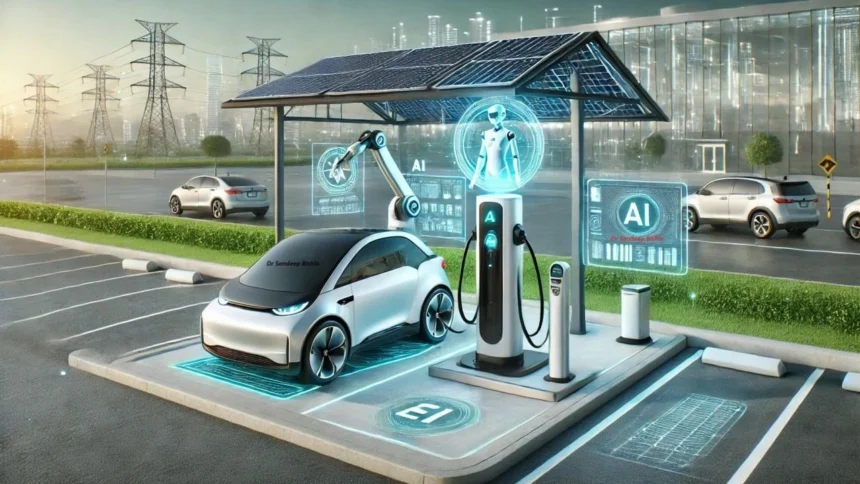
Researchers at Chalmers University of Technology have developed an AI-driven charging system that could extend lithium-ion battery lifespan by approximately 23%. The study, published by the Institute of Electrical and Electronics Engineers (IEEE), uses reinforcement learning — a machine learning technique where a system learns optimal behaviour through continuous trial and feedback — to manage how current flows during fast-charging sessions.

How the Technology Works

Fast charging is increasingly common across Indian cities, where public charging infrastructure is expanding under programmes like PM E-DRIVE and FAME III. However, repeated fast charging accelerates a process called lithium plating, where ions build up on a battery’s anode and gradually degrade its capacity.

The AI system addresses this by continuously monitoring the battery’s chemistry and state of health, then adjusting voltage and current in real time to minimise internal stress. Crucially, it adapts as the battery ages — meaning its protective effect could grow stronger over time, not weaker.

Lead researcher Meng Yuan noted that the system achieved 703 equivalent full charge cycles under testing, compared to the standard baseline — a measurable 22.9% improvement in battery longevity without compromising charging speed.

Why This Matters for Indian EV Buyers

Battery replacement remains one of the largest cost anxieties for Indian EV consumers. A lithium-ion pack for a mid-range electric two-wheeler or car can cost anywhere between ₹40,000 and ₹3 lakh or more, depending on capacity. If AI-managed charging can meaningfully delay that replacement — even by three to five years — it changes the total cost of ownership calculation significantly.

Global data suggests EV batteries degrade at roughly 1.8% annually, potentially lasting 20 years or 200,000 miles under normal conditions. A 23% improvement in cycle life could, in practical terms, add tens of thousands of additional kilometres of usable range before a battery needs attention.

The Sustainability Upside

Beyond personal savings, the environmental logic is compelling. Battery manufacturing is resource-intensive, relying on lithium, cobalt, and nickel — materials that require high-energy extraction processes. India, which imports a significant share of these critical minerals, stands to benefit both economically and environmentally if domestic EV batteries simply last longer.

Fewer battery replacements means less mining demand, less electronic waste, and a stronger lifecycle argument for EVs over internal combustion vehicles — a case the Indian government is actively building as it targets 30% EV penetration by 2030.

Where Things Stand

It is important to note that the research was conducted under controlled laboratory conditions, not on physical batteries in operating vehicles. Real-world validation is the next critical step. If results hold outside the lab, the technology could influence battery warranty structures, resale valuations in the used EV market, and integration standards for charging networks — all of which are rapidly evolving in India.

For Indian manufacturers like Tata Motors, Ola Electric, and Ather Energy, as well as charging infrastructure players expanding across Tier 1 and Tier 2 cities, this research signals a direction worth watching closely.

SolarSquare in Talks to Raise Up to $60 Million as India’s Rooftop Solar Market Accelerates

PM Modi’s five-nation tour secures nearly $40 billion investment pipeline for India
AI Data Centres Could Double Electricity Consumption by 2030- and What It Means for India
Why India’s Sustainability Professionals Must Not Hand Over Strategic Control to AI
Stride Raises $15 Million to Expand Rooftop Solar Financing and Clean Energy Access Across Southeast Asia
Jubilant FoodWorks Challenges Haryana Pollution Board Order Over Faridabad Store Operations
TAGGED:AI EV charging Indiaelectric vehicle battery lifeEV battery degradationIndia EV sustainabilitylithium-ion battery AI
Share This Article
Facebook Whatsapp Whatsapp LinkedIn Email Print
Previous Article solar Tata Power, DGPC Sign Bhutan Clean Energy Workforce Pact
Next Article AI In Sutainability Why India’s Sustainability Professionals Must Not Hand Over Strategic Control to AI
Leave a Comment

Leave a Reply Cancel reply

Your email address will not be published. Required fields are marked *

About Us

Esgworldnews logo white

Navigate Site

  • About Us
  • Disclaimer
  • Contact Us
  • Advertise With Us
  • Privacy Policy

Contact Us

Mail Us At- Editor@esgworldnews.com

Find Us on Socials

Join Us!
Subscribe to our newsletter and never miss our latest news, podcasts etc..

Subscribe

* indicates required
/* real people should not fill this in and expect good things - do not remove this or risk form bot signups */

Intuit Mailchimp

Zero spam, Unsubscribe at any time.
Esgworldnews logo Esgworldnews logo
Welcome Back!

Sign in to your account

Username or Email Address
Password

Lost your password?