
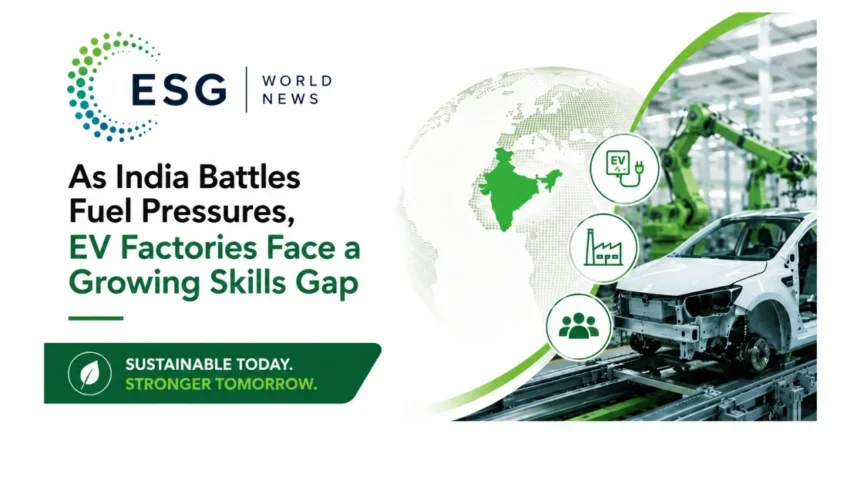
The country’s electric vehicle ambitions are running at full throttle — but the workforce powering those factories is struggling to keep up.
A Country on the Edge of an Energy Crisis
India has never felt the weight of oil quite so acutely. In May 2026, petrol prices rose by ₹3 per litre overnight — Delhi now pays ₹97.77 per litre for petrol, Mumbai ₹106.68, and Kolkata ₹108.74 — the first revision in nearly 11 weeks, pushed through even as Prime Minister Narendra Modi was publicly urging citizens to reduce fuel consumption. It was a moment of uncomfortable contradiction: a government asking people to drive less while absorbing staggering losses to keep prices politically palatable.
Behind the scenes, the math is ugly. The Indian Crude Oil Basket — the benchmark for the country’s fuel procurement costs — surged by approximately 133% from January to March 2026, driven by the West Asia crisis and disruptions around the Strait of Hormuz, which sent Brent crude past $110 per barrel. State-owned oil marketing companies — Indian Oil Corporation (IOCL), Bharat Petroleum (BPCL), and Hindustan Petroleum (HPCL), which together control roughly 90% of India’s fuel retail market — were incurring losses of approximately ₹13.50 per litre on diesel and ₹1 per litre on petrol. In just 10 weeks, cumulative under-recoveries crossed ₹1 lakh crore. Since India imports nearly 85% of its crude oil, every dollar spike in global prices translates directly into fiscal pain.
It is precisely this vulnerability that has made the pivot to electric vehicles feel not just desirable, but existential. Yet for all its urgency, India’s EV revolution faces a crisis hiding in plain sight — not one of ambition, but of talent.
The EV Market Is Surging, the Workforce Is NotIndia’s EV market is one of the most exciting growth stories in global mobility. EV sales crossed the 2-million mark for the first time in 2024, a 24% jump from 2023, up from just 50,000 units in 2016. Battery electric vehicle production is projected to nearly triple to 377,000 units in 2025 from 130,000 in 2024 — a year-over-year manufacturing surge of 140.2% — driven by launches from Tata Motors, Mahindra, Hyundai, Maruti Suzuki, and JSW MG Motor. India now holds approximately 5% of the global EV market share and boasts over 29,000 public charging stations as of August 2025, up from just 451 in 2021.
The financial ambitions are equally staggering. The Indian EV market, valued at $3.98 billion in 2024, is projected to grow to $17.88 billion by 2032. The EV battery market alone is expected to expand from $2.72 billion in 2025 to $15.9 billion by 2034, growing at a CAGR of 21.7%. Meanwhile, India’s EV battery demand is forecast to grow 14 times over by 2032, according to Customised Energy Solutions. Government investment has matched this momentum: the PM E-DRIVE Scheme allocated ₹10,900 crore ($1.28 billion) to the EV ecosystem, the PLI Scheme for Advanced Chemistry Cells (ACC) committed ₹18,100 crore to establish 50 GWh of domestic battery manufacturing capacity, and the PLI Scheme for Automobiles added another ₹25,938 crore to incentivise EV production.
But there is a gaping hole in this story. The workforce to build, maintain, and scale this industry simply does not exist in the numbers required.
The Numbers Behind the GapThe Society of Indian Automobile Manufacturers (SIAM) estimates that achieving 30% EV adoption by 2030 will require 2 lakh (200,000) skilled workers, with an annual addition of 30,000 professionals — double the current rate of hiring. The Ministry of Skill Development and Entrepreneurship projects that EV companies will generate 1 crore (10 million) direct jobs and 5 crore (50 million) indirect jobs by 2030. Meeting those numbers demands workforce expansion at a scale India has never attempted in a single industrial sector.
The scope of re-skilling required is vast and underappreciated. An analysis by the OMI Foundation reveals that out of 35 EV-related job categories, only one-third require skill sets similar to those in the traditional Internal Combustion Engine (ICE) sector. A separate SIAM study found that 43% of EV-specific skills require entirely new training — particularly in battery chemistry, electric propulsion systems, and power electronics. Demand for ICE and powertrain designers has meanwhile plummeted by 50% to 62% over the past two years.
Put simply: nearly seven out of ten jobs in India’s future EV factories require capabilities that most of the country’s existing auto workforce does not have.
India’s proficiency gap is also visible in global comparisons. While China’s auto workforce reports 70% proficiency in advanced EV manufacturing technologies, the United States stands at 65%, Europe at 60%, and India at a comparatively modest 50%. This gap — 20 percentage points below China — reflects the structural inadequacies in how India trains its technical workforce. Yet there is a silver lining: India has witnessed a 40% increase in automotive workers with at least one EV-related skill over the past five years, outpacing the USA, Mexico, Canada, and several European nations, according to the Global Green Skills Report 2023.
What Exactly Is Missing?The skills shortage in India’s EV factories is not monolithic — it cuts across multiple disciplines simultaneously.
Battery Technology. Expertise in battery management systems (BMS), electrochemistry, and battery pack design is critically scarce. India largely imports lithium-ion cells and converts them into battery packs domestically using low-value-added, labour-intensive processes. Cell manufacturing — the high-value step — remains dominated by China, which controls 60% of global EV production capacity. Building genuine cell manufacturing capability in India requires a workforce fluent in advanced materials science, thermal management.
Charging Infrastructure. The Mercedes-Benz Research and Development India (MBRDI) and TERI joint white paper on EV charging found that nearly half of all skills needed by charging point operators relate to installation and testing of chargers, combined with digital capabilities like IoT monitoring and app-based diagnostics. Fault-troubleshooting, smart grid integration, and service optimisation make up the rest. Despite charging stations growing from 451 in 2021 to over 29,000 by 2025, the specialised technician workforce has not kept pace. TERI’s researchers note that most Industrial Training Institutes still follow outdated curricula that barely cover charging infrastructure, power electronics, or battery recycling.
Advanced Manufacturing & Automation. As Indian EV factories adopt robotics, AI-driven quality control, and Industry 4.0 systems, the gap between what shop floors need and what workers can offer is widening. A leading Indian EV manufacturer reported a 30% reduction in production time and 25% improvement in product quality after integrating robotic assembly lines — but achieving these gains required skills that had to be developed through in-house training because they couldn’t be sourced from the market.
Software and Digital Skills. Emerging roles in EV manufacturing increasingly demand expertise in IoT, mechatronics, 3D printing, AI, machine learning, analytics, and automotive design software. These are domains where traditional auto sector training programs offer little preparation.
The Curriculum ProblemAt the heart of the skills gap is a fundamental mismatch between India’s education system and the industry’s needs. Only 42.6% of Indian engineering and technical graduates were considered employable in 2024, according to Mercer-Mettl’s India Graduate Skill Index 2025 — and that figure covers general employability, not the far narrower pool of EV-ready graduates.
Most engineering curricula in India remain ICE-centric. While institutions like IIT Delhi, IIT Bombay, IIT Madras, and Delhi Technological University have begun offering MTech courses in electric mobility, these represent a tiny fraction of the country’s 4,000-plus engineering colleges. The Automotive Skills Development Council (ASDC), under the Ministry of Skill Development and Entrepreneurship, has launched certification programs in EV manufacturing, maintenance, and charging infrastructure, but training capacity remains far below projected demand.
The analogy offered by energy experts is instructive: India’s solar industry scaled its workforce through the government’s Suryamitra scheme, which trained over 78,000 technicians. A similar, but far larger, initiative is needed for EVs — and it is yet to materialise at the required scale.
The Curriculum ProblemAt the heart of the skills gap is a fundamental mismatch between India’s education system and the industry’s needs. Only 42.6% of Indian engineering and technical graduates were considered employable in 2024, according to Mercer-Mettl’s India Graduate Skill Index 2025 — and that figure covers general employability, not the far narrower pool of EV-ready graduates.
Most engineering curricula in India remain ICE-centric. While institutions like IIT Delhi, IIT Bombay, IIT Madras, and Delhi Technological University have begun offering MTech courses in electric mobility, these represent a tiny fraction of the country’s 4,000-plus engineering colleges. The Automotive Skills Development Council (ASDC), under the Ministry of Skill Development and Entrepreneurship, has launched certification programs in EV manufacturing, maintenance, and charging infrastructure, but training capacity remains far below projected demand.
The analogy offered by energy experts is instructive: India’s solar industry scaled its workforce through the government’s Suryamitra scheme, which trained over 78,000 technicians. A similar, but far larger, initiative is needed for EVs — and it is yet to materialise at the required scale.
The Cost of Getting It WrongThe fuel crisis has added a layer of urgency that raises the stakes for the skills gap. Rising crude prices are a powerful tailwind for EV adoption — higher petrol and diesel costs make the total cost of ownership argument for EVs far more compelling. But there is a complication.
A Centre for Social and Economic Progress (CSEP) analysis notes that even as crude procurement costs surged 133% in early 2026, retail petrol and diesel prices were largely held unchanged by OMCs for political reasons. This means the operating cost advantage of EVs — typically the strongest selling point — remains muted for consumers. Adding to the challenge, a September 2025 GST rationalisation reduced taxes on ICE vehicles, widening the EV price premium by ₹1.1 lakh to ₹1.5 lakh for electric passenger cars. EVs may only reach cost parity with ICE vehicles in some passenger segments around 2030.
Meanwhile, India’s battery manufacturing ambitions face a critical supply chain vulnerability: the country remains heavily dependent on China for lithium, cobalt, nickel, and key battery components. PLI-ACC beneficiaries, including Ola Electric (which became the first firm to receive PLI disbursement of ₹73.7 crore in March 2025), have already sought extensions due to supply chain disruptions. Without a domestically trained workforce capable of operating and innovating at every step of the battery value chain, India’s gigafactory ambitions risk becoming assembly shops dependent on foreign technology.