

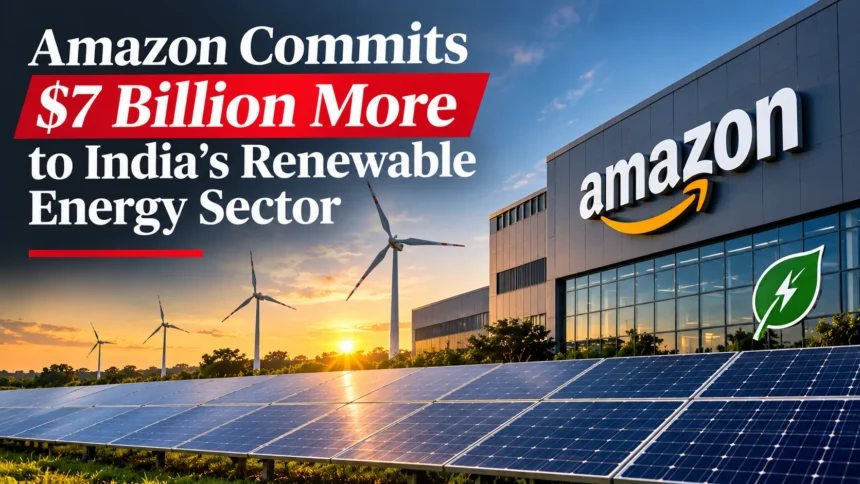
21st, November, 2026, India, ESG World News Desk – Amazon has announced an additional $7 billion commitment towards renewable energy projects in India by 2030, taking its cumulative clean-energy investment in the country to approximately $11 billion. Backed by new wind and solar power-purchase agreements across Karnataka, Madhya Pradesh and Rajasthan, the expansion will increase Amazon’s contracted renewable energy capacity in India to approximately 2.9 GW once the projects become operational.
- Amazon’s New Renewable Energy Projects Across Three Indian States
- Why Amazon Is Increasing Its Renewable Energy Investment in India
- Amazon’s Growing Role in India’s Corporate Renewable Energy Market
- Amazon India Renewable Energy Investment: Key Numbers
- Why Amazon’s $7 Billion Renewable Energy Commitment Matters for India
- What to Watch Next
Global technology and e-commerce company Amazon is significantly expanding its renewable energy portfolio in India, announcing plans to invest an additional $7 billion by 2030.
Announced on November 17, 2026, the commitment builds on approximately $4 billion in renewable energy investments and contracted projects already associated with the company in India. Together, the commitments represent an estimated $11 billion in cumulative clean-energy investment in the country.
The latest expansion is supported by new long-term power-purchase agreements (PPAs) covering more than 900 MW of utility-scale wind and solar capacity across Karnataka, Madhya Pradesh and Rajasthan.
Once the newly announced projects become operational, Amazon’s contracted renewable energy capacity in India is expected to reach approximately 2.9 GW.
The announcement highlights the growing role of large corporate energy buyers in financing India’s renewable energy expansion, particularly as electricity demand increases across data centres, cloud computing and artificial intelligence infrastructure.
Amazon’s New Renewable Energy Projects Across Three Indian States
Amazon’s latest renewable energy agreements cover four additional utility-scale projects across Karnataka, Madhya Pradesh and Rajasthan.
The projects include:
- Karnataka: A 234 MW wind farm and a combined 200 MW solar-and-wind project.
- Madhya Pradesh: A 300 MW solar power project.
- Rajasthan: A 200 MW solar power project.
Together, these projects add more than 900 MW of renewable energy capacity to Amazon’s Indian portfolio.
The 234 MW wind project in Karnataka is described by Amazon as one of the largest individual wind projects in Asia.
The company’s existing Indian renewable energy portfolio includes 14 utility-scale wind and solar projects and 43 on-site solar installations across its warehouses and data centres. These installations and projects account for more than 2 GW of contracted renewable energy capacity.
Amazon Chief Sustainability Officer Kara Hurst described the expansion as the outcome of “years of sustained effort, planning, and collaboration” with Indian renewable energy developers and state governments.
The latest agreements reflect a continued effort to secure long-term renewable electricity supply for the company’s operations in India.
Why Amazon Is Increasing Its Renewable Energy Investment in India
Amazon’s expanded commitment comes as the company pursues its global climate objectives while responding to rising electricity requirements across its operations.
One of its key priorities is reducing the carbon intensity of the electricity powering its operations. Amazon has adopted a target to cut this intensity by 65% by 2030, using 2019 as the baseline year.
The growing electricity requirements of data centres and artificial intelligence infrastructure make renewable energy procurement increasingly important to this target.
India has also become an important market for corporate renewable energy investment. The country’s ambitious clean-energy development plans, renewable energy resources and expanding power market create opportunities for large companies to enter long-term electricity procurement agreements.
India has set a target of 500 GW of clean-energy capacity by 2030. Achieving this ambition requires substantial investment in renewable generation, transmission infrastructure and supporting energy systems.
The government has separately estimated that approximately $220 billion in investment will be required to achieve its 2030 clean-energy target.
In this environment, long-term corporate power-purchase agreements can provide renewable energy developers with greater revenue visibility and support the financing of large-scale projects.
Amazon’s Growing Role in India’s Corporate Renewable Energy Market
Amazon’s cumulative renewable energy commitment of approximately $11 billion places the company among the major corporate participants in India’s clean-energy market.
Large corporate buyers are increasingly entering into utility-scale renewable energy agreements to support their electricity requirements and manage the emissions associated with their operations.
For renewable energy developers, agreements with established corporate buyers can provide predictable long-term demand, helping improve project bankability and support investment decisions.
This is particularly relevant in India, where expanding renewable energy capacity requires significant financing and long-term purchasing commitments.
Amazon’s latest investment also highlights the relationship between technology infrastructure and clean energy. As cloud computing and AI services expand, the electricity required to power data centres is becoming an increasingly important consideration in corporate sustainability strategies.
Amazon India Renewable Energy Investment: Key Numbers
The company’s expanded renewable energy programme includes several significant commitments and targets:
- $7 billion: Additional renewable energy investment commitment in India by 2030.
- $11 billion: Approximate cumulative renewable energy investment and commitments, including the existing $4 billion.
- 900+ MW: New utility-scale wind and solar capacity covered by the latest agreements.
- Approximately 2.9 GW: Expected total contracted renewable energy capacity in India once the new projects become operational.
- 65%: Amazon’s target for reducing the carbon intensity of electricity powering its operations by 2030, against a 2019 baseline.
- 500 GW: India’s national clean-energy capacity target for 2030.
- $220 billion: Estimated investment requirement cited for achieving India’s 2030 clean-energy target.
Why Amazon’s $7 Billion Renewable Energy Commitment Matters for India
Amazon’s latest announcement reflects a wider shift in how multinational companies are approaching renewable energy procurement.
As electricity consumption rises across digital infrastructure, data centres and AI applications, technology companies are increasingly looking beyond their home markets to secure renewable energy capacity in countries where they operate.
For India, large corporate commitments can help attract investment into wind and solar projects while strengthening demand for long-term renewable electricity agreements.
Such investments also create opportunities for domestic developers, project financiers and infrastructure providers participating in the country’s energy transition.
However, contracted renewable energy capacity does not automatically translate into immediate emissions reductions. Projects must be completed, connected to the grid and operational before their electricity generation can contribute to the company’s energy requirements.
Transmission capacity, grid integration and the timely execution of projects will therefore remain important factors in determining the actual impact of Amazon’s expanded portfolio.
What to Watch Next
The next phase of Amazon’s renewable energy expansion in India will depend on the execution of its newly announced agreements.
Several developments will be important to monitor:
- Project commissioning: Whether the four new wind and solar projects reach commercial operation according to their planned timelines.
- Renewable capacity growth: Whether Amazon achieves its expected 2.9 GW contracted capacity in India.
- Corporate renewable investment: Whether other multinational technology companies expand their renewable energy commitments in India.
- Grid infrastructure: Whether transmission and grid-integration capabilities keep pace with new renewable generation.
- Climate targets: How the additional renewable capacity contributes towards Amazon’s global electricity carbon-intensity reduction target.
Amazon’s additional $7 billion commitment reinforces India’s position as an important destination for corporate renewable energy investment.
As the country works towards its clean-energy ambitions, long-term partnerships between global companies and Indian renewable energy developers could become an increasingly important source of capital for the energy transition.
GIFT City Becomes India’s First UN-Recognised Resilience Hub