

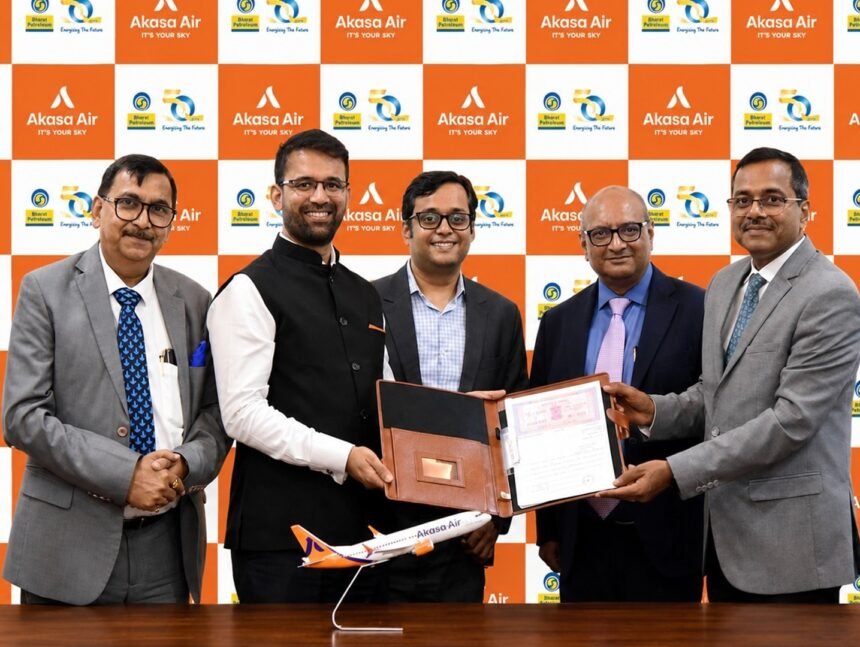
Bharat Petroleum Corporation Limited (BPCL) and Akasa Air have signed a Memorandum of Understanding (MoU) to collaborate on the development and adoption of Sustainable Aviation Fuel (SAF) in India. The partnership marks another significant step toward building a domestic SAF ecosystem while supporting the country’s long-term aviation decarbonisation and clean energy objectives.
- Partnership to Strengthen India’s Sustainable Aviation Ecosystem
- Supporting India’s Aviation Decarbonisation Goals
- BPCL Expands Focus on Green Energy
- Akasa Air Reinforces Sustainability Commitment
- Industry Collaboration Beyond Fuel Supply
- Aligned with Global Sustainability Standards
- Growing Momentum for Sustainable Aviation in India
- Looking Ahead
The agreement, signed on July 14, 2026, reflects the shared commitment of both organisations to reduce aviation emissions by promoting the use of alternative fuels and strengthening India’s sustainable aviation infrastructure.
Partnership to Strengthen India’s Sustainable Aviation Ecosystem
Under the MoU, BPCL and Akasa Air will work together to establish a framework for the supply and offtake of SAF-blended Aviation Turbine Fuel (ATF) at selected airports across India.
The collaboration aims to gradually increase the use of Sustainable Aviation Fuel as production capacity and infrastructure mature within the country.
As part of the partnership, both organisations will also collaborate on:
- Developing long-term SAF supply strategies
- Sharing demand forecasts to improve production planning
- Supporting phased adoption of SAF blending
- Strengthening India’s domestic aviation fuel ecosystem
The initiative is expected to improve fuel availability while helping airlines prepare for future sustainability requirements.
Supporting India’s Aviation Decarbonisation Goals
The aviation sector is under increasing pressure to reduce greenhouse gas emissions, and Sustainable Aviation Fuel has emerged as one of the most promising solutions for lowering the carbon footprint of air travel.
Unlike conventional jet fuel, SAF is produced from sustainable feedstocks and can significantly reduce lifecycle carbon emissions while remaining compatible with existing aircraft engines and airport infrastructure.
The BPCL–Akasa Air collaboration is aligned with India’s broader clean energy transition and efforts to promote low-carbon transportation solutions.
BPCL Expands Focus on Green Energy
As part of its clean energy strategy, BPCL continues to invest in projects that support India’s transition toward sustainable fuels.
The company is currently developing a 61 KTPA Sustainable Aviation Fuel production facility at its Mumbai Refinery, which is expected to play an important role in increasing domestic SAF availability.
BPCL stated that the new agreement complements its existing relationship with Akasa Air while reinforcing its commitment to supporting the aviation sector’s transition toward cleaner fuels.
The company is also investing in operational efficiency and digital innovation through initiatives such as its aviation automation platform, Be-Winged, aimed at enhancing fuel management and aviation operations.
Akasa Air Reinforces Sustainability Commitment
Akasa Air has identified sustainability as a key pillar of its long-term growth strategy.
Through this partnership, the airline aims to strengthen its readiness for SAF adoption while contributing to the development of a reliable domestic supply chain for sustainable aviation fuels.
The collaboration is expected to help the airline prepare for increasing environmental regulations and evolving industry standards focused on reducing aviation-related carbon emissions.
Industry Collaboration Beyond Fuel Supply
Beyond commercial fuel arrangements, the partnership also focuses on broader industry collaboration.
Both organisations intend to work together on:
- Knowledge sharing and technical collaboration
- Policy advocacy for sustainable aviation fuels
- Engagement with government agencies
- Collaboration with industry stakeholders
- Supporting the development of a favourable regulatory environment for SAF adoption
These efforts are expected to accelerate the growth of India’s emerging Sustainable Aviation Fuel ecosystem.
Aligned with Global Sustainability Standards
The BPCL–Akasa Air partnership supports international efforts to decarbonise the aviation sector.
The initiative aligns with global sustainability frameworks such as the International Civil Aviation Organization’s (ICAO) Carbon Offsetting and Reduction Scheme for International Aviation (CORSIA), which encourages airlines worldwide to reduce carbon emissions through the adoption of cleaner aviation fuels and other sustainability measures.
As countries continue working toward net-zero commitments, Sustainable Aviation Fuel is expected to become a critical component of the aviation industry’s long-term climate strategy.
Growing Momentum for Sustainable Aviation in India
India’s aviation sector is witnessing increasing momentum toward cleaner operations as airlines, fuel suppliers, and policymakers work together to reduce emissions without compromising operational efficiency.
Collaborations such as the one between BPCL and Akasa Air are expected to strengthen domestic production capabilities, improve fuel accessibility, and position India as an emerging player in the global Sustainable Aviation Fuel market.
Looking Ahead
The partnership between BPCL and Akasa Air represents an important milestone in India’s journey toward sustainable aviation.
By combining fuel production expertise with airline operational capabilities, both organisations aim to accelerate SAF adoption, strengthen domestic supply chains, and support India’s ambition to build a cleaner, more resilient aviation ecosystem.
As investment in green fuels continues to grow, collaborations like this are expected to play a crucial role in reducing aviation emissions and advancing the country’s net-zero aspirations.
MS Dhoni Invests in SolarSquare as Rooftop Solar Startup Raises $53 Million Series C Funding