

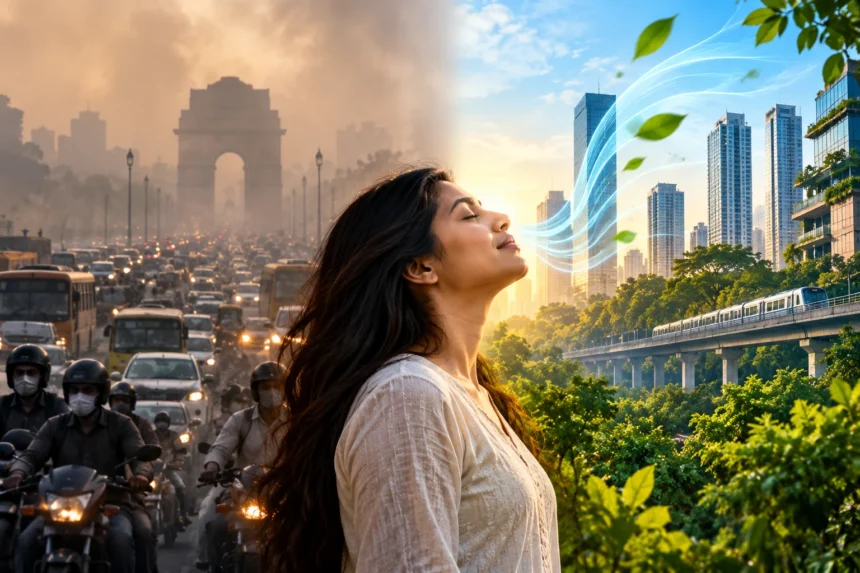
October, 27, 2026 – In September 2026, Delhi recorded its cleanest September in five years, with an average AQI of 102. By 21 October, the city’s index had climbed to 244 and slipped into the “poor” band. That one-month swing captures the state of clean air in India today: it is seasonal, it is unequal, and for a growing number of households it is something you buy rather than something you simply have.
- The baseline: no Indian breathes “safe” air
- The 2025 scorecard: India’s cities still top the global list
- Delhi in 2026: better Septembers, the same Octobers
- The human cost, in deaths
- How clean air became a product
- The catch: a purifier protects a room, not a life
- What would make clean air public again
- Key numbers at a glance
- Frequently asked questions
Here is what the latest data says about air quality in India, what it costs in years of life, and how a basic public good quietly turned into a premium product.
The baseline: no Indian breathes “safe” air
Start with the most uncomfortable number. According to the University of Chicago’s Air Quality Life Index (AQLI) 2025, all 1.4 billion Indians live in places where fine particulate pollution (PM2.5) is above the WHO guideline of 5 µg/m³.
It gets worse when you use India’s own, far looser yardstick of 40 µg/m³. Nearly 46% of Indians live in areas that fail even that national standard.
The health bill is measured in years:
- The average Indian loses 3.5 years of life expectancy to polluted air.
- A Delhi-NCR resident loses 8.2 years, the steepest loss of any city in the world.
- Bihar (5.6 years), Haryana (5.3 years) and Uttar Pradesh (5 years) follow.
- AQLI estimates bad air takes nearly twice as many life-years as childhood and maternal malnutrition, and over five times as many as unsafe water and sanitation.
In other words, air pollution is not one health issue among many. It is the largest external threat to an Indian’s lifespan.
The 2025 scorecard: India’s cities still top the global list
IQAir’s World Air Quality Report 2025, released in March 2026, offered a little relief and a lot of warning.
- India ranked as the 6th most polluted country, down from 5th the year before.
- 66 of the world’s 100 most polluted cities were in India.
- Loni in Ghaziabad was the most polluted city on the planet, with an annual PM2.5 average of 112.5 µg/m³, more than 22 times the WHO limit and roughly 23% worse than in 2024.
- New Delhi was the world’s most polluted capital for the 8th year running, at 82.2 µg/m³.
India’s national average did dip by about 3%. But the report’s lead scientist said the fall was not statistically significant. Put simply, the needle has barely moved.
Delhi in 2026: better Septembers, the same Octobers
The capital’s 2026 numbers show why one good month should not be confused with a trend.
- An independent analysis of CPCB bulletins put Delhi’s January–September 2026 average AQI at 167.6, slightly worse than 164.3 in the same period of 2025.
- September 2026 averaged 102, a five-year low.
- The first week of October averaged 171, the second-worst start to October in six years.
- Between 2021 and 2025, Delhi’s average AQI jumped from about 100 in September to 212 in October. It more than doubles, every year, as stubble fires, festive emissions and still winter air combine.
The pattern is predictable enough to plan around. Which is exactly what people with money now do.
The human cost, in deaths
Two studies in The Lancet Planetary Health turned the AQI into mortality figures.
- Long-term exposure to PM2.5 is linked to about 1.5 million additional deaths a year in India, compared with a scenario where the WHO guideline is met (2009–2019 data across 655 districts).
- Every 10 µg/m³ rise in annual PM2.5 was tied to 8.6% higher mortality.
- Short-term spikes alone were linked to about 33,000 deaths a year across 10 major cities. In Delhi, around 12,000 deaths a year, or 11.5% of all deaths, were attributed to PM2.5 above WHO levels.
- Even Shimla, the cleanest city in that study, recorded 59 such deaths a year. There is no truly safe level.
How clean air became a product
When the air outside does not improve, the market moves indoors. India now has a fast-growing clean air economy.
Air purifiers. IMARC Group values India’s air purifier market at about USD 579 million in 2025, and expects it to reach roughly USD 1.8 billion by 2034, growing at around 13.5% a year. HEPA-filter machines make up about 45% of sales, and portable units about 67%, a sign that most buyers are protecting one room at a time.
Wider air treatment. Future Market Insights puts the broader category, including purifiers and related systems, at over USD 1.7 billion in 2025, rising to an estimated USD 5.8 billion by 2036.
Homes. Filtration has moved from brochure extra to a core selling point in premium housing. In NCR, so-called wellness homes with advanced air filtration, cross-ventilation and green buffers can command a 10–30% price premium, according to industry estimates. One Bengaluru luxury project even launched with an outdoor purification tower rated to clean 1.3 million cubic metres of air an hour.
Hotels. Luxury hotels in Delhi, Mumbai and Bengaluru now market filtered air as part of the stay. In December 2024, a photo of a five-star Bengaluru hotel advertising clean air as a service went viral, sparking a national debate on whether a basic necessity had become a perk.
This is the clearest sign of a luxury good: something everyone needs, that only some can reliably get, and that the market has learned to price.
The catch: a purifier protects a room, not a life
The clean air economy has a hard ceiling. A purifier cleans a bedroom. It does not clean a commute, a school playground, a construction site or a street stall.
The people with the highest exposure are usually those with the least protection: delivery riders, traffic police, construction labourers, auto drivers and street vendors spend most of the day outdoors in the same air the purifier is keeping out. Clean air, bought privately, protects the few who can afford it while the many breathe what is left.
That is why calling clean air a “luxury” is not just a catchy headline. It describes a real and widening gap in who gets to stay healthy in an Indian city.
What would make clean air public again
The fixes are well known. The gap is in delivery.
- Hit the targets already set. The National Clean Air Programme aims to cut particulate levels by 40% by 2026 across 131 non-attainment cities. Few are close.
- Meet our own standard first. AQLI estimates that simply meeting India’s 40 µg/m³ standard would add about 1.5 years to the average Indian’s life.
- Govern by airshed, not by state. PM2.5 can travel hundreds of kilometres. Delhi cannot clean its air without Punjab, Haryana and Uttar Pradesh acting together.
- Monitor where people actually live. India has about 1,600 monitoring stations, heavily skewed towards big cities. Large parts of rural India, where biomass burning is common, remain unmeasured.
- Enforce, then expand. Delhi’s rule from 1 October 2026, which allows fuel only for vehicles with a valid pollution certificate, checked by number-plate cameras, is a start. The test is whether it holds through November.
Key numbers at a glance
| Indicator | Figure | Source |
|---|---|---|
| Indians living above WHO PM2.5 guideline | 1.4 billion (100%) | AQLI 2025 |
| Life expectancy lost, average Indian | 3.5 years | AQLI 2025 |
| Life expectancy lost, Delhi-NCR | 8.2 years | AQLI 2025 |
| India’s rank, most polluted countries | 6th | IQAir 2025 |
| Indian cities in world’s 100 most polluted | 66 | IQAir 2025 |
| World’s most polluted city | Loni, 112.5 µg/m³ | IQAir 2025 |
| Delhi PM2.5, annual | 82.2 µg/m³ | IQAir 2025 |
| Delhi avg AQI, Jan–Sep 2026 | 167.6 | CPCB data analysis |
| Deaths linked to long-term PM2.5 | ~1.5 million a year | Lancet Planetary Health |
| India air purifier market, 2025 | ~USD 579 million | IMARC |
| India air purifier market, 2034 (est.) | ~USD 1.8 billion | IMARC |
| Premium for NCR wellness homes | 10–30% | Industry estimates |
Frequently asked questions
Is clean air really a luxury in India? In practice, increasingly yes. No Indian lives in air that meets WHO guidelines, so cleaner air at home now depends on purifiers, filtered homes and premium spaces that only some households can afford.
How much does air pollution reduce life expectancy in India? By about 3.5 years for the average Indian, and by 8.2 years for residents of Delhi-NCR, according to AQLI 2025.
How big is India’s air purifier market? About USD 579 million in 2025, projected to reach roughly USD 1.8 billion by 2034 at around 13.5% annual growth.
Why does Delhi’s air get worse every October? Crop stubble burning in neighbouring states, festive firecrackers, vehicle and construction emissions, and cooler, stiller weather that traps pollutants near the ground. Delhi’s AQI typically more than doubles between September and October.
What is a safe PM2.5 level? The WHO recommends an annual average of 5 µg/m³ or less. India’s national standard is 40 µg/m³.
Vikram Solar Wins 289.87 MWp Solar Module Order for NLC India’s 810 MW Rajasthan Project