

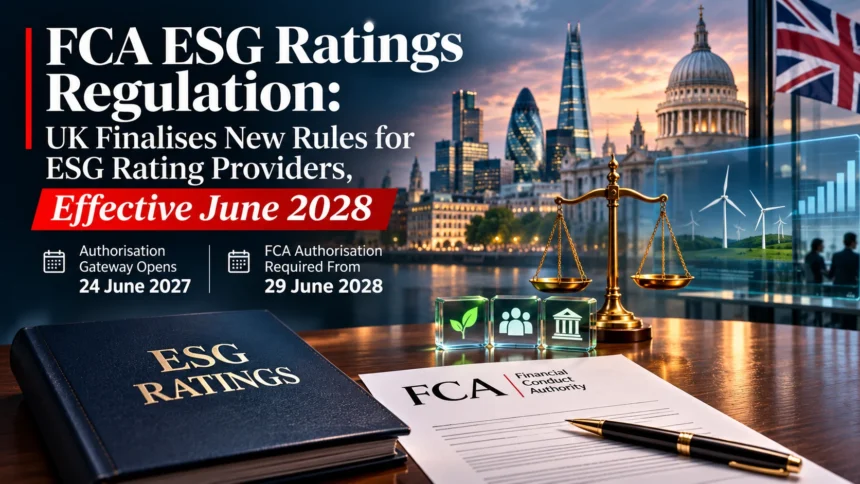
13 November 2026 – The UK is taking a significant step towards greater accountability in sustainable finance. The Financial Conduct Authority (FCA) has published Policy Statement PS26/22, titled ESG Ratings: Final Regime, establishing a dedicated regulatory framework for providers of environmental, social and governance (ESG) ratings.
- What Does FCA Policy Statement PS26/22 Mean for ESG Rating Providers?
- FCA Will Regulate ESG Rating Processes, Not Prescribe Scores
- ESG Ratings Authorisation: Key Dates and Implementation Timeline
- What Activities and Consumer Protections Are Excluded?
- Why Is the UK Regulating ESG Ratings Providers?
- Implications for Global ESG Rating Agencies and Investors
- UK and EU ESG Ratings Regulation: What Should Businesses Watch?
- What Happens Next?
The new FCA ESG ratings regulation will bring rating providers serving UK users within the financial regulatory framework for the first time. From 29 June 2028, firms conducting regulated ESG ratings activities will generally need FCA authorisation and the appropriate regulatory permission, subject to specified exclusions.
The decision addresses longstanding concerns about the ESG ratings market, particularly inconsistent assessments, limited transparency and potential conflicts of interest. ESG scores increasingly influence investment decisions, portfolio construction, corporate assessments and sustainability-linked financial products. However, the processes behind those scores have often been difficult for investors and rated companies to understand.
The final framework is designed to strengthen confidence in ESG ratings without requiring providers to adopt a single definition of sustainability or a common scoring methodology.
What Does FCA Policy Statement PS26/22 Mean for ESG Rating Providers?
Under FCA PS26/22, firms providing ESG ratings to users in the UK will generally be required to obtain regulatory authorisation before carrying out the relevant activity from 29 June 2028.
The framework introduces expectations around several areas of business conduct, including:
- Governance and accountability: Providers will need appropriate governance arrangements and oversight of their ESG ratings activities.
- Transparency: Firms will face requirements designed to improve the information available about their ratings and the processes behind them.
- Systems and controls: Providers must maintain suitable operational arrangements to manage their ratings activities.
- Conflict-of-interest management: Firms will need to identify, manage and address conflicts that could affect the independence of their assessments.
- Engagement with stakeholders: The framework addresses how rating providers interact with users of their ratings and the companies being assessed.
These measures are intended to make ESG rating services more accountable and improve the information available to investors, financial institutions and rated businesses.
The FCA’s approach also places emphasis on the responsibilities of individuals overseeing regulated activities. The UK’s Senior Managers and Certification Regime will apply to authorised ESG ratings providers, creating clearer personal accountability within regulated firms.
FCA Will Regulate ESG Rating Processes, Not Prescribe Scores
An important feature of the UK’s ESG ratings final regime is its focus on how ratings are produced and communicated rather than what the final sustainability assessment should say.
The FCA is not introducing a mandatory ESG scoring formula or requiring all rating agencies to use the same methodology. Providers will retain the ability to develop their own approaches, including how they assess environmental, social and governance factors.
Instead, the regulator is concentrating on the quality of the processes supporting those assessments. This includes governance, transparency, controls and the management of conflicts of interest.
This distinction matters because ESG ratings can reflect different analytical perspectives. One provider may place greater emphasis on climate-related risks, while another may give more weight to workforce practices, board oversight or broader social indicators.
The FCA’s objective is to improve confidence in the way ratings are managed and presented without removing methodological diversity from the market.
ESG Ratings Authorisation: Key Dates and Implementation Timeline
The transition to the new framework will give ESG ratings providers time to prepare their businesses and apply for the necessary regulatory permissions.
The authorisation application gateway is expected to open in 2027, with the regulatory regime taking effect on 29 June 2028.
Providers operating in the UK market should use this transition period to review their governance structures, internal controls, disclosures, conflict-management procedures and senior management responsibilities.
Key implementation dates:
- 2027: Expected opening of the FCA authorisation application gateway.
- 29 June 2028: The new ESG ratings regulatory regime comes into force.
- Before implementation: Firms should assess whether their activities fall within the regulatory perimeter and prepare for the authorisation process.
The transition period will be particularly important for international rating agencies that serve clients across several jurisdictions. They may need to align their UK compliance arrangements with regulatory obligations in other major markets.
What Activities and Consumer Protections Are Excluded?
The FCA has also clarified the limits of its new framework.
The final regime does not introduce bespoke prudential capital requirements specifically for ESG ratings activities. It also excludes several existing UK consumer-protection mechanisms, including:
- The Consumer Duty.
- Financial Ombudsman Service jurisdiction.
- Financial Services Compensation Scheme protection.
These exclusions are important when considering what the new rules are designed to achieve.
The framework focuses primarily on the conduct, governance and transparency of ESG ratings providers. It should not be interpreted as creating a general consumer compensation or redress mechanism for investors dissatisfied with an ESG score.
For institutional users, asset managers and companies assessed by rating agencies, the emphasis will instead be on better-governed ratings processes and clearer information about how ratings are produced.
Why Is the UK Regulating ESG Ratings Providers?
ESG ratings have become an important part of the sustainable investment ecosystem. Asset managers use them to evaluate companies, construct portfolios and support sustainability-related investment strategies. Banks and other financial institutions may also consider ESG assessments when evaluating counterparties and financial risks.
However, different rating providers can reach substantially different conclusions about the same company.
These differences can arise from variations in data sources, assessment criteria, weightings, estimates and definitions of material ESG issues. As a result, a company may receive significantly different assessments from separate providers.
For investors, this can make it difficult to compare businesses or determine what a particular ESG score actually represents. Companies being assessed may also struggle to understand the reasons behind their ratings or identify how their performance could be evaluated differently.
The FCA’s new rules seek to address these concerns by improving the governance and transparency of the ratings process.
Rather than regulating only how financial institutions use ESG scores, the UK is introducing direct oversight of the providers producing them.
Implications for Global ESG Rating Agencies and Investors
The new UK ESG ratings regulation for 2028 has implications beyond domestic rating providers.
International organisations serving UK clients will need to consider whether their activities fall within the FCA’s regulatory perimeter. Major ESG data and ratings businesses with international operations may therefore need to review their authorisation requirements and compliance arrangements.
For asset managers, banks and investment firms, stronger governance and transparency requirements could provide additional information when evaluating ESG ratings from different providers.
Companies receiving ESG assessments may also benefit from improved clarity around rating processes and engagement expectations. However, the new framework does not guarantee that different providers will reach identical conclusions about the same organisation.
The regulatory change could therefore improve confidence in the ratings market while leaving methodological differences intact.
UK and EU ESG Ratings Regulation: What Should Businesses Watch?
The UK’s framework is emerging as an important reference point as other jurisdictions develop their own approaches to ESG ratings oversight.
The European Union is pursuing a separate regulatory framework for ESG rating activities. Differences between the UK and EU approaches could create additional compliance considerations for providers operating across both markets.
For multinational rating agencies, regulatory divergence may mean maintaining separate processes, disclosures and governance arrangements to meet different requirements.
Investors and rated companies will also be watching how these frameworks affect the availability, transparency and comparability of ESG assessments.
The key question is whether stronger process-level regulation will meaningfully improve confidence in ratings while preserving the analytical independence of individual providers.
What Happens Next?
The next major milestone is the opening of the FCA’s authorisation application gateway in 2027.
ESG ratings providers should begin reviewing their regulatory exposure and preparing for the transition well before the June 2028 implementation date. This includes assessing internal governance, senior management accountability, data processes, disclosures and potential conflicts of interest.
For the wider sustainable finance market, the longer-term test will be whether the new requirements make ESG ratings easier to understand, evaluate and use.
The FCA has established a framework for greater oversight, but the impact on consistency and market confidence will become clearer only after the rules have been implemented.
For investors, businesses and ESG ratings providers, the message is clear: transparency and accountability are becoming increasingly important to the credibility of sustainable finance.
India Climate Change Performance Index 2027: Rank Falls to 28th