
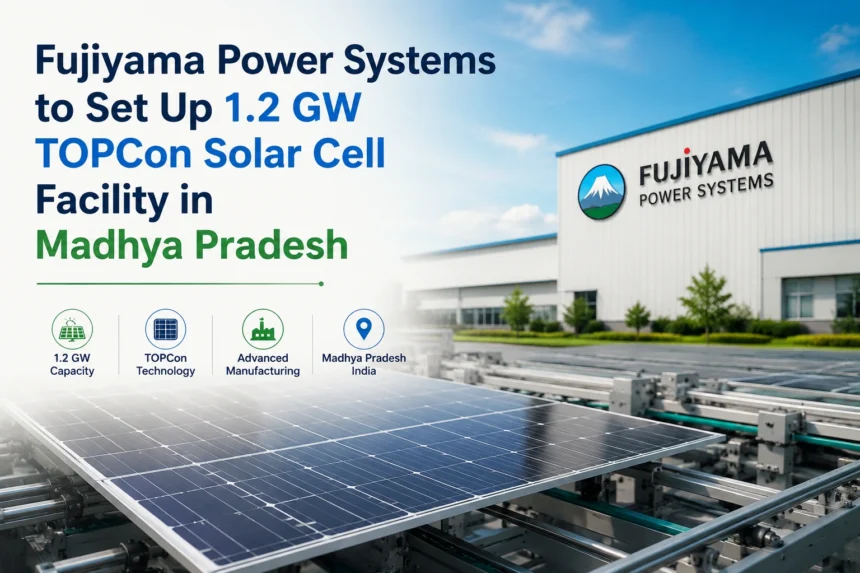
Fujiyama Power Systems has announced plans to expand its solar manufacturing operations with the approval of a new 1.2 GW TOPCon solar cell manufacturing facility at its Ratlam plant in Madhya Pradesh.
- Major Expansion in Solar Manufacturing Capacity
- ₹350 Crore Investment Planned
- Focus on Advanced TOPCon Solar Technology
- Strengthening Backward Integration Strategy
- ALMM-II Regulations Expected to Boost Domestic Demand
- Company Sees Opportunity Under PM Surya Ghar Scheme
- India’s Renewable Energy Manufacturing Push Continues
- Conclusion
The investment marks a significant step in the company’s strategy to strengthen its integrated solar manufacturing ecosystem and increase domestic production capacity for advanced solar technologies in India.
Major Expansion in Solar Manufacturing Capacity
Fujiyama Power Systems currently operates a 1 GW Mono PERC solar cell manufacturing facility at its Dadri plant in Uttar Pradesh.
With the addition of the 1.2 GW TOPCon facility in Ratlam, the company aims to significantly enhance its manufacturing capabilities across the solar value chain.
The Ratlam plant is expected to begin commercial production during the first quarter of FY2028.
₹350 Crore Investment Planned
According to the company, the project will require an estimated investment of ₹350 crore.
The expansion will be funded through a combination of:
- Internal accruals
- Debt financing
Industry experts believe the move reflects growing confidence in India’s renewable energy manufacturing sector as domestic demand for solar equipment continues to rise.
Focus on Advanced TOPCon Solar Technology
The new facility will manufacture TOPCon (Tunnel Oxide Passivated Contact) solar cells, an advanced solar technology known for:
- Higher efficiency levels
- Better energy generation performance
- Improved durability
- Enhanced output in different weather conditions
TOPCon technology is increasingly being adopted globally as solar manufacturers shift toward next-generation photovoltaic solutions.
Strengthening Backward Integration Strategy
Fujiyama said the new facility forms a key part of its:
- Backward integration strategy
- Technology upgradation roadmap
- Domestic supply chain strengthening efforts
The company expects the expansion to help:
- Reduce cost volatility
- Improve gross margins
- Ensure stable availability of DCR-compliant solar cells
- Strengthen competitiveness in the rooftop solar market
The company is particularly focused on expanding its presence in India’s growing B2C rooftop solar segment.
ALMM-II Regulations Expected to Boost Domestic Demand
The timing of the expansion aligns with the implementation of ALMM-II regulations for solar photovoltaic cells from June 1, 2026.
The Approved List of Models and Manufacturers (ALMM-II) framework is expected to significantly increase demand for:
- India-made solar cells
- DCR-compliant solar panels
- Domestic renewable energy components
Industry analysts believe the policy will accelerate investments in local solar manufacturing while reducing dependence on imported solar equipment.
Company Sees Opportunity Under PM Surya Ghar Scheme
Pawan Kumar Garg, Chairman and Joint Managing Director of Fujiyama Power Systems, said the expansion would strengthen the company’s position in India’s rooftop solar market.
He noted that Fujiyama’s inclusion in the Ministry of New and Renewable Energy’s ALMM-II list for solar cells places the company in a stronger position to meet rising domestic demand.
The company also expects growth opportunities under the:
- Pradhan Mantri Surya Ghar Muft Bijli Yojana
The government initiative aims to accelerate rooftop solar adoption among Indian households through subsidies and clean energy incentives.
India’s Renewable Energy Manufacturing Push Continues
India has been rapidly scaling domestic renewable energy manufacturing as part of its:
- Net-zero goals
- Energy transition strategy
- Energy security plans
- Make in India initiatives
The country is increasingly investing in:
- Solar cell manufacturing
- Solar module production
- Battery storage systems
- Integrated clean energy supply chains
Experts believe advanced solar technologies such as TOPCon will play a critical role in India’s next phase of renewable energy growth.
Conclusion
Fujiyama Power Systems’ new TOPCon solar cell facility highlights the growing momentum in India’s clean energy manufacturing sector.
As rooftop solar adoption, policy support, and domestic demand for renewable energy infrastructure continue to rise, investments in advanced solar manufacturing technologies are expected to become increasingly important for India’s long-term sustainability and energy transition goals.