
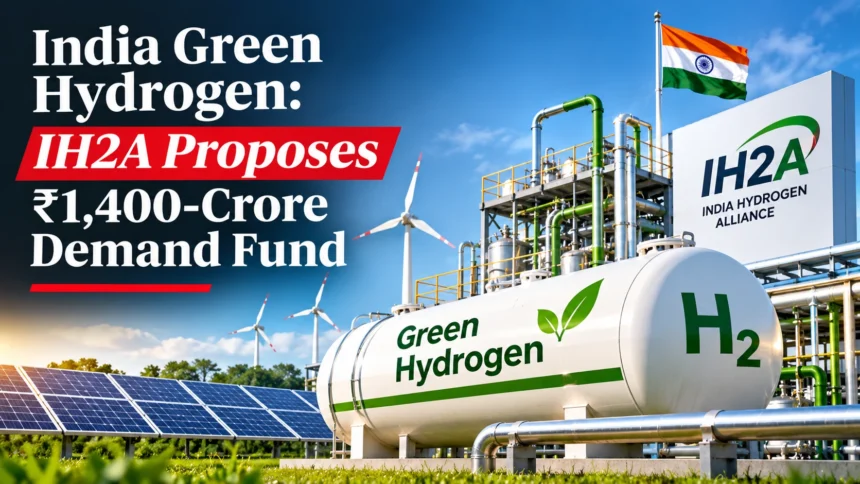
ENVIRONMENT | INDIA | 23 NOVEMBER 2026 – India’s ambition to become a global hub for green hydrogen is facing an important market challenge: turning production capacity into sustained industrial demand.
- How the Proposed ₹1,400-Crore Green Hydrogen Fund Would Work
- Why India’s Green Hydrogen Mission Needs Demand-Side Incentives
- IH2A Proposes 10% Green Hydrogen Purchase Obligation by 2030
- Five Priorities in IH2A’s Green Hydrogen Agenda
- Green Hydrogen in India: Key Numbers
- Why the Proposal Matters for India’s Energy Transition
- What Happens Next?
- India’s Green Hydrogen Market Needs Buyers as Much as Producers
The India Hydrogen Alliance (IH2A), an industry coalition representing green hydrogen producers and technology developers, has proposed a ₹1,400-crore (approximately $150 million) Contract-for-Difference (CfD) funding mechanism to encourage industrial consumers to purchase green hydrogen.
The proposal is part of a broader five-point agenda submitted to the government. It seeks to address what the alliance identifies as a significant gap in India’s National Green Hydrogen Mission: while production incentives have encouraged investment in manufacturing and supply capacity, industrial buyers still face limited financial motivation to replace conventional hydrogen with its more expensive green alternative.
IH2A argues that without stronger demand-side incentives, project development and industrial adoption could struggle to keep pace with India’s green hydrogen ambitions.
How the Proposed ₹1,400-Crore Green Hydrogen Fund Would Work
The proposed CfD mechanism is designed to reduce the price difference between green hydrogen and conventional hydrogen alternatives.
Under the proposal, the ₹1,400-crore fund would provide $1.50 per kilogram in offtake support, covering up to 100,000 metric tonnes of green hydrogen.
A Contract-for-Difference arrangement generally compensates for an agreed price gap between a reference price and a contracted price. In this case, the proposed mechanism would help make green hydrogen more commercially attractive to industrial buyers.
The intended beneficiaries include hydrogen-intensive sectors such as:
- Oil refineries
- Steel manufacturing
- Fertiliser production
- Chemical industries
These industries currently have economic reasons to continue using conventional hydrogen, which can be cheaper than green hydrogen.
By supporting the purchase price rather than focusing exclusively on production costs, IH2A wants to encourage buyers to enter into long-term offtake agreements.
Such agreements could give producers greater revenue visibility, improve project bankability and help move green hydrogen projects beyond pilot-scale operations.
Why India’s Green Hydrogen Mission Needs Demand-Side Incentives
India’s National Green Hydrogen Mission has focused significantly on building the supply ecosystem, including incentives for electrolyser manufacturing and green hydrogen production.
However, IH2A argues that production capacity alone cannot create a sustainable market.
Industrial consumers must be willing to purchase green hydrogen at commercially viable prices. Without reliable demand, producers may find it difficult to secure long-term customers, even when production facilities and technology are available.
The alliance’s proposal highlights the difference between encouraging companies to manufacture green hydrogen and creating a market in which industrial users are financially motivated to buy it.
This demand-side challenge is particularly relevant for refineries, fertiliser manufacturers and steelmakers, where hydrogen is an important industrial input.
IH2A Proposes 10% Green Hydrogen Purchase Obligation by 2030
Another major recommendation in the alliance’s five-point agenda is a proposed Green Hydrogen Purchase Obligation.
IH2A has recommended that large refineries, fertiliser plants, steelmakers and chemical manufacturers be required to source 10% of their hydrogen requirements from green hydrogen by 2030.
The proposed mechanism draws on the concept of renewable purchase obligations, which have been used to encourage electricity distribution companies and other obligated entities to procure renewable power.
A similar framework for green hydrogen could create predictable demand across industrial sectors.
For producers, a defined purchase obligation could improve visibility into future sales. For industrial consumers, it would establish a clearer pathway towards replacing fossil-based hydrogen with lower-carbon alternatives.
The recommendation remains an industry proposal and should not be confused with an already implemented nationwide purchase mandate.
Five Priorities in IH2A’s Green Hydrogen Agenda
Beyond the proposed funding mechanism and purchase obligation, IH2A has outlined additional measures intended to strengthen India’s green hydrogen ecosystem.
1. Contract-for-Difference funding
A ₹1,400-crore funding pool to support industrial green hydrogen purchases and reduce the cost gap between green and conventional hydrogen.
2. Green Hydrogen Purchase Obligation
A proposed requirement for major industrial consumers to source 10% of their hydrogen from green sources by 2030.
3. National low-carbon hydrogen standard
A certification framework to establish emissions thresholds and allow buyers, regulators and export markets to verify the carbon intensity of hydrogen production.
4. Green steel procurement requirements
Proposed procurement mandates encouraging automotive, construction and infrastructure companies to source a share of their steel from green-hydrogen-based production.
5. National hydrogen skilling programme
A dedicated workforce development initiative covering hydrogen production, storage, infrastructure and industrial applications.
Together, these recommendations address several challenges facing the industry, including financing, demand creation, certification, downstream market development and workforce readiness.
Green Hydrogen in India: Key Numbers
- ₹1,400 crore: Proposed size of the Contract-for-Difference fund.
- Approximately $150 million: Estimated dollar value of the proposed funding pool.
- $1.50 per kg: Proposed offtake support for green hydrogen purchases.
- 100,000 metric tonnes: Green hydrogen volume the proposed fund is designed to support.
- 10% by 2030: Proposed Green Hydrogen Purchase Obligation for selected industrial sectors.
Why the Proposal Matters for India’s Energy Transition
The IH2A proposal could have implications extending beyond the green hydrogen industry.
Industrial decarbonisation: Steel, fertiliser and refining industries are important targets for emissions reduction. Greater green hydrogen adoption could help these sectors reduce dependence on fossil-based hydrogen.
Investment confidence: Producers and technology developers need reliable buyers to secure long-term revenue and attract investment. Stronger offtake commitments could improve project economics.
Green steel development: Access to commercially viable green hydrogen could support lower-carbon steelmaking, creating opportunities for manufacturers and downstream industries.
Export competitiveness: A credible low-carbon hydrogen certification framework could help Indian producers demonstrate emissions performance to international buyers.
Employment and skills: Expanding production, storage and distribution infrastructure will require specialised technical capabilities and trained workers.
For companies preparing sustainability disclosures under India’s BRSR framework, credible adoption of green hydrogen could also become relevant to industrial emissions reduction strategies and decarbonisation reporting.
What Happens Next?
The next important development will be whether the government considers IH2A’s recommendations while reviewing the National Green Hydrogen Mission and its future policy priorities.
Several questions remain:
- Will the government establish a dedicated CfD fund, and will its structure match the proposed ₹1,400-crore framework?
- Will a Green Hydrogen Purchase Obligation be introduced for major industrial consumers?
- How will India establish a national certification standard for low-carbon hydrogen?
- Will green steel procurement requirements help create additional demand?
- Can the country develop the skilled workforce needed to support large-scale hydrogen infrastructure?
The response from industrial buyers will also be important. Voluntary long-term purchase agreements could provide an early indication of whether the demand gap can be addressed through commercial partnerships or whether stronger policy intervention will be necessary.
India’s Green Hydrogen Market Needs Buyers as Much as Producers
India has made progress in developing its green hydrogen production ecosystem, but the next stage of growth will depend on whether industrial consumers are ready to adopt the fuel at scale.
IH2A’s ₹1,400-crore proposal highlights a central issue for the country’s energy transition: production incentives can encourage capacity creation, but sustained demand is essential to make projects commercially viable.
If the proposed CfD mechanism, purchase obligations and supporting policy measures gain government consideration, they could help bridge the gap between green hydrogen production and industrial consumption.
For India’s green hydrogen ambitions to translate into meaningful industrial decarbonisation, building supply will not be enough. The country must also create a market that is ready to buy.
Sources: Energetica India, PV Magazine India and Renewable Watch. This article is an original editorial rewrite based on the supplied reporting and source material.
NGT Seeks Centre’s Response on PFAS ‘Forever Chemicals’ in India’s Drinking Water