

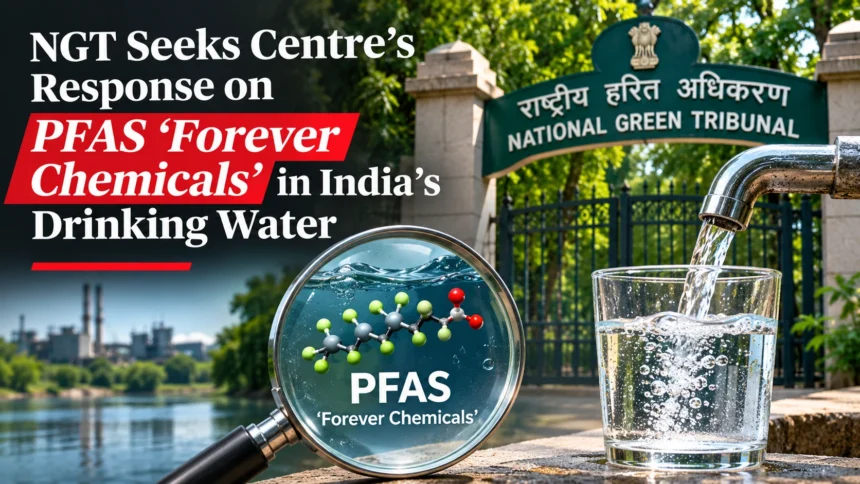
ENVIRONMENT | INDIA | 23 NOVEMBER 2026 – The National Green Tribunal (NGT) has taken suo motu cognisance of concerns surrounding the presence of per- and polyfluoroalkyl substances (PFAS), commonly known as “forever chemicals”, in India’s water sources.
- NGT Seeks Responses from Five Authorities and Institutions
- Why PFAS Are Called Forever Chemicals
- Why Conventional Water Treatment May Not Be Enough
- India’s Drinking Water Standards Face a Regulatory Gap
- PFAS Contamination: Key Facts and Numbers
- Why the NGT Proceedings Matter for India’s ESG Agenda
- What to Watch Next
- A Turning Point for Emerging Contaminant Regulation?
The tribunal has issued notices to the Union Ministry of Environment, Forest and Climate Change, the Central Pollution Control Board (CPCB), the Bureau of Indian Standards (BIS) and two research institutions, seeking responses to reports that conventional water treatment plants may not effectively remove these persistent chemical compounds.
The matter follows media reporting published on October 15, 2026, highlighting concerns about the ability of India’s water treatment infrastructure to filter PFAS from drinking water.
The tribunal’s intervention comes amid questions about India’s regulatory preparedness. The country’s drinking water standard, IS 10500:2012, does not currently prescribe PFAS-specific limits, while the regulatory framework governing these substances remains under examination.
Research conducted by the University of Hyderabad has also detected PFAS compounds in samples collected around Visakhapatnam, adding a domestic research dimension to the growing environmental concern.
NGT Seeks Responses from Five Authorities and Institutions
In its November 20 order, a bench led by NGT Chairperson Justice Prakash Shrivastava included five authorities and institutions as respondents in the matter:
- Union Ministry of Environment, Forest and Climate Change
- Central Pollution Control Board (CPCB)
- Bureau of Indian Standards (BIS)
- CSIR’s Indian Institute of Toxicology Research
- Indian Institute of Technology Madras (IIT Madras)
The tribunal has directed the respondents to submit affidavit-based responses at least one week before the next hearing.
The proceedings consider both the media report and research findings from the University of Hyderabad. Researchers tested 77 different PFAS compounds in seawater and sewage samples collected around Visakhapatnam in July 2026 and reported detectable contamination.
The findings have added to concerns about the presence of these substances in Indian water environments and the country’s capacity to monitor and manage emerging contaminants.
Why PFAS Are Called Forever Chemicals
PFAS refers to a large group of synthetic chemicals used in a range of industrial and consumer applications.
They are commonly associated with products and processes such as:
- Non-stick cookware coatings
- Firefighting foams
- Waterproof and stain-resistant textiles
- Industrial surfactants
- Certain protective coatings and specialised manufacturing applications
These substances are often described as forever chemicals because many PFAS compounds are highly resistant to environmental degradation.
Their strong carbon-fluorine chemical bonds make them difficult to break down through many natural and conventional treatment processes. As a result, certain PFAS compounds can persist in the environment and may accumulate in water, soil and living organisms.
This persistence has made PFAS contamination an increasingly important issue for environmental regulators and water-quality authorities internationally.
Why Conventional Water Treatment May Not Be Enough
One of the central concerns raised in the reporting is that conventional municipal water treatment processes are not necessarily designed to remove PFAS compounds.
Traditional treatment methods, including coagulation, flocculation and chlorination, are primarily designed to remove suspended particles and reduce microbial contamination. They may not effectively eliminate dissolved PFAS substances.
Specialised treatment technologies that can help remove certain PFAS compounds include:
Granular activated carbon: Adsorbs selected PFAS compounds from water, although performance depends on the chemicals present and operating conditions.
Ion exchange resins: Can capture certain PFAS substances through specialised filtration media.
Reverse osmosis: Uses membrane filtration to remove many dissolved contaminants, including several PFAS compounds.
The availability, cost and effectiveness of these technologies can vary depending on the PFAS compounds involved and the treatment system’s design.
The issue therefore extends beyond detecting contamination. Water authorities also need suitable monitoring systems, treatment capabilities and clear standards against which water quality can be assessed.
India’s Drinking Water Standards Face a Regulatory Gap
A major concern in the case is the absence of PFAS-specific limits in India’s current drinking water quality standard, IS 10500:2012.
According to the supplied reporting, the Environment Ministry has confirmed that India does not currently have a regulation specifically banning PFAS manufacturing.
However, the regulatory position is being examined as part of the revision of the drinking water standard.
BIS has informed the tribunal that it has constituted a working group on emerging contaminants. The group is examining PFAS thresholds alongside other substances that are not specifically covered by the existing standard.
The development could become important for future drinking water monitoring, regulatory compliance and treatment requirements.
Until specific limits and monitoring requirements are established, questions remain about how PFAS contamination should be measured, reported and addressed across India’s water supply systems.
PFAS Contamination: Key Facts and Numbers
- 77 PFAS compounds: Tested by University of Hyderabad researchers in seawater and sewage samples collected around Visakhapatnam in July 2026.
- 5 respondents: The authorities and research institutions included in the NGT proceedings.
- No PFAS-specific limit: India’s IS 10500:2012 drinking water standard currently does not prescribe a dedicated PFAS limit.
- One week: Minimum period before the next hearing by which respondents have been directed to submit their affidavit replies.
Why the NGT Proceedings Matter for India’s ESG Agenda
The case has implications for public health protection, environmental governance, industrial compliance and water-resource management.
1. Greater scrutiny of water quality
The proceedings could encourage closer examination of emerging contaminants that are not routinely addressed by conventional water-quality monitoring programmes.
2. Stronger regulatory standards
The review of IS 10500 could provide an opportunity to consider specific PFAS thresholds and more comprehensive monitoring requirements.
3. Investment in water treatment infrastructure
If future standards require PFAS removal, municipal utilities and industrial operators may need to assess whether their existing treatment facilities are adequate.
4. Greater industrial accountability
Businesses using PFAS-containing materials or chemicals may face increased scrutiny over chemical management, wastewater treatment and environmental reporting.
5. Emerging ESG risk for investors
PFAS exposure could become an increasingly relevant consideration for investors assessing water-related risks, environmental liabilities and supply-chain practices.
For companies operating in sectors that use specialised coatings, firefighting materials, textiles and industrial chemicals, the issue may also create future compliance and disclosure considerations.
What to Watch Next
The next stage of the proceedings will depend on the responses submitted by the five respondents.
Several developments will be important:
- Whether BIS’s working group proposes specific PFAS limits during the revision of IS 10500.
- Whether CPCB identifies additional locations or industrial sources requiring investigation.
- Whether the Environment Ministry outlines a clearer regulatory approach to PFAS manufacturing and use.
- Whether India’s water authorities consider expanded monitoring and specialised treatment requirements.
The responses could help establish whether the issue remains focused on the reported contamination around Visakhapatnam or develops into a wider national discussion on PFAS regulation and drinking water safety.
A Turning Point for Emerging Contaminant Regulation?
The NGT’s intervention has placed PFAS contamination firmly on India’s environmental governance agenda.
The immediate challenge is to establish a clearer understanding of where these substances are present, how they enter water systems and what measures are required to control their movement through the environment.
As India reviews its drinking water standards and strengthens environmental monitoring, PFAS could become an important test of the country’s ability to respond to emerging chemical risks.
Protecting water quality will require more than conventional treatment. It will demand stronger scientific monitoring, clear regulatory thresholds and accountability across the industrial and municipal water ecosystem.
Sources: ANI, The Wire and Awaz-The Voice. This article is an original editorial rewrite based on the supplied reporting and source material.