

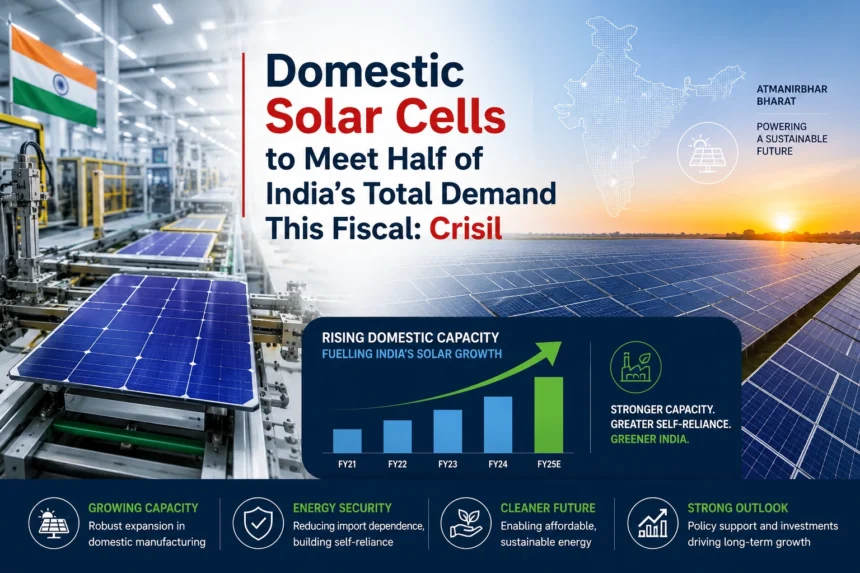
India’s solar manufacturing sector is poised for a major transformation, with domestically produced solar cells expected to meet nearly half of the country’s total demand during fiscal year 2026-27, according to a new assessment by Crisil Ratings.
- Policy Support Accelerates Domestic Solar Manufacturing
- Domestic Cells to Capture a Larger Share of India’s Solar Market
- Solar Cell Manufacturing Capacity Set to Double
- Profitability Pressures Could Extend Payback Periods
- Backward Integration May Improve Long-Term Returns
- Demand Risks Remain a Key Monitorable
- India’s Solar Manufacturing Ecosystem Enters a New Growth Phase
The projected increase marks a significant jump from the previous fiscal year, when locally manufactured cells accounted for only about one-fourth of overall demand. The shift is being driven by government initiatives aimed at reducing import dependence and strengthening India’s renewable energy manufacturing ecosystem.
Policy Support Accelerates Domestic Solar Manufacturing
The growth in domestic solar cell production follows a series of policy measures introduced by the Ministry of New and Renewable Energy (MNRE) to encourage local manufacturing across the solar photovoltaic (PV) value chain.
After implementing the Approved List of Models and Manufacturers (ALMM) framework in April 2024, the government expanded localization requirements through the introduction of the Approved List of Cell Manufacturers (ALCM).
The ALCM framework, which comes into effect from June 2026, mandates the use of approved domestically manufactured solar cells for utility-scale renewable energy projects with bid submission dates after August 31, 2025. The regulation also applies to net-metering and open-access projects commissioned after June 1, 2026.
However, residential rooftop solar installations under the PM Surya Ghar: Muft Bijli Yojana will remain exempt from the requirement until March 31, 2027.
 Domestic Cells to Capture a Larger Share of India’s Solar Market
According to Crisil, India’s total solar cell demand is expected to reach approximately 60–65 GW during FY27.
The ratings agency estimates that local manufacturers will supply nearly half of this requirement, while imports will continue to meet the remaining demand, particularly for projects that were approved before the implementation of the new localization rules.
Manish Gupta, Deputy Chief Ratings Officer at Crisil Ratings, noted that the ALCM policy is expected to significantly alter India’s solar supply mix.
Demand for indigenous solar cells is likely to be supported by new utility-scale renewable energy projects, net-metering installations, open-access projects, and government-backed initiatives such as the Kisan Urja Suraksha Evam Utthaan Mahabhiyan (KUSUM) scheme.
As older projects dependent on imported components are completed, India’s reliance on imported solar cells is expected to decline substantially over the coming years.
Solar Cell Manufacturing Capacity Set to Double
To capitalize on growing demand, several domestic manufacturers are investing heavily in new production facilities and capacity expansions.
Crisil estimates that India’s cumulative solar cell manufacturing capacity could nearly double to approximately 60 GW by the end of FY27, with additional projects expected to come online in subsequent years.
While this rapid expansion strengthens India’s manufacturing self-sufficiency, it may also create challenges for manufacturers.
An increase in supply could lead to lower capacity utilization rates and reduced pricing power, potentially impacting profitability across the industry.

Profitability Pressures Could Extend Payback Periods
Industry analysts believe that the influx of new manufacturing capacity may alter project economics for solar cell producers.
Early entrants into solar cell manufacturing benefited from higher margins, favorable pricing, and relatively limited competition. These companies typically achieved payback periods of four to five years after stabilizing operations.
However, Crisil expects newer manufacturing facilities commissioned during FY27 to face longer recovery timelines, with payback periods potentially extending by one to two additional years.
According to Ankit Hakhu, Director at Crisil Ratings, the growing number of market participants is likely to narrow the profitability advantages enjoyed by early movers.
As more production capacity enters the market, competition could intensify, reducing premiums and affecting overall returns on investment.
Backward Integration May Improve Long-Term Returns
Industry experts suggest that manufacturers investing beyond solar cell production and moving into upstream segments such as ingot and wafer manufacturing could be better positioned for long-term profitability.
Currently, India remains heavily dependent on imports for solar wafers and ingots, creating supply chain vulnerabilities and exposing manufacturers to price fluctuations.
The government’s proposed implementation of ALMM III, covering solar ingots and wafers from June 2028 onward, could create additional opportunities for companies pursuing deeper vertical integration.
Such investments may enable manufacturers to capture greater value across the solar supply chain while improving margins and reducing import dependence.
Demand Risks Remain a Key Monitorable
Despite strong policy support and growing manufacturing capacity, several factors could affect market growth.
One key concern is the potential delay in power purchase agreement (PPA) signings, which could slow project execution and reduce near-term demand for solar modules and cells.
In addition, the MNRE has established an expert committee to review requests for ALCM exemptions from developers of certain net-metering and open-access projects that have already installed imported modules or made substantial progress toward implementation.
Any significant exemptions granted under this process could temporarily impact demand for domestically manufactured solar cells.
India’s Solar Manufacturing Ecosystem Enters a New Growth Phase
The combination of policy support, rising renewable energy demand, and substantial manufacturing investments is positioning India as a major global solar manufacturing hub.
As the country accelerates its clean energy transition and seeks to strengthen supply chain resilience, domestic solar cell production is expected to play a critical role in reducing import dependence and supporting India’s ambitious renewable energy targets.
While profitability challenges may emerge as capacity expands, the sector’s long-term outlook remains closely tied to the country’s growing renewable energy ambitions and continued policy support for local manufacturing.