

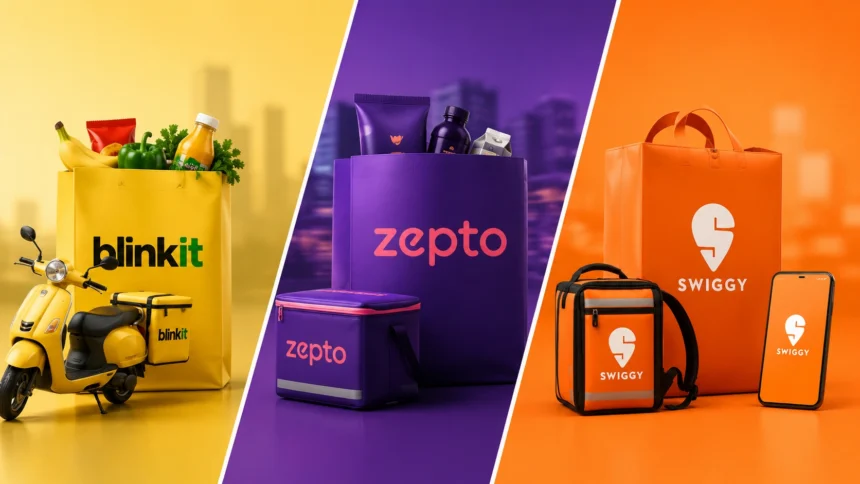
India’s new waste management rules have reclassified quick commerce platforms as brand owners and bulk waste generators. For a sector processing hundreds of millions of orders a year, the compliance clock is already running.
For three years, Blinkit, Zepto and Swiggy Instamart competed on one axis above all others: speed. Ten minutes to your door. The race for dark store density, delivery radius, and order volume defined the sector. Sustainability, if it appeared at all, was a footnote in investor presentations — a voluntary gesture, not a structural obligation.
That calculus changed on 1 April 2026.
India’s Solid Waste Management Rules 2026 and the Plastic Waste Management Amendment Rules 2026, notified by the Ministry of Environment, Forest and Climate Change, have formally reclassified quick commerce platforms as “brand owners,” “aggregators,” and “bulk waste generators” under India’s Extended Producer Responsibility framework. The shift is not semantic. It is legal, enforceable, and backed by penalties of up to ₹15 lakh per violation.
The sector that built itself on convenience now has to account for what it leaves behind.
The Scale of the Problem
To understand why regulators have turned their attention here, consider the numbers.
Blinkit processed 424 million orders in fiscal 2025, with analysts projecting that figure to climb to 863 million in 2026. Swiggy Instamart handled 286 million orders in FY2025, expected to reach 469 million in 2026. Zepto, meanwhile, processes approximately 25 lakh FMCG units each day through its automated systems.
Every one of those orders arrives at a door in packaging. Bubble wrap, multi-layer plastic pouches, single-use carry bags, insulated liners for cold chain products, foam padding for fragile items. The packaging-to-product ratio in quick commerce is often higher than in traditional retail, because the 10-minute promise demands that everything survive a rushed bike journey intact.
India generates over 3.4 million tonnes of plastic waste annually, with a considerable portion still not fully recycled. More than 60,000 producers, importers, and brand owners are already registered under the EPR framework. Quick commerce, as a category, is now joining that registry — not voluntarily, but by law.
Research by Earth5R finds the packaging composition of quick commerce orders particularly challenging from a recycling standpoint. Multi-layer plastic represents 22% of quick commerce packaging waste but achieves only 18% diversion in recovery programmes, due to the near-absence of cost-effective recycling pathways at scale in India. PET and HDPE packaging is typically recovered; bubble wrap, foam, and multi-layer plastic is almost always landfilled or burned — precisely the packaging types that dominate quick commerce volumes.
What the New Rules Actually Require
From 1 April 2026, brand owners, importers, and e-commerce entities must register on the CPCB portal and begin filing half-yearly returns. The first return covers the April to September 2026 period.
The obligations go well beyond registration. Platforms must comply with mandatory collection and recycling targets that increase annually, linked to material types and tonnage placed on the market; quarterly and annual reporting of packaging placed, waste collected, and recycled quantities through digital EPR portals; integration of recycled content moving beyond waste collection toward circularity; and partnerships with authorised processors — verified recyclers and co-processors.
For rigid plastic packaging, the recycled content target has been raised to 60% for the 2026-27 period. Flexible and multi-layer plastics have specific, albeit lower, mandatory recycled content goals. New labelling norms require companies to disclose the percentage of recycled content on packaging — making claims visible and verifiable by both regulators and consumers.
A tradable EPR certificate system has also been formalised. Companies exceeding their recycling targets can sell surplus certificates; those falling short can purchase them. But the framework also introduces independent environmental auditors to verify EPR claims — ending the era of paper-only compliance that critics say allowed widespread non-performance under previous rules.
Operating without registration when covered by EPR rules is a compliance violation. Penalties range from ₹10,000 to ₹15 lakh per violation, with potential daily penalties and permit suspension.
Why This Is Different From Previous ESG Pressure
India’s quick commerce players have not been ignoring sustainability entirely. Blinkit has publicly explored sustainable delivery options, including electric vehicles, as part of its long-term operational roadmap. All three platforms have made references to green commitments in investor communications. But references and registrations are different things.
What changed in 2026 is that the regulatory floor moved from voluntary to mandatory — and it moved decisively. Quick commerce brands are now officially categorised as brand owners, aggregators, and bulk waste generators, bringing heavy explicit liabilities for product life cycles.
This matters for three reasons that go beyond compliance.
First, investor exposure. Quick commerce contributed 19% of Eternal’s (Zomato’s parent) sales in 2024, rising to 26% in FY2025, with analysts expecting the share to reach 60% in 2026 and as high as 75% by 2031. For a sector that now represents the majority of Zomato’s projected future revenue, unresolved ESG liability is balance sheet risk, not just reputational noise. Swiggy, which listed publicly in 2024, faces similar scrutiny from institutional investors who assess ESG compliance as part of their capital allocation decisions.
Second, BRSR exposure. India’s top 1,000 listed companies must now report Scope 3 emissions and value chain sustainability data under SEBI’s mandatory BRSR Core framework. For Zomato (listed) and Swiggy (listed), packaging waste, delivery emissions, and EPR compliance are all now disclosable metrics — which means non-compliance will eventually surface in documents that global investors read.
Third, consumer behaviour is shifting. Earth5R’s survey data reveals that 76% of quick commerce consumers are unaware of the recyclability of the packaging materials they receive, and 68% have no access to compliant disposal infrastructure. As that awareness grows — and as labelling requirements make recycled content visible on every package — consumer preference will increasingly reflect it.
The Opportunity Hidden Inside the Obligation
KPMG India’s National Head of ESG, Namrata Rana, argues that the regulatory shift is not simply a cost to be managed. Rather than treating sustainability as a burden, quick commerce companies can convert sustainability headwinds into new opportunities for driving growth and enhancing customer experience.
Platforms could turn dark stores into community circular packaging hubs — returning to refillable glass or rigid plastic models that effectively build collection infrastructure into the existing delivery network. Dark stores already have the logistics density and last-mile reach to serve as neighbourhood waste collection points. The same delivery champion who drops off an order can pick up empty packaging on the return trip — a model that addresses EPR collection obligations while building brand equity with consumers who are already at the door.
The organic waste opportunity is equally concrete. Near-expiry perishable inventory — which faces strict 2026 shelf-life mandates — can be converted into premium organic manure using on-site micro-composters, creating a new product line that is both compliant and commercially viable.
Voluntary adoption of BRSR Core standards — currently mandatory only for listed companies — offers a further strategic advantage. Platforms that proactively report on sustainability metrics position themselves ahead of compliance requirements and simultaneously make themselves more attractive to international ESG capital, a consideration that matters as quick commerce players approach further funding rounds or secondary listings.
The Broader Signal for Indian E-Commerce
The reclassification of quick commerce platforms as brand owners is not an isolated regulatory moment. It is part of a deliberate and accelerating pattern in India’s approach to producer responsibility.
All producers, importers, and brand owners dealing with plastic packaging are required to register on the Central Pollution Control Board EPR portal. India’s packaging industry is entering a new phase where sustainability, compliance, and accountability are becoming deeply interconnected. The 2026 amendments specifically broaden the regulatory net to include sellers of plastic raw materials — resins, pellets, and similar inputs — for the first time, ensuring that traceability extends across the entire value chain from raw material to final disposal.
For an industry that has spent five years optimising for speed, the next five will require an equivalent investment in accountability. The companies that treat EPR compliance as a floor, and sustainability as a competitive differentiator above it, will be better positioned — with regulators, with investors, and with consumers — than those that wait for enforcement to force their hand.
India generates 3.4 million tonnes of plastic waste a year. Quick commerce adds to that number with every order. The rules now say: track it, reduce it, prove it.
The Cost of Fuel is So High, This Hyderabad Tech Firm is Buying EVs for Its Staff!