
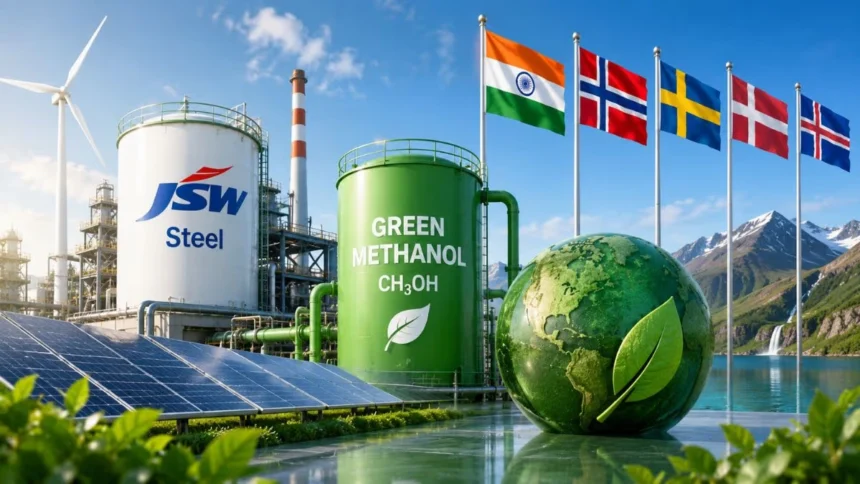
JSW Steel, Bharatia and Carbon Iceland International have signed a strategic Memorandum of Understanding (MoU) to jointly explore the development of a large-scale green methanol (eMethanol) project in India.
- MoU Signed During India–Nordic Summit in Norway
- Proposed Green Methanol Project in Maharashtra
- Focus on Carbon Capture and Utilisation (CCU)
- Roles of the Partner Companies
- India’s Green Fuel and Industrial Decarbonisation Push
- Growing Demand for Green Methanol Globally
- India-Nordic Climate Collaboration Expands
- Conclusion
The agreement marks a major step toward industrial decarbonisation, carbon utilisation, and the development of next-generation sustainable fuel infrastructure.
MoU Signed During India–Nordic Summit in Norway
The MoU signing took place in Oslo, Norway, during the 3rd India–Nordic Summit.
The event was witnessed by:
- Kristrún Frostadóttir
- Benedikt Höskuldsson
The collaboration highlights the growing partnership between India and Iceland in:
- Climate technology
- Sustainable fuels
- Industrial transition
- Clean energy innovation
Senior representatives from all participating organisations attended the signing ceremony.
Proposed Green Methanol Project in Maharashtra
The proposed project is expected to have:
- 300 KTPA (Kilo Tonnes Per Annum) production capacity
The facility aims to utilise:
- Carbon dioxide (CO₂) emissions from JSW Steel’s operations in Raigad district, Maharashtra
The captured emissions will be converted into:
- Green methanol (eMethanol)
using:
- Green hydrogen generated from renewable energy sources
Industry experts believe green methanol could become an important low-carbon fuel for:
- Shipping
- Heavy industries
- Industrial chemicals
- Hard-to-abate sectors
Focus on Carbon Capture and Utilisation (CCU)
The partnership aims to establish a scalable:
- Carbon Capture and Utilisation (CCU) model
for India’s steel sector.
The initiative will evaluate:
- Existing high-purity CO₂ streams at JSW Steel facilities
- Additional carbon capture opportunities across steel operations
The companies said the project could demonstrate how industrial emissions can be transformed into:
- Sustainable fuels
- Low-carbon chemical feedstocks
- Circular industrial resources
Analysts believe CCU technologies will play an increasingly important role in reducing emissions from sectors such as:
- Steel manufacturing
- Cement
- Chemicals
- Shipping
Roles of the Partner Companies
Under the collaboration:
JSW Steel
will contribute:
- Industrial infrastructure
- Operational expertise
- Steel manufacturing capabilities
Bharatia
will support:
- Project development
- Financing pathways
- Ecosystem integration
- Policy and implementation strategy
Carbon Iceland International
will focus on:
- Carbon capture integration
- E-fuels production systems
- Industrial decarbonisation technologies
The companies stated that the project will follow a phased approach beginning with:
- Feasibility studies
- Technical assessments
- Validation processes
before potential commercial-scale implementation.
India’s Green Fuel and Industrial Decarbonisation Push
India has been accelerating investments in:
- Renewable energy
- Green hydrogen
- Sustainable fuels
- Industrial decarbonisation infrastructure
The government has also introduced policies supporting:
- Net-zero targets
- Clean manufacturing
- Green hydrogen production
- Energy transition initiatives
Industry observers say green methanol could emerge as a key component of:
- Future shipping fuels
- Industrial energy systems
- Sustainable chemical manufacturing
Growing Demand for Green Methanol Globally
Global interest in green methanol has been rising as industries seek alternatives to fossil fuels.
Green methanol is increasingly being explored for:
- Maritime transport
- Aviation fuel blending
- Renewable chemicals
- Industrial heating applications
Several global companies are now investing in:
- Carbon capture technologies
- Green hydrogen infrastructure
- E-fuel production facilities
to reduce industrial emissions and meet climate goals.
India-Nordic Climate Collaboration Expands
The agreement also reflects strengthening cooperation between India and Nordic countries in:
- Sustainability
- Clean energy technologies
- Climate innovation
- Green industrial infrastructure
Cross-border collaborations are increasingly being viewed as critical for accelerating:
- Scalable climate solutions
- Industrial decarbonisation
- Technology transfer
- Sustainable manufacturing
particularly across emerging markets and the Global South.
Conclusion
The partnership between JSW Steel, Bharatia, and Carbon Iceland International highlights the growing momentum behind green fuels and industrial decarbonisation initiatives in India.
By combining renewable energy, carbon capture, and green hydrogen technologies, the proposed eMethanol project could help establish a scalable model for low-carbon industrial infrastructure.
As global industries move toward net-zero targets and sustainable fuel adoption, projects focused on carbon utilisation and green fuel production are expected to become increasingly important in the global energy transition.
AI Data Centres Could Double Electricity Consumption by 2030- and What It Means for India