

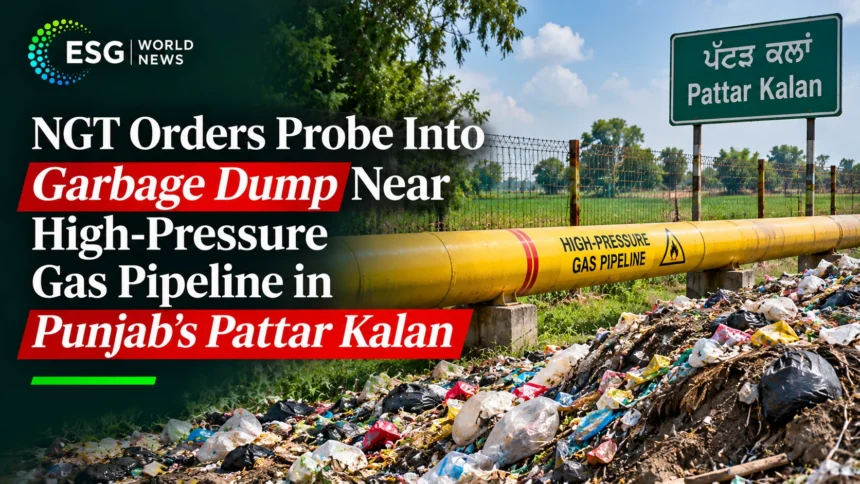
ENVIRONMENT | GOVERNANCE | INDIA | 24 NOVEMBER 2026 – The National Green Tribunal (NGT) has ordered an investigation into an uncontrolled garbage dumping site in Pattar Kalan village of Punjab’s Jalandhar district, bringing renewed attention to gaps in rural solid waste management and local environmental governance.
- NGT Constitutes Five-Member Committee to Investigate Pattar Kalan Dumping Site
- How a Village Waste Management Project Allegedly Failed
- High-Pressure Gas Pipeline Raises Additional Safety Concerns
- Key Facts and Numbers From the NGT Case
- Why the Pattar Kalan Case Matters for Punjab’s Environmental Governance
- What Happens Next?
- A Wake-Up Call for Rural Waste Management in Punjab
The tribunal’s intervention follows a petition alleging that a Gram Panchayat-approved solid waste management project was never properly implemented, allowing waste to accumulate at an unmanaged location just 12 to 15 feet from nearby residential homes.
The complaint has also raised concerns about the proximity of the dumping site to high-pressure gas distribution infrastructure belonging to THINK Gas, including an underground gas pipeline reportedly running beneath or adjacent to the location.
Recognising the need for a coordinated investigation, the NGT has constituted a five-member joint committee comprising senior Punjab government officials, district administrators and pollution-control authorities. The committee has been directed to investigate the allegations, recommend prompt remedial measures if violations are established and submit its report within three months.
NGT Constitutes Five-Member Committee to Investigate Pattar Kalan Dumping Site
The NGT has formed a joint committee involving representatives from five government departments and authorities to examine the situation in Pattar Kalan.
The committee includes:
- Principal Secretary, Punjab Housing and Urban Development Department.
- Principal Secretary, Punjab Local Government Department.
- District Magistrate, Jalandhar.
- District Development Officer, Jalandhar.
- Member Secretary, Punjab State Pollution Control Board (PPCB).
The committee’s responsibilities include verifying the allegations through a ground-level investigation and recommending immediate corrective action if environmental violations are identified.
It must submit its findings to the tribunal within three months.
The involvement of multiple departments reflects the different dimensions of the complaint, which includes waste disposal, local governance, pollution control, residential proximity and concerns relating to gas distribution infrastructure.
How a Village Waste Management Project Allegedly Failed
According to the petition, Pattar Kalan’s Gram Panchayat had approved a solid waste management project intended to improve the village’s waste disposal arrangements.
However, the applicant alleged that the project was never properly implemented. As a result, garbage continued to accumulate at an uncontrolled dumping location rather than being managed through an organised waste-processing system.
The case highlights an important challenge facing rural sanitation programmes: approving a waste management project does not necessarily ensure that it becomes operational or remains functional.
Effective village-level solid waste management requires more than infrastructure approval. It also depends on implementation, waste segregation, regular collection, processing arrangements, funding and monitoring by local authorities.
The NGT investigation will examine whether the allegations concerning the failed project and uncontrolled dumping are supported by the findings on the ground.
High-Pressure Gas Pipeline Raises Additional Safety Concerns
One of the most serious aspects of the Pattar Kalan complaint is the reported presence of THINK Gas’s high-pressure gas distribution infrastructure near the dumping site.
The petition has alleged that an underground gas pipeline runs beneath or close to the garbage dumping area.
This raises concerns beyond the environmental consequences commonly associated with unmanaged waste disposal.
The proximity of a waste accumulation site to gas distribution infrastructure makes it important to establish whether the pipeline’s designated safety requirements and surrounding land-use conditions are being maintained.
The joint committee’s investigation will be important in determining the actual relationship between the dumping site and the pipeline, whether any safety requirements have been compromised and what corrective measures may be necessary.
At this stage, the reported pipeline-related risk remains an allegation requiring verification rather than a confirmed finding of damage or immediate danger.
Key Facts and Numbers From the NGT Case
- 12–15 feet: Reported distance between the garbage dumping site and nearby residential homes.
- Five members: Officials and authorities included in the NGT-appointed joint committee.
- Three months: Deadline for submitting the committee’s investigation report.
- One sanitation project: A Gram Panchayat-approved solid waste management project alleged to have remained unimplemented.
- THINK Gas: The gas distribution company whose high-pressure infrastructure is reportedly located beneath or close to the dumping site.
Why the Pattar Kalan Case Matters for Punjab’s Environmental Governance
The NGT’s intervention has implications for local sanitation administration, environmental protection and infrastructure safety.
1. Accountability in rural waste management
The case raises questions about how approved sanitation projects are monitored and whether local authorities have adequate systems to ensure that waste management infrastructure becomes operational.
2. Protection of residential communities
An unmanaged dumping site located close to homes can create concerns around sanitation, environmental quality and residents’ well-being. The investigation will help establish the extent of the reported problem.
3. Coordination between local bodies and utility providers
The reported proximity of a high-pressure gas pipeline highlights the importance of coordination between village administrations, municipal authorities and infrastructure operators when selecting and managing waste disposal locations.
4. Stronger pollution-control enforcement
The participation of the Punjab State Pollution Control Board gives the investigation an important regulatory dimension, particularly if violations of applicable waste management requirements are established.
5. Better implementation of sanitation programmes
The case underscores the need to evaluate sanitation projects not just on the basis of approval or funding, but also on their actual implementation, operation and long-term maintenance.
What Happens Next?
The joint committee’s findings will determine the next steps in the Pattar Kalan case.
Several developments will be important to watch:
- Whether the committee confirms that the approved village solid waste management project was not properly implemented.
- Whether the reported proximity of the garbage dump to the THINK Gas pipeline creates a violation of applicable safety requirements.
- Whether authorities recommend relocating the dumping site or implementing alternative waste management arrangements.
- Whether the Punjab State Pollution Control Board identifies environmental violations requiring corrective action.
- Whether the findings prompt a broader review of rural waste management infrastructure in Jalandhar district.
The three-month reporting deadline gives the committee a defined period to establish the facts and identify the necessary remedial measures.
A Wake-Up Call for Rural Waste Management in Punjab
The Pattar Kalan case illustrates how weaknesses in local waste management can develop into wider environmental and infrastructure concerns.
An approved sanitation project that does not function effectively can leave communities dealing with unmanaged garbage, while the location of a dumping site near critical infrastructure can introduce additional questions about public safety and administrative oversight.
The NGT’s investigation now places responsibility on Punjab’s government departments and pollution-control authorities to establish the facts and recommend appropriate action.
The larger lesson is clear: sustainable waste management requires more than government approvals. It demands effective implementation, continuous monitoring and accountability at the local level.
Sources: ANI, Down To Earth, The Tribune and Ground Report. This article is an original editorial rewrite based on the supplied reporting and source material.
Tata Steel Plans 10 TPD Hydrogen Project at Kalinganagar Using Steel Plant Off-Gases