

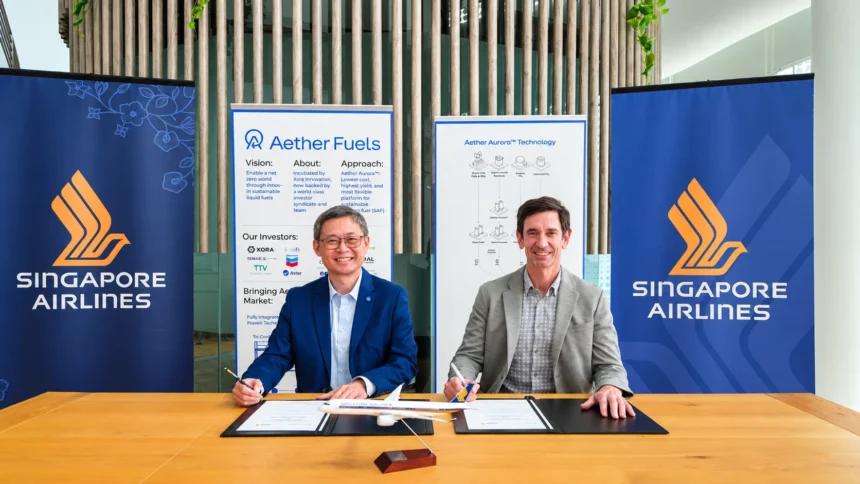
28 October 2026 | ESG World News – Singapore Airlines (SIA) has signed an agreement to purchase up to 4,800 tonnes of sustainable aviation fuel (SAF) from Aether Fuels over three years, with deliveries expected to begin in 2028. The agreement marks a significant step towards developing alternative aviation fuel production pathways in Singapore.
Under the agreement, SIA will purchase fuel produced by Aether Beacon Pte Ltd at Project Beacon, a commercial production facility being developed at Aster’s refining complex on Pulau Bukom, Singapore.
The airline is the first to purchase SAF from Project Beacon, which will use waste-derived carbon feedstocks, including biomethane and industrial waste gases, to produce aviation fuel using Aether’s proprietary Aurora technology.
The deal also represents SIA’s first purchase of sustainable aviation fuel produced through this emerging technology pathway, strengthening its efforts to secure alternative fuels as the aviation sector works towards reducing its carbon footprint.
Project Beacon to Produce Aviation Fuel from Waste Carbon
Project Beacon is designed to convert waste-derived gases into sustainable aviation fuel using Aether’s proprietary Aether Aurora technology.
The process draws on the Fischer-Tropsch synthesis pathway, which can convert suitable carbon-containing gases into liquid fuels. By using feedstocks such as biomethane and industrial waste gases, the technology offers an alternative to conventional SAF production routes that rely on lipid-based materials, including used cooking oils and animal fats.
The availability of sustainable feedstocks is an important consideration for the aviation industry’s transition to lower-carbon fuels. Waste-derived carbon technologies could help diversify the range of resources available for SAF production, although their overall climate benefits depend on feedstock sourcing, processing methods, energy inputs and lifecycle emissions.
The SAF produced at Project Beacon is expected to be certified under the Carbon Offsetting and Reduction Scheme for International Aviation (CORSIA), the international framework established to address emissions from international aviation.
Certification requirements are important because the environmental benefits of alternative aviation fuels depend on their lifecycle greenhouse gas performance and compliance with recognised sustainability criteria.
Singapore Airlines Strengthens Its Aviation Decarbonisation Strategy
The agreement supports Singapore Airlines’ longer-term ambition to achieve net-zero carbon emissions by 2050.
Sustainable aviation fuel is widely viewed as one of the key options for reducing emissions from commercial aviation, particularly on routes where electrification and other emerging propulsion technologies are difficult to deploy at scale.
However, expanding SAF adoption remains challenging. Production costs, access to sustainable feedstocks, technology readiness and the availability of commercial-scale facilities all influence how quickly these fuels can enter the aviation supply chain.
By committing to purchase fuel from Project Beacon, SIA is helping establish demand for an emerging production pathway while working to secure future supplies.
Lee Wen Fen, Chief Sustainability Officer of Singapore Airlines, said supporting SAF development and securing future supplies are integral to the airline’s net-zero ambition. She also highlighted the importance of working with partners to expand production capacity and strengthen the aviation industry’s sustainability ecosystem.
The agreement demonstrates how airline procurement commitments can support the development of new fuel production technologies. Actual emissions reductions will depend on the quantity of SAF delivered, the fuel’s lifecycle emissions profile and the conventional aviation fuel it replaces.
Aether Fuels Plans Larger-Scale SAF Production by 2031
Aether Fuels plans to expand beyond Project Beacon as it works to establish a larger commercial SAF production base.
The company intends to begin operations at its first large-scale commercial plant by 2031, with planned production capacity at least ten times greater than that of Project Beacon.
The proposed expansion reflects the wider industry effort to move next-generation aviation fuels from early commercial facilities towards larger-scale production.
Conor Madigan, Co-Founder and Chief Executive Officer of Aether Fuels, said the agreement represents an important step since the company and Singapore Airlines signed a memorandum of understanding the previous year.
Madigan pointed to Singapore’s refining and aviation infrastructure, investment support and sustainability policies as important factors supporting the development of aviation decarbonisation solutions.
The binding purchase agreement also signals demand from a major international airline, an important factor for companies seeking to establish commercially viable production facilities.
The planned expansion remains dependent on successful project development, financing, technology execution and the availability of suitable feedstocks.
Why Sustainable Aviation Fuel Matters for the Aviation Industry
Aviation is a difficult sector to decarbonise because aircraft require fuels with high energy density, particularly for medium- and long-haul journeys.
SAF can help address this challenge because compatible fuels can be used in existing aircraft and infrastructure, subject to applicable fuel standards and blending requirements. This makes SAF an important near- and medium-term option for reducing aviation’s lifecycle emissions.
Different SAF production pathways offer different advantages and limitations. Some use oils and fats, while others rely on alcohol-based processes, synthetic fuels or waste-derived gases. Their environmental performance varies according to feedstock availability, conversion efficiency, energy sources and lifecycle emissions.
Waste-carbon technologies could broaden the range of feedstocks available for aviation fuel production. However, their contribution to climate goals must be assessed through lifecycle analysis rather than fuel origin alone.
For airlines, long-term purchase agreements can help provide demand certainty to producers. For fuel developers, these commitments can support investment decisions and the development of commercial production facilities.
The Singapore Airlines–Aether agreement illustrates how cooperation between fuel developers and airlines can support the development of alternative SAF production technologies.
Singapore’s Role in Sustainable Aviation Fuel Development
Singapore’s position as an international aviation and refining hub provides an important setting for the development of alternative aviation fuels.
Project Beacon is being developed within an existing refining complex on Pulau Bukom, connecting emerging fuel-production technology with established industrial infrastructure.
The project also aligns with broader efforts to develop lower-carbon aviation fuel capabilities and support the transition towards more sustainable air transport.
As the industry seeks to increase SAF production, the ability to establish reliable supply chains and bring new technologies to commercial scale will be critical.
The planned start of deliveries in 2028 will be an important milestone for the partnership. Aether’s proposed larger-scale facility, targeted for 2031, could represent a further step if the expansion proceeds as planned.
What This Means for the Future of Green Aviation
The agreement between Singapore Airlines and Aether Fuels combines an airline’s long-term fuel procurement strategy with an emerging technology designed to produce aviation fuel from waste-derived carbon feedstocks.
With up to 4,800 tonnes of SAF scheduled for delivery over three years from 2028, the partnership provides a commercial pathway for Project Beacon while supporting Singapore’s ambitions in lower-carbon fuel production.
The longer-term impact will depend on the project’s operational performance, the lifecycle emissions of its fuel and Aether’s ability to expand production capacity.
As airlines explore multiple approaches to decarbonisation, partnerships that connect technology development, fuel supply and committed demand will remain central to the growth of the sustainable aviation fuel market.
ESG World News Insight: The next phase of aviation decarbonisation will depend not only on developing alternative fuels but also on making them available at commercial scale with measurable lifecycle emissions benefits.
Oyster Renewable Energy Advances Phase 2 of Its Wind-Solar Hybrid Project in Madhya Pradesh