
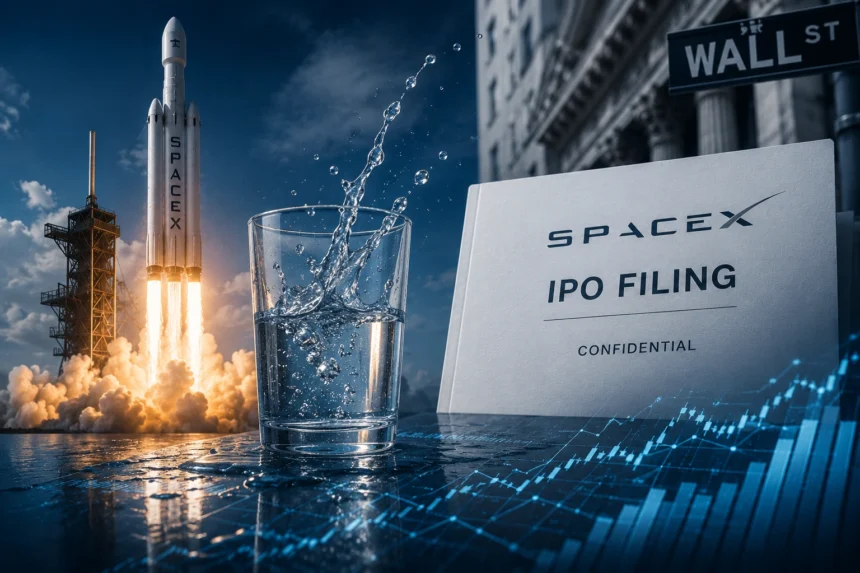
For decades, water was an environmental concern — the domain of NGOs, regulators, and local protests. Then, on June 1, 2026, SpaceX filed an amended S-1 registration statement with the SEC. Buried inside it, alongside the familiar warnings about power supply and chip availability, was a new line of risk language that nobody expected to see in a rocket company’s IPO filing: water.
The filing warns that “water scarcity, drought conditions, competition for local water resources, or regulatory restrictions on water use” could limit SpaceX’s ability to cool its data centres, constrain expansion, raise costs, and force the adoption of more expensive cooling alternatives.
Water had officially joined the investment risk ledger. It won’t be leaving.
The Three Constraints of the AI Age
For years, the AI infrastructure story was told through two bottlenecks: power and chips. Could utilities deliver enough electricity? Could NVIDIA manufacture enough GPUs? These were the variables that shaped data centre site selection, capital expenditure, and competitive positioning.
SpaceX’s updated S-1 — filed ahead of what could be the largest IPO in US market history — adds a third constraint that is arguably harder to solve than the other two. You can build more power plants. You can ramp up semiconductor fabs. You cannot manufacture water.
The company is not describing an active shortage. It does not identify a specific delayed project. But the disclosure matters precisely because of what it signals: that the legal teams, auditors, and SEC comment-letter reviewers who scrub IPO filings for material risk now consider water access a financially meaningful variable — one serious enough to require a formal warning to investors before they put their money in.
Notably, the amended prospectus does not mention climate change anywhere in its risk factors. The physical consequences of a warming planet — drought, water stress, extreme heat — appear to be considered real enough to warrant disclosure. Their cause, apparently, is not.
 How Much Water Does AI Actually Use?
The numbers are staggering, and they are accelerating.
US data centres used roughly 17 billion gallons for direct cooling in 2023. When indirect water use — the water consumed by power plants generating the electricity those data centres run on — is included, the figure rises to an estimated 211 billion gallons. By 2025, total water consumption by AI data centres had broken 264 billion gallons annually. Projections suggest that figure could double or quadruple by 2028.
A single large data centre can consume up to five million gallons of water per day — equivalent to the daily water needs of between 10,000 and 50,000 people. A 2025 study estimated that AI could consume between 312 and 764 billion litres of water in that year alone. A June 2026 UN report warned that AI could be using as much water as 1.3 billion people by 2030.
SpaceX’s own AI operations give a sense of the scale at play. Its AI segment — operating massive GPU clusters under the Colossus brand — spent $7.7 billion in capital expenditure in the first quarter of 2026 alone, more than double the Space and Connectivity segments combined. In May, the company signed a cloud services agreement with Anthropic, granting access to approximately 325,000 NVIDIA GPUs. Anthropic agreed to pay $1.25 billion per month through May 2029. That single contract generates more quarterly revenue than SpaceX’s entire Starlink subscriber base across 164 countries. The infrastructure supporting that contract needs to be cooled. Cooling requires water.
The Ground Is Already Shifting
SpaceX’s disclosure doesn’t arrive in a vacuum. Across the US and beyond, communities have been fighting back against data centre development with mounting effectiveness.
Between early 2023 and March 2025, 142 activist groups in 24 states — crossing party lines — organised efforts that resulted in an estimated $64 billion worth of US data centre projects being stalled or stopped outright. A more recent figure from Data Center Watch puts the toll even higher: between March and June 2025 alone, community opposition led to $98 billion in projects being blocked or delayed. A Heatmap Pro review found that at least 25 projects were cancelled in 2025 in direct response to local objections.
Water has been the flashpoint in many of those battles. In 2024, Google shelved a planned facility outside Santiago, Chile after a court partially revoked its permits over water concerns. In Tucson, Arizona, a proposal called “Project Blue” would draw millions of gallons of drinking water from the desert for cooling purposes — residents and environmentalists have organised vigorously in opposition. In Utah’s Great Salt Lake region, a 40,000-acre data centre project has sparked fierce local resistance over its water demands in an area already under severe drought stress.
The politics are combustible. A recent Gallup poll found that seven in ten Americans oppose data centre development in their communities. Water scarcity ranked as their single top concern — ahead of electricity costs, noise, and land use. In Indianapolis, opposition to a Google data centre project was so fierce the company withdrew its rezoning request; the announcement was met with loud cheers in the council chamber. The intensity of the backlash has not stayed peaceful everywhere: in April 2026, an Indianapolis city councillor who had supported a data centre project had 13 bullets fired at his home. A note reading “No Data Centers” was found at the scene.
A Problem Without an Easy Fix
What makes water different from power and chips is the absence of a straightforward technological escape route.
The industry has pursued more water-efficient cooling approaches — air cooling, liquid cooling, closed-loop systems — but these technologies come with their own cost and performance trade-offs. SpaceX’s prospectus acknowledges this directly, warning that alternative cooling techniques may be “more costly or less available.” Some hyperscalers have explored locating facilities near coastlines or rivers, but those choices carry their own regulatory and ecological complications.
The geography of AI infrastructure and the geography of US drought risk are increasingly, uncomfortably overlapping. Nearly 63% of the US was experiencing drought conditions in 2025. The Sun Belt states — Texas, Arizona, Nevada — that have attracted enormous data centre investment are precisely the regions facing the most severe long-term water stress. The irony is sharp: the data centres training AI systems that predict climate patterns and optimise agricultural water use are themselves competing with farms and households for the same shrinking resource.
What It Means That SpaceX Said This
IPO filings are legal documents. They are written carefully, reviewed extensively, and carry real liability if material risks are omitted. When a company of SpaceX’s profile — filing for what could be one of the largest stock market debuts in history — adds new language to its risk section about water, it is not doing so casually.
This is how capital markets formalise a concern. Environmental and community opposition is one kind of pressure. Regulatory friction is another. But the moment a resource constraint appears in an S-1 risk factor, it becomes something different: a financial variable that investors must price, that analysts must model, and that site-selection teams can no longer treat as someone else’s problem.
Water has moved from the protest line to the prospectus. That is a meaningful shift — and for an industry that has moved extraordinarily fast, it may prove to be one of the slowest problems it has ever had to solve.