

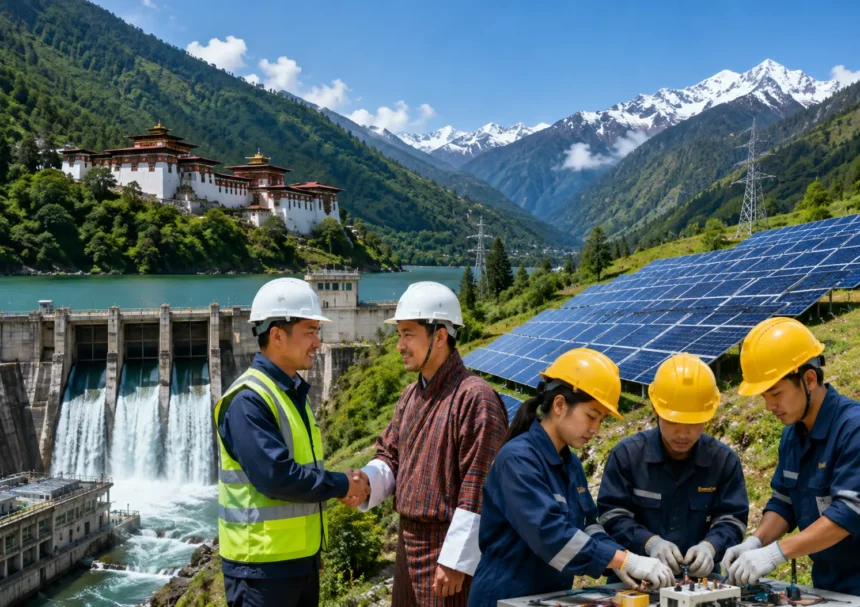
Tata Power and Druk Green Power Corporation (DGPC) have signed a Memorandum of Understanding (MoU) to strengthen workforce development for Bhutan’s rapidly expanding clean energy sector.
- Partnership to Support Bhutan’s Renewable Energy Goals
- Tata Power Skill Development Institute to Lead Training
- Three-Phase Training Programme Planned
- Phase 1: Safety and Worker Induction
- Phase 2: Technical Construction Skills
- Phase 3: Long-Term Operations and Maintenance
- Bhutan Expanding Hydropower and Solar Capacity
- Growing Focus on Green Skills and Clean Energy Jobs
- Tata Power Expands Renewable Energy and Sustainability Initiatives
- Conclusion
The partnership comes as Bhutan accelerates plans to build a large renewable energy portfolio, including hydropower and solar energy projects over the coming decade.
The agreement was signed in Thimphu in the presence of Tshering Tobgay and senior officials from both organisations.
Partnership to Support Bhutan’s Renewable Energy Goals
Under the agreement, Tata Power and DGPC will jointly develop a skill development ecosystem focused on training manpower for:
- Construction of renewable energy projects
- Operations and maintenance activities
- Technical workforce development
- Clean energy infrastructure support
The initiative aims to create a trained local workforce capable of supporting Bhutan’s long-term clean energy expansion plans.
Bhutan is currently scaling renewable energy capacity through major investments in:
- Hydropower projects
- Solar energy developments
- Sustainable energy infrastructure
Tata Power Skill Development Institute to Lead Training
The training programme will be managed by the Tata Power Skill Development Institute (TPSDI).
TPSDI will provide:
- Technical expertise
- Training infrastructure
- Course materials
- Certification and accreditation support
Meanwhile, DGPC will:
- Mobilise trainees
- Coordinate with Bhutanese authorities
- Align training programmes with national energy priorities
Tata Power will also work with Indian authorities to secure necessary approvals for the initiative.
Three-Phase Training Programme Planned
According to the companies, the workforce development initiative will be implemented in three phases.
Phase 1: Safety and Worker Induction
The initial phase will focus on:
- Worker safety training
- Site induction programmes
- Deployment readiness
Phase 2: Technical Construction Skills
The second phase will provide training in:
- Material handling
- Construction support
- Earth-moving equipment operations
- Renewable energy project execution skills
Phase 3: Long-Term Operations and Maintenance
The final phase will focus on:
- Operations management
- Asset maintenance
- Long-term renewable energy workforce capability building
Industry experts believe workforce development will become increasingly important as clean energy infrastructure projects expand globally.
Bhutan Expanding Hydropower and Solar Capacity
Bhutan currently operates:
- 3,473 MW of hydropower capacity
The country now plans to expand renewable energy generation to:
- 15,000 MW hydropower capacity
- 5,000 MW solar energy capacity
over the next decade.
The renewable energy expansion forms part of Bhutan’s broader sustainability and energy transition strategy.
Growing Focus on Green Skills and Clean Energy Jobs
Governments and energy companies across Asia are increasingly investing in:
- Green workforce development
- Renewable energy training
- Sustainable infrastructure skills
- Clean energy employment ecosystems
Industry analysts say the transition toward renewable energy will create significant demand for skilled workers in areas such as:
- Solar installation
- Hydropower engineering
- Grid operations
- Energy storage
- Infrastructure maintenance
Tata Power Expands Renewable Energy and Sustainability Initiatives
Tata Power has been actively expanding its clean energy and sustainability initiatives across:
- Renewable power generation
- Solar rooftop projects
- EV charging infrastructure
- Green energy partnerships
- Skill development programmes
The company has also focused on building training ecosystems to support India and neighbouring countries in their energy transition efforts.
Conclusion
The partnership between Tata Power and Bhutan’s DGPC highlights the growing importance of workforce development in supporting the clean energy transition.
As Bhutan accelerates investments in hydropower and solar energy infrastructure, the collaboration is expected to help build a strong local talent pipeline for the country’s future renewable energy ecosystem.
The initiative also reflects a broader regional trend where clean energy growth is increasingly being linked with skill development, sustainable employment, and long-term energy security.