

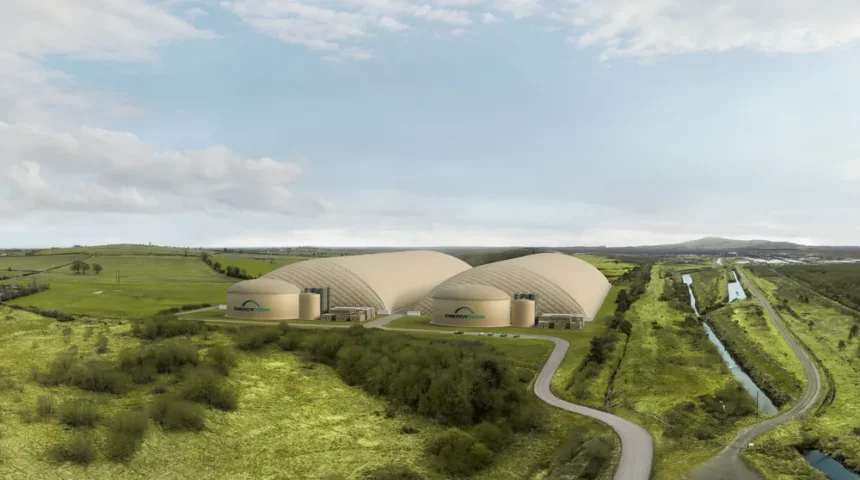
Google and Italian energy storage company Energy Dome have announced plans to develop a 23 MW/200 MWh long-duration energy storage facility in Ireland, marking the first commercial project under their strategic partnership to scale Energy Dome’s innovative CO2 Battery technology globally.
- First Commercial Deployment Under Strategic Partnership
- Why Long-Duration Energy Storage Matters
- How Energy Dome’s CO2 Battery Technology Works
- Supporting Renewable Energy Integration
- Supporting Google’s 24/7 Carbon-Free Energy Goal
- Leadership Commentary
- Backed by Long-Term Capacity Contract
- Accelerating the Global Energy Transition
The project will be built at a former thermal power station near Rhode, Ireland, and is expected to play a significant role in supporting renewable energy integration, improving grid reliability, and advancing Google’s goal of achieving 24/7 carbon-free energy across its operations.
First Commercial Deployment Under Strategic Partnership
The Ireland project represents the first commercial implementation of a broader partnership announced by Google and Energy Dome in 2025. The collaboration aims to accelerate the deployment of long-duration energy storage technologies across Europe, North America, and the Asia-Pacific region.
As renewable energy generation continues to expand globally, long-duration storage systems are becoming increasingly important to address the intermittent nature of solar and wind power while ensuring a stable and reliable electricity supply.

Why Long-Duration Energy Storage Matters
Energy storage has emerged as a critical component of the global energy transition. While renewable energy sources such as solar and wind are rapidly expanding, their variable generation patterns create challenges for power grids.
Long-duration energy storage solutions help bridge this gap by storing excess electricity during periods of high renewable generation and releasing it when demand rises or renewable output declines.
These technologies are becoming even more important as electricity demand grows due to:
- Electric vehicle adoption
- Industrial electrification
- Data centres
- Artificial intelligence (AI) computing infrastructure
- Smart city development
How Energy Dome’s CO2 Battery Technology Works
Founded in 2019 and headquartered in Milan, Italy, Energy Dome specializes in long-duration energy storage systems designed to make renewable energy available on demand.
The company’s proprietary CO2 Battery technology uses thermodynamic processes involving carbon dioxide to store and release energy.
The process works by:
- Compressing CO2 at ambient temperatures to store energy.
- Storing the compressed CO2 within a closed system.
- Allowing the CO2 to warm and expand when electricity is needed.
- Using the expanding CO2 to drive a turbine and generate electricity for the grid.
According to Energy Dome, the technology can provide between 8 and 24 hours of dispatchable electricity, significantly longer than many conventional lithium-ion battery systems.
Supporting Renewable Energy Integration
The new Irish facility will help absorb surplus renewable energy during periods of oversupply and dispatch stored electricity during times of peak demand or grid stress.
This capability is expected to:
- Improve grid stability
- Increase renewable energy utilization
- Enhance energy security
- Reduce renewable energy curtailment
- Strengthen system resilience
Unlike many battery technologies that depend on critical minerals and complex global supply chains, Energy Dome’s CO2 Battery uses readily available industrial components, making it a potentially scalable and cost-effective solution for long-duration energy storage.
Supporting Google’s 24/7 Carbon-Free Energy Goal
Google’s parent company, Alphabet, announced its ambitious 24/7 Carbon-Free Energy (CFE) target in 2020.
The initiative aims to power Google’s operations entirely with carbon-free energy by 2030, ensuring that every hour of electricity consumption is matched with carbon-free electricity generation in every region where the company operates.
Long-duration energy storage is considered a key enabler of this objective, helping bridge gaps between renewable energy generation and electricity demand.
Leadership Commentary
Commenting on the project, Claudio Spadacini, Founder and CEO of Energy Dome, said:
“We are proud to work with Google on a project that strengthens grid resilience and unlocks the path to 24/7 carbon-free energy in Ireland. This project is the first commercial bilateral deployment under the strategic partnership between our companies, which aims to develop CO2 Battery projects across Europe, North America and Asia-Pacific.”
The partnership highlights growing confidence in alternative energy storage technologies as countries seek to accelerate decarbonization while maintaining reliable electricity systems.
Vanessa Hartley, Head of Google Ireland, said:
“This milestone is a next step in our long-term partnership with Energy Dome, and will help scale their promising long-duration energy storage technology, charging ahead to an affordable, secure and clean energy future.”
Backed by Long-Term Capacity Contract
The project has secured a 10-year capacity contract from EirGrid, Ireland’s state-owned electricity transmission system operator, providing long-term support for the facility’s operation.
The energy storage plant is expected to become operational in 2028.
Energy Dome has also announced plans to develop a second 200 MWh storage unit at the same location, creating a major long-duration energy storage hub in Ireland’s Midlands region.
Accelerating the Global Energy Transition
As nations and corporations pursue ambitious decarbonization targets, long-duration energy storage is increasingly viewed as one of the most important technologies for enabling a renewable-powered future.
The Google-Energy Dome partnership demonstrates how innovative storage solutions can support energy security, grid flexibility, and renewable energy integration while helping organizations meet their carbon reduction commitments.
With a growing need for reliable clean energy and rising power demand from emerging technologies such as AI and data centres, projects like this are expected to play a critical role in shaping the future of global energy infrastructure.