
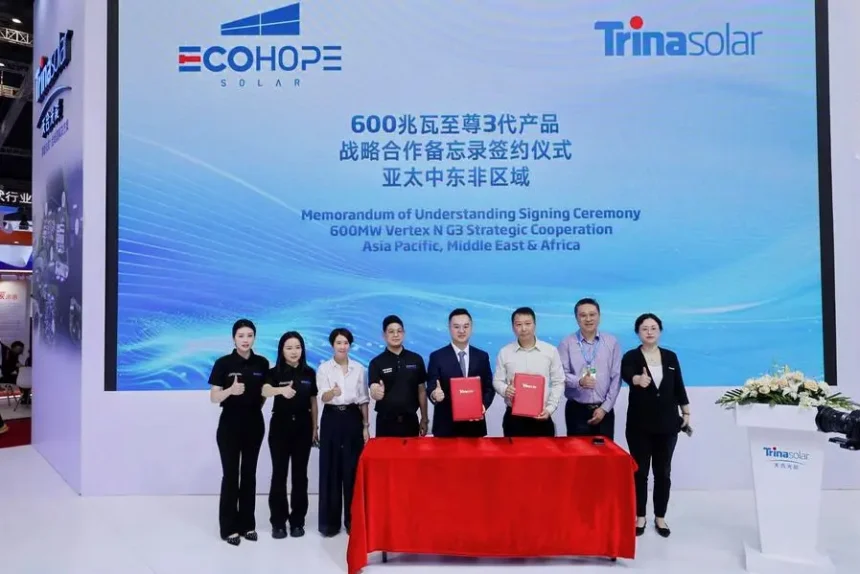
Global solar and energy storage leader Trinasolar has signed a Memorandum of Understanding (MoU) with Ecohope Solar, a leading photovoltaic (PV) and energy storage solutions provider, to support the deployment of advanced solar technologies across Southeast Asia, the Middle East, and Africa.
The agreement was formalized during the SNEC PV Power Expo in Shanghai, one of the world’s largest renewable energy exhibitions, highlighting growing collaboration within the global solar industry.
Under the partnership, Ecohope Solar intends to purchase and distribute 600MW of Trinasolar’s latest Vertex N G3 and Vertex S+ G3 solar modules over the next three years, supporting residential, commercial, industrial, and utility-scale solar projects across key international markets.
Expanding Solar Adoption Across High-Growth Markets
The collaboration is expected to strengthen the availability of high-performance solar solutions in rapidly growing renewable energy markets.
The deployment strategy will focus on:
- Thailand and Southeast Asia as key growth markets for residential and commercial solar projects
- Gulf Cooperation Council (GCC) countries as strategic markets in the Middle East
- Expanding opportunities across broader African energy markets
As governments and businesses continue investing in clean energy infrastructure, demand for efficient and reliable solar technologies is rising significantly across these regions.
The agreement supports efforts to accelerate solar adoption while helping organizations reduce energy costs and carbon emissions.
Advanced Solar Technology to Drive Efficiency
At the center of the partnership is Trinasolar’s latest Vertex N G3 module portfolio, powered by the company’s advanced n-type i-TOPCon Ultra technology.
The next-generation solar modules offer:
- Power output of up to 760W
- Module efficiency of up to 24.5%
- Enhanced bifacial energy generation performance
- Improved energy density
- Lower balance-of-system (BOS) costs
- Reduced levelized cost of electricity (LCOE)
The low-voltage architecture enables more power generation per string, making the technology particularly suitable for large-scale commercial, industrial, and utility applications.
Meanwhile, the Vertex S+ G3 module brings the same high-efficiency technology to residential and rooftop installations through a compact dual-glass design optimized for limited roof space and long-term durability.
Meeting Growing Demand for Higher Project Returns
As solar developers and commercial energy users seek greater efficiency and stronger project economics, access to advanced module technology is becoming increasingly important.
Henry Yuan, Founder and CEO of Ecohope Solar, said:
“Customers across our markets are under pressure to deliver stronger project returns from every installation. The Vertex G3 portfolio gives us access to high-output, reliable module technology that supports better system design and long-term value. This cooperation strengthens our ability to serve customers across Southeast Asia, the Middle East and Africa with solutions that match real market requirements.”
His comments reflect a broader industry trend where project developers are prioritizing technologies that maximize energy generation while reducing lifecycle costs.
Supporting the Transition to Integrated Energy Solutions
Beyond solar modules, the partnership also lays the groundwork for future collaboration in energy storage technologies.
As renewable energy deployment expands, the integration of solar generation and battery storage is becoming increasingly critical for ensuring grid stability, energy reliability, and optimized power management.
Todd Li, President of Trinasolar Asia Pacific, Middle East and Africa, said:
“Ecohope Solar has a strong regional footprint across PV and energy storage, making it a relevant partner as customers move toward more integrated energy solutions. Through this MoU, we are expanding access to Trinasolar’s latest i-TOPCon Ultra module portfolio while laying the groundwork for potential cooperation across PV and storage solutions.”
The collaboration aligns with growing demand for integrated renewable energy systems that combine solar generation with advanced storage capabilities.
Strengthening Renewable Energy Supply Chains
The agreement also highlights Trinasolar’s strategy of supporting partners across diverse international markets through a combination of advanced technology, manufacturing capabilities, and local service expertise.
As renewable energy deployment accelerates worldwide, industry players are increasingly seeking partnerships that can ensure reliable access to high-efficiency equipment while meeting regional project requirements.
By combining Trinasolar’s technology leadership with Ecohope Solar’s market presence and distribution capabilities, the companies aim to strengthen renewable energy supply chains across multiple regions.
Solar Industry Growth Continues to Accelerate
The partnership comes amid strong global momentum for solar energy adoption.
Governments, businesses, and utilities are investing heavily in renewable energy infrastructure to achieve climate goals, improve energy security, and reduce dependence on fossil fuels.
High-efficiency solar technologies such as n-type TOPCon modules are gaining traction as project developers seek greater performance, longer operational lifespans, and improved project economics.
The increasing integration of solar generation with battery energy storage systems is also reshaping energy markets, creating new opportunities for technology providers and project developers alike.
Outlook
The 600MW agreement between Trinasolar and Ecohope Solar represents a significant step toward expanding access to next-generation solar technologies across Southeast Asia, the Middle East, and Africa.
With growing demand for clean energy solutions and integrated solar-plus-storage systems, the partnership is expected to support renewable energy deployment in some of the world’s fastest-growing energy markets.
As countries accelerate their transition toward low-carbon energy systems, collaborations like this will play an important role in driving solar adoption, improving energy efficiency, and supporting global sustainability goals.