

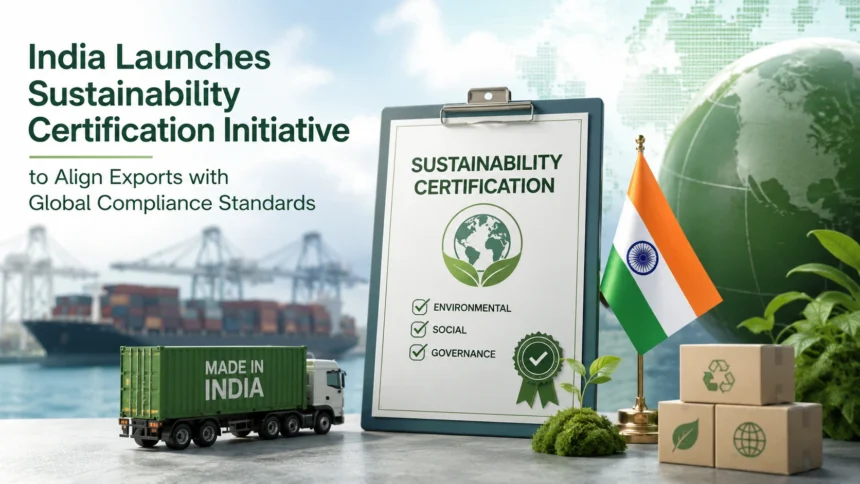
India’s Ministry of Commerce and Industry has begun laying the groundwork for a national sustainability certification framework for exports. According to officials cited in trade press coverage this week, the ministry has formally reached out to export-oriented industries, asking them to identify which products are likely to face sustainability-related certification demands in overseas markets in the near future.
This isn’t a finished policy yet — it’s the information-gathering phase. The ministry is collecting input on three things: which products and which destination markets already require sustainability documentation (or soon will), what data points and methodologies should anchor an Indian certification system, and what verification processes would make that system credible enough for foreign buyers and regulators to actually accept it.
That last point matters most. As multiple industry trackers have noted, there is no single, universally recognized “sustainability certificate” today. Compliance is currently demonstrated through a patchwork of sector-specific certifications, supply chain traceability records, emissions disclosures, and independent third-party audits. India’s goal appears to be building a framework coherent enough to be recognized across that patchwork — something foreign buyers can point to with confidence rather than having to evaluate certificate-by-certificate.
Why now: the regulatory walls are already going up in Europe
The timing isn’t arbitrary. Indian exporters — particularly those selling into the EU and UK — are currently navigating a stack of new compliance regimes that have either just become binding or are phasing in through 2026 and 2027.
The EU’s Carbon Border Adjustment Mechanism (CBAM) moved from a reporting-only pilot into its definitive, paid phase on January 1, 2026. From this point, EU importers bringing in more than 50 tonnes per year of covered goods — currently cement, iron and steel, aluminium, fertilisers, electricity, and hydrogen — must register as authorized CBAM declarants and begin purchasing certificates priced against the EU’s own carbon trading benchmark. For India, this isn’t a marginal concern: iron and steel make up roughly 90% of the value of Indian exports that fall under CBAM’s scope, and projections suggest CBAM-linked costs on Indian steel and iron exports could run to roughly €5 billion between 2026 and 2030. Commentary from trade policy researchers has also flagged that smaller exporters are hit hardest, since the verification and emissions-data infrastructure CBAM demands is expensive to build and India’s steel sector alone has a large base of SME producers.
The EU Deforestation Regulation (EUDR) is a parallel pressure point for a different set of Indian exports — coffee, natural rubber, palm oil derivatives, timber and wood products, and soy. Unlike a conventional certificate-based system, EUDR requires geolocation-backed, plot-level traceability data proving goods aren’t linked to deforestation after a 2020 cutoff date. Industry compliance trackers estimate this could touch close to $10 billion in Indian exports across roughly 479 tariff lines. Large and medium enterprises faced a compliance deadline at the end of December 2025, while small and micro exporters have a later runway into 2026.
Beyond CBAM and EUDR, the EU’s broader customs modernization — including the ICS2 advance security-data system — is adding to the documentation and traceability burden on anything moving into the bloc, regardless of sector.
Put together, these aren’t isolated red-tape items. They represent a structural shift in how the EU defines market access: increasingly, the right to sell into Europe is conditional on a business being able to produce verified, auditable sustainability data on demand — not simply assert it.
The domestic half of the equation: BRSR is tightening too
India’s own ESG disclosure regime is moving in a similar direction, even if the immediate trigger for the new export certification push is overseas pressure rather than domestic rules.
The Securities and Exchange Board of India’s Business Responsibility and Sustainability Reporting (BRSR) framework, and its more rigorous “BRSR Core” subset, has been on a multi-year glide path — starting with voluntary disclosure for India’s largest 150 listed companies and expanding toward mandatory third-party assessment or assurance across the top 1,000 by FY 2026–27. Value-chain disclosure — meaning companies reporting on the ESG conduct of major suppliers and customers, not just their own operations — was eased back to a voluntary basis in a March 2025 SEBI circular, but the regulatory direction is clearly toward making that mandatory in time, not away from it.
The overlap with the new export certification initiative is practical rather than incidental: a company that has already built internal systems to track emissions, water use, waste, and supplier-level ESG data for BRSR Core is far better positioned to produce the same kind of evidence a CBAM declarant or EU buyer will eventually demand. The data infrastructure — not the regulation it happens to be filed under — is the actual asset.
What this signals for businesses
The throughline across CBAM, EUDR, and BRSR is the same: ESG performance is shifting from a disclosure exercise into a market-access requirement. A growing share of international buyers are now effectively asking a single question before placing or renewing an order — can you produce credible, verifiable evidence of your sustainability performance, not just a statement of intent?
Businesses that treat this as a compliance afterthought are likely to face friction at the point of sale: shipment delays, additional costs from default emissions assumptions when verified data isn’t available, or in EUDR’s case, blocked entry at customs altogether. Businesses that build the underlying measurement, traceability, and verification systems early are positioned to use the same data as a competitive differentiator — particularly in sectors like steel, textiles, agri-commodities, and chemicals where EU buyers are already factoring carbon and traceability data into procurement decisions.
The broader implication is that the next phase of ESG regulation in India may be driven less by reporting deadlines set by domestic regulators, and more by the conditions export markets are unilaterally attaching to access. A national sustainability certification framework, if designed well, would give Indian exporters one recognized, India-built reference point to meet those conditions — rather than leaving each company to negotiate credibility with foreign buyers on a case-by-case basis.
This article is based on current reporting on India’s Ministry of Commerce and Industry sustainability certification initiative, along with public regulatory information on the EU’s CBAM and EUDR frameworks and SEBI’s BRSR disclosure regime, as of June 2026.