

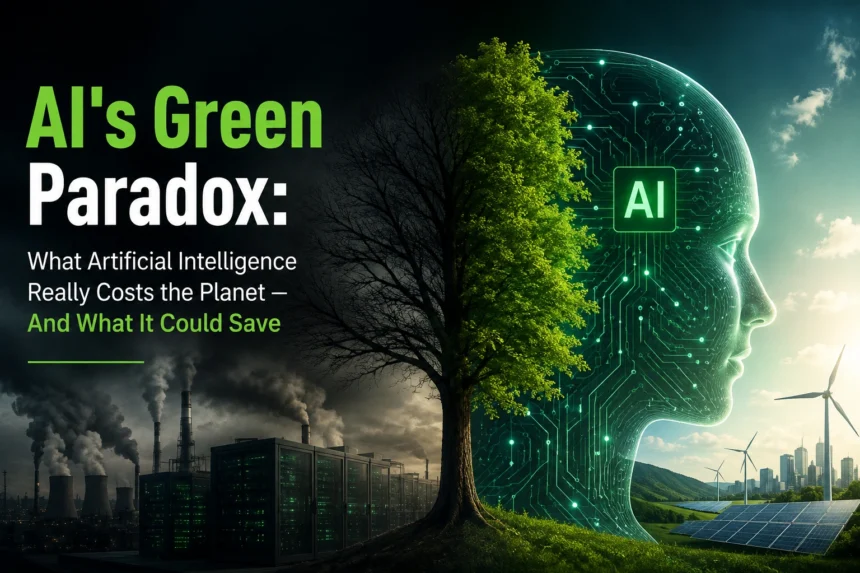
Every ChatGPT query, every AI-generated image, every large model trained in a hyperscale data center draws real electricity from a real grid, and increasingly, real water from a real watershed. As artificial intelligence reshapes how businesses operate, it is quietly becoming one of the fastest-growing sources of electricity demand, water stress, and corporate carbon emissions on the planet.
- How Much Electricity Does AI Actually Use?
- The Water AI Drinks: A Hidden Environmental Cost
- Big Tech’s Emissions Are Climbing — And AI Is Why
- The Nuclear Bet: How Big Tech Is Trying to Power AI Sustainably
- The Other Side of the Ledger: How AI Is Helping Fight Climate Change
- So — Is AI Good or Bad for the Planet?
- The ESG Takeaway for Businesses and Policymakers
- Frequently Asked Questions
- Sources
But the same technology is also emerging as one of the most powerful tools ever built to fight climate change — from cutting data center energy use to sharpening renewable energy forecasts. Here’s what the numbers actually say about AI’s cost to sustainability, and its payoff.
How Much Electricity Does AI Actually Use?
The starting point for any honest conversation about AI and sustainability is the grid — and the numbers are moving fast.
- 565 terawatt-hours (TWh): global data center electricity consumption in 2026, up 26.4% from 447 TWh in 2025 — driven overwhelmingly by AI-optimized servers, which now account for 31% of all data center power draw and are expected to overtake conventional servers as soon as 2027.
- 950 TWh by 2030: the International Energy Agency projects global data center electricity demand will nearly double by the end of the decade — more than Japan’s entire current electricity consumption, and roughly 3% of global electricity demand.
- 432 TWh: Gartner’s projection for AI-optimized server electricity use in 2030, up from 93 TWh in 2025 — a nearly fivefold increase in five years.
- 11x to 44x: AI server power density increased 11-fold between 2020 and 2025, and the IEA expects a further fourfold jump by 2027 — meaning a single refrigerator-sized server rack could soon draw as much power as 65 households combined.
The Water AI Drinks: A Hidden Environmental Cost
Electricity gets most of the attention, but AI’s water footprint — used mainly to cool data centers — is a growing flashpoint in communities near hyperscale facilities.
- 10.9 billion gallons: water consumption Google disclosed for 2026; Amazon separately disclosed 2.5 billion gallons consumed globally in 2025.
- ~185,000 gallons (700,000 liters): the estimated water consumed to train a single large-scale AI model — enough to fill roughly a third of an Olympic swimming pool.
- 300% increase projected: U.S. AI data center water use is projected to rise from about 17 billion gallons in 2023 to as much as 68 billion gallons by 2028.
- 399 billion gallons by 2030: the projected water draw from data centers in Texas alone, up from an estimated 49 billion gallons in 2025 — in a state that already faces recurring drought stress.
Big Tech’s Emissions Are Climbing — And AI Is Why
The clearest evidence of AI’s environmental cost shows up in Big Tech’s own sustainability disclosures, where years of emissions progress are reversing in real time.
- +25%: the rise in Microsoft’s carbon footprint in fiscal year 2025, driven by AI data center expansion.
- +25%: Google’s total emissions growth year-over-year, driven largely by Scope 3 emissions tied to AI infrastructure — GPUs, steel, cement, and data center construction.
- +16%: Amazon’s emissions increase over the same period, even as the company added more data center capacity globally in 2025 than any other company — over 1.2 gigawatts in Q4 alone.
- +150% in three years: the rise in major tech companies’ indirect (Scope 3) emissions as AI has scaled, per a UN-linked analysis — a trajectory that puts publicly stated net-zero targets across the industry at real risk.
The Nuclear Bet: How Big Tech Is Trying to Power AI Sustainably
Facing surging demand and grid interconnection queues stretching up to eight years, hyperscalers are increasingly bypassing public utilities altogether.
- $50 billion+ and nearly 10 GW: the combined nuclear power commitments made by Microsoft, Google, Amazon and Meta in 2026 alone — enough capacity to power roughly 7 million homes.
- $16 billion, 20 years: the value and length of Microsoft’s power purchase agreement to restart the Three Mile Island Unit 1 reactor, expected back online in 2027.
- 500 MW: the capacity of Google’s small modular reactor (SMR) fleet deal with Kairos Power — the first of its kind among US corporate buyers.
- $700 million + $20 billion: Amazon’s investment in X-energy for up to 12 next-generation reactors, alongside a $20 billion-plus AI data center campus in Pennsylvania.
- Up to 267%: the surge in wholesale electricity prices reported near some hyperscale data center clusters — a sign of just how tight the grid has become.
The Other Side of the Ledger: How AI Is Helping Fight Climate Change
None of this means AI is a net negative for the climate — the technology is also one of the most promising tools available for cutting emissions elsewhere in the economy.
- 40% cooling energy cut: achieved when Google’s DeepMind applied AI to its own data centers, improving overall facility energy efficiency (PUE) by 15% — proof AI can shrink its own footprint.
- 2.6 to 5.3 gigatons of CO2e by 2030: the emissions reduction potential estimated by a joint Google/BCG study if AI were fully applied to corporate sustainability efforts — roughly equal to the European Union’s entire annual emissions — while generating an estimated $1.3-2.6 trillion in economic value.
- $600 billion by 2028: the annual value a 2026 Temasek/BCG report estimates AI-enabled climate and sustainability sectors could generate, with AI helping cut industrial Scope 1 and 2 emissions by an estimated 0.6 gigatons a year.
- 95%+ forecasting accuracy: AI models can now predict solar and wind output with over 95% accuracy, while AI-driven smart-grid optimization is delivering operational cost reductions ranging from roughly 4% to 55%, depending on the application.
So — Is AI Good or Bad for the Planet?
The honest answer is both, and the gap between the two is where the real ESG story sits today. The costs are immediate, physical, and measurable — in gigawatt-hours on the grid and gallons in the water table. The benefits are real but conditional: they depend on how deliberately AI is deployed, and how quickly the electricity powering it comes from clean sources rather than the natural gas plants Big Tech has also been racing to build.
The next few years will be decisive. As nearly 10 gigawatts of new nuclear capacity comes online and AI-specific electricity demand continues to climb, the question isn’t whether AI has an environmental cost — it clearly does — but whether the industry can decouple AI’s growth from fossil-fuel generation before that cost outweighs the climate gains AI itself makes possible.
The ESG Takeaway for Businesses and Policymakers
- Treat AI-related Scope 3 emissions (compute, hardware, construction) as a reportable, material category — not an afterthought.
- Prioritize AI use cases with quantifiable climate ROI, such as grid forecasting, logistics optimization, and materials efficiency, over speculative deployments.
- Demand transparency from AI vendors on the energy and water footprint of the models and data centers you rely on.
- Watch the nuclear and clean-power build-out as the clearest leading indicator of whether the AI industry can genuinely decouple growth from emissions.
Frequently Asked Questions
How much electricity does AI use?
Global data center electricity consumption reached about 565 TWh in 2026, with AI-optimized servers responsible for roughly 31% of that demand — a share expected to keep growing through the decade, according to IEA-based industry estimates.
How much water does training an AI model use?
Training a single large AI model can consume roughly 700,000 liters (about 185,000 gallons) of water, mostly for data center cooling — enough to fill close to a third of an Olympic swimming pool.
Can AI help fight climate change?
Yes. Research from Google and BCG estimates AI could help cut global greenhouse gas emissions by 2.6 to 5.3 gigatons of CO2-equivalent by 2030, while also improving renewable energy forecasting accuracy and grid efficiency.
Why are Big Tech companies investing in nuclear power?
To meet AI’s surging electricity demand without relying solely on fossil fuels. Microsoft, Google, Amazon and Meta have committed over $50 billion combined to nuclear power projects in 2026 alone.
India Recycles Just 1% of Construction Waste. Here’s Why That’s a ₹11.5 Trillion Opportunity
Sources
International Energy Agency (IEA), “Energy and AI” and “Key Questions on Energy and AI,” 2026
Axis Intelligence, AI Data Center Energy & Water Usage Statistics 2026
Gartner, Data Center Electricity Demand Forecast, 2025
Forbes, “How Much Water Does AI Use? The $58 Billion Risk,” July 2026
Qz / Trellis, Microsoft, Google and Amazon 2026 sustainability/emissions disclosures
Google DeepMind, “DeepMind AI Reduces Google Data Centre Cooling Bill by 40%”
Google & Boston Consulting Group, AI for corporate sustainability research
Temasek & Boston Consulting Group, AI-Enabled Climate and Sustainability report, 2026
Forbes, “The AI Boom Is Making Nuclear Power Bankable Again,” July 2026; smrintel.com nuclear data center deal tracker, 2026
ESG World News Research, Aug 2026