

October 2026, New Delhi, India – India’s wind energy industry is entering a new phase of expansion, with annual installations projected to increase to 8 GW in FY27 and potentially reach 13.2 GW by FY31.
- India’s Wind Capacity Could Cross 100 GW
- Wind Installations Hit Record 6.05 GW in FY26
- Green Energy Corridor to Support Renewable Expansion
- India Looks to Strengthen Wind Manufacturing
- Wind Equipment Exports Continue to Grow
- Domestic Supply Chains Need Further Development
- Higher Turbine Capacity Could Shape the Next Growth Phase
- India’s Wind Energy Outlook
The growth could take India’s cumulative installed wind power capacity to approximately 107 GW, building on the 59.2 GW already installed across the country.
An additional 43 GW of wind capacity is currently under implementation, taking India’s total installed and under-construction capacity to around 102.2 GW. The existing project pipeline is expected to provide a strong foundation for the sector’s next growth cycle.
India’s Wind Capacity Could Cross 100 GW
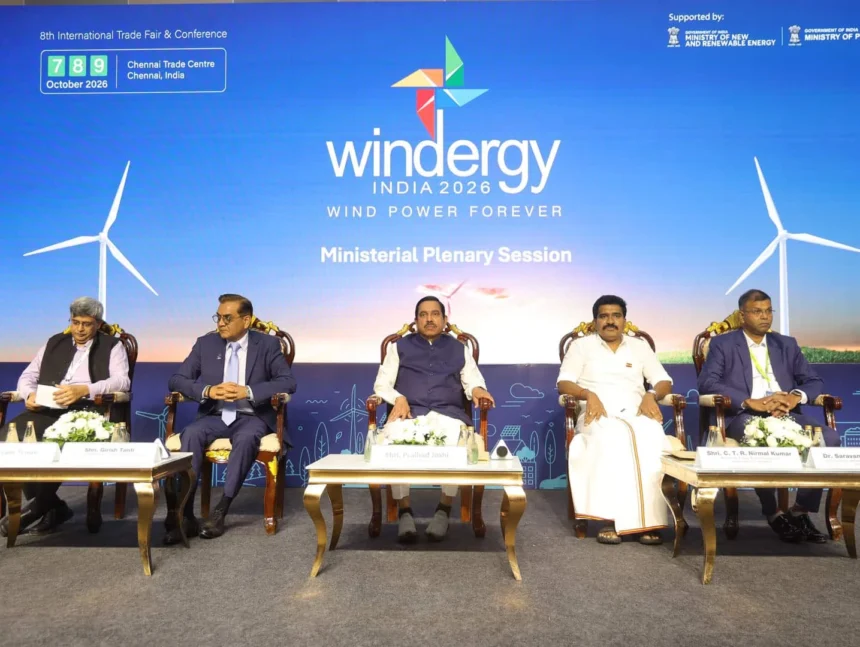
The projections were highlighted at Windergy India 2026, the flagship event of the Indian Wind Turbine Manufacturers Association (IWTMA), being held from October 7 to 9, 2026.
The event has brought together approximately 400 exhibitors from more than 20 countries, along with around 500 delegates. Dedicated country pavilions from Denmark, Germany and Spain are also part of the event.
The gathering provides a platform for wind turbine manufacturers, component suppliers, technology companies, policymakers and other industry stakeholders to discuss the next stage of India’s wind energy development.
Wind Installations Hit Record 6.05 GW in FY26
India recorded its highest-ever annual wind power installation of 6.05 GW in FY26, according to Union Minister for New & Renewable Energy Pralhad Joshi.
The government expects the sector to surpass that figure in FY27 as new projects move forward.
Joshi said the continued expansion of wind power will contribute to India’s objective of reaching 100 GW of installed wind capacity by 2030, while strengthening the country’s renewable energy base.
The expected increase in annual installations from 6.05 GW in FY26 to 8 GW in FY27 indicates a significant acceleration in deployment.
Green Energy Corridor to Support Renewable Expansion
Transmission infrastructure will play an important role as India adds more wind and other renewable energy capacity.
The Green Energy Corridor Phase-III programme, estimated at ₹1.86 lakh crore, is aimed at expanding and strengthening the transmission network required to integrate growing renewable power generation.
The investment is also linked to India’s broader ambition of reaching 900 GW of installed non-fossil fuel capacity by 2035.
For wind developers, improved transmission infrastructure could help address one of the key requirements associated with integrating large-scale renewable generation into the electricity grid.
India Looks to Strengthen Wind Manufacturing
The expected growth in domestic wind installations is also creating opportunities for India’s turbine and component manufacturing ecosystem.
Girish Tanti, Chairman of IWTMA, said India’s wind sector has 59.2 GW of installed capacity and 43 GW under implementation, placing the industry on a potential path toward crossing 100 GW by 2030.
India’s annual wind manufacturing capacity has reportedly increased to more than 24 GW, compared with approximately 12 GW in FY23.
The expansion has been supported by a growing domestic component ecosystem and increasing demand for wind equipment.
Wind Equipment Exports Continue to Grow
India’s wind manufacturing industry is also expanding its international presence.
According to IWTMA, wind-sector exports reached ₹12,800 crore in FY2025-26, representing nearly 50% year-on-year growth.
The increase highlights the growing role of Indian manufacturers and component suppliers in global wind-energy supply chains.
A combination of domestic demand and export opportunities could provide manufacturers with greater scale while supporting investments in production capacity and technology.
Domestic Supply Chains Need Further Development
As the industry moves toward larger and higher-rated wind turbines, manufacturers will need to strengthen domestic capabilities across critical components.
Aditya Pyasi, CEO of IWTMA, said the next phase of growth will require a resilient and globally competitive domestic manufacturing ecosystem.
He highlighted the need to accelerate indigenisation of critical components, increase manufacturing capacity and strengthen supply chains to meet rising demand.
Greater coordination between original equipment manufacturers, component suppliers, technology companies and government agencies will be important as India’s wind market expands.
Higher Turbine Capacity Could Shape the Next Growth Phase
The transition toward higher-rated turbines is expected to influence India’s future wind manufacturing requirements.
Larger turbines can support greater generation capacity from individual projects, but they also require stronger manufacturing capabilities, specialised components and supply-chain readiness.
For India’s wind industry, scaling domestic production alongside project deployment could therefore be important to maintaining competitiveness in both domestic and international markets.
India’s Wind Energy Outlook
India’s wind sector is entering the next stage of growth with a combination of rising annual installations, a large project pipeline, expanding manufacturing capacity and stronger transmission infrastructure.
If the projected installation trajectory materialises, annual additions could rise from the record 6.05 GW achieved in FY26 to 8 GW in FY27 and eventually 13.2 GW by FY31.
The expansion could push cumulative wind capacity toward 107 GW, while creating additional opportunities for turbine manufacturers, component suppliers, technology providers and renewable energy developers.
With India targeting 100 GW of installed wind capacity by 2030, the coming years will be critical for scaling manufacturing, infrastructure and supply chains across the sector.