

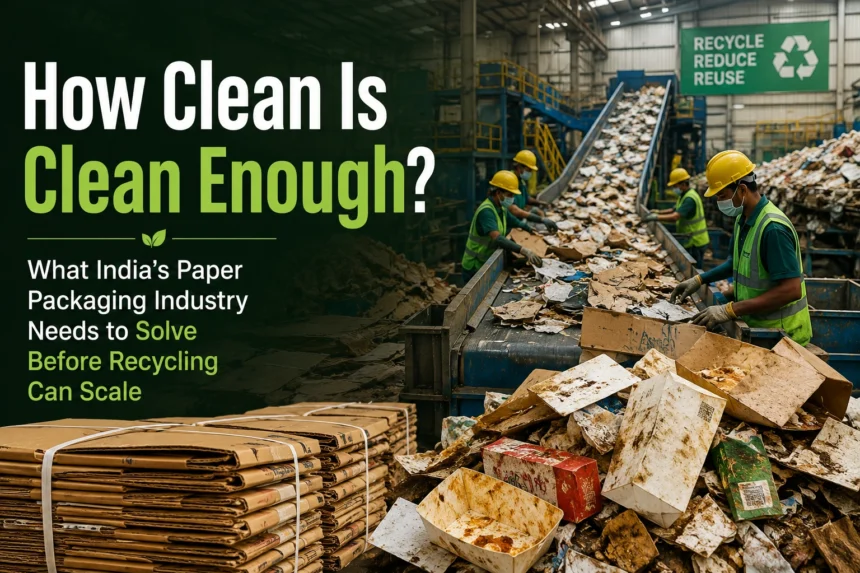
Anyone who has ever stared at a greasy pizza box wondering whether it belongs in the recycling bin or the garbage has run into one of the oldest unresolved questions in waste management: how clean does paper packaging actually need to be before it can be recycled? In India, where food delivery and quick-commerce have exploded over the past five years, this question is no longer a minor household dilemma — it is becoming an industrial-scale problem for the country’s paper recycling sector.
As India’s appetite for paper-based food packaging grows — biryani containers, pizza boxes, dosa wraps, sweet boxes, and quick-commerce delivery cartons — the country’s paper mills and kabadiwalas (informal waste collectors) who form the backbone of India’s paper recycling economy are facing a contamination problem that has never been systematically studied or addressed at scale.
The Scale of the Problem in India
India generates an enormous and growing volume of paper and cardboard waste from food packaging, driven largely by the rapid expansion of food delivery platforms and the corresponding rise in single-use paperboard containers, corrugated boxes, and takeaway packaging. Unlike several Western markets, where formal municipal recycling programmes set baseline expectations for “clean” recyclables, India’s paper recycling stream runs predominantly through an informal network of waste pickers, scrap dealers, and recycling units that have developed their own working tolerances for contamination — often without any standardised guidance from packaging brands or regulators.
This creates a structural mismatch. Indian consumers, increasingly encouraged by sustainability messaging on packaging, often assume that any paper or cardboard item is automatically recyclable regardless of food residue. Meanwhile, the paper mills and recycling units actually processing this material have a much narrower tolerance — one that nobody in the supply chain has clearly communicated to the people generating the waste in the first place.
Grease Is Tolerable. Food Chunks Are Not.
International research into this exact question offers a useful benchmark for the Indian context, even though no equivalent large-scale Indian study currently exists. A recent investigation by the Sustainable Packaging Coalition, which interviewed dozens of paper recyclers and packaging brokers, found that recyclers generally tolerate grease and oil absorbed into the paper fibre itself — the kind of residue typical of a pizza box or a parcel of fried snacks. What recyclers will not tolerate is actual solid food debris: rice grains, curry residue, or chunks of food left inside a container.
This distinction matters enormously for the Indian context, where curries, gravies, and rice-based dishes dominate the food delivery market. A paper container with absorbed turmeric or oil staining is fundamentally different, from a recycling standpoint, than one with leftover dal or rice still sitting inside it. The former can usually still be processed. The latter introduces pests, odour, and contamination that can spoil an entire bale of sorted paper at a recycling facility — a risk that paper mills operating on thin margins are increasingly unwilling to absorb.
This finding aligns with earlier global research, including a widely cited 2019 study on corrugated pizza boxes, which similarly found that typical grease and cheese residue does not meaningfully compromise recyclability. The practical takeaway for India’s packaging brands and food delivery platforms is the same: residue is not automatically disqualifying, but undischarged food waste is.
Why This Matters More in India Than Almost Anywhere Else
India’s recycling economy operates differently from the formal municipal systems seen in much of Europe and North America. A significant share of post-consumer paper and cardboard recovery happens through informal channels — waste pickers who sort and sell recyclables to local scrap dealers, who in turn supply paper mills. These workers operate on volume and speed, with limited capacity to clean, inspect, or reject individual items at the point of collection.
This means that contamination problems which might be caught and corrected at a formal materials recovery facility in another country often pass straight through India’s informal collection chain and surface only at the mill level, when an entire consignment of recovered paper is found to be too contaminated to process economically. The cost of that contamination is absorbed disproportionately by waste pickers and small recyclers, who have the least ability to push back up the supply chain toward the brands and consumers actually generating the problem.
What Indian Consumers Actually Know — And Don’t
A parallel piece of the international research focused on consumer behaviour rather than recycler tolerance, studying how on-pack messaging affects whether people clean food packaging before discarding it. The findings showed that while most consumers have a general intuitive sense that food residue should be removed before recycling, explicit on-pack instructions dramatically improved compliance — and pairing those instructions with a short educational explanation nearly doubled the likelihood that consumers properly cleaned packaging requiring at least some residue removal.
India faces a more fundamental version of this same gap. Recycling labelling on food packaging remains inconsistent across brands, and consumer awareness of what “recyclable” actually requires in practice — beyond the symbol itself — remains low across most urban markets. Quick-commerce and food delivery packaging, in particular, frequently carries generic “recyclable” messaging with no guidance on rinsing, scraping, or drying before disposal.
What Needs to Happen Next in the Indian Context
Closing this gap will require coordinated action across three fronts, adapted to India’s specific recycling infrastructure.
First, India’s packaging industry, paper mills, and waste management associations need to establish a shared, practical definition of acceptable food residue specific to Indian food packaging formats — curry containers, biryani boxes, sweet boxes, and delivery cartons all carry different contamination profiles than the pizza boxes and takeout containers studied internationally. A working threshold developed in consultation with Indian recyclers, including representatives of the informal waste sector, would give brands a concrete standard to design packaging and messaging around.
Second, food delivery platforms and packaging brands need to move beyond generic recyclability symbols toward specific, actionable on-pack instructions — language as simple as “Scrape and rinse before recycling” printed directly on biryani boxes, dabba-style containers, and sweet boxes could meaningfully shift consumer behaviour, based on the scale of improvement seen in international consumer studies using similar messaging.
Third, consumer education needs to extend beyond the packaging itself. Given India’s heavy reliance on app-based food delivery, platforms like Swiggy, Zomato, Blinkit, and Zepto are uniquely positioned to embed recycling guidance directly into their order confirmation or delivery experience — a channel with far greater reach than packaging labels alone, and one that does not currently carry any meaningful sustainability messaging around packaging disposal.
The Larger Stakes
India has committed to ambitious circular economy and waste reduction targets as part of its broader sustainability and Extended Producer Responsibility framework under the Plastic Waste Management Rules and related policies. Paper-based packaging is frequently promoted by brands and regulators alike as the more sustainable alternative to plastic packaging in the food delivery sector. But that sustainability promise only holds if the paper packaging actually gets recycled rather than rejected at the mill gate due to contamination that nobody told consumers how to avoid.
Solving this is not about achieving perfect cleanliness from every consumer. It is about establishing a clear, realistic, and widely communicated threshold for what “clean enough” means in the Indian context — one that protects the waste pickers and recyclers who keep this material in circulation, while giving brands and consumers a simple, achievable standard to work toward. Getting that threshold right could meaningfully increase how much of India’s growing paper packaging volume actually completes its journey back into the recycling stream, rather than ending up contaminated, rejected, and landfilled despite being technically recyclable all along.