

There is a version of corporate sustainability that lives in annual reports. It has net-zero commitments, carbon offset tables, and a foreword signed by the CEO. It is produced by communications teams and consumed by ratings agencies. It changes very little.
- The ESG Credibility Gap — and How to Close It
- Five Programmes. One Coherent Strategy.
- Farming Smarter in a Changing Climate
- Restoring a Heritage Water Body in Braj
- Nine Check Dams in Palghar
- Watershed Restoration in Chhatrapati Sambhajinagar
- A Waste Facility for the Himalayas
- The Business Case for Doing This Well
- An Invitation to Other Brands
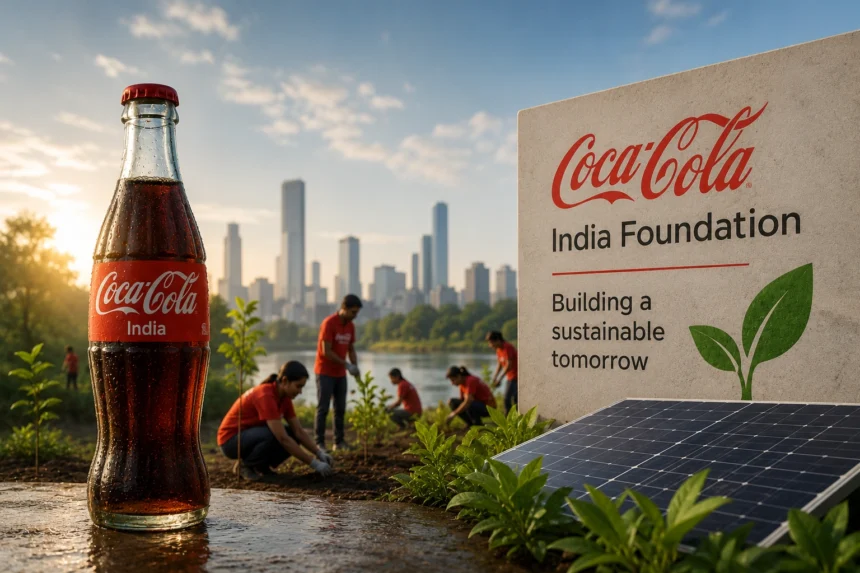
And then there is what Anandana — The Coca-Cola India Foundation — has been doing in the villages, watersheds and high-altitude pilgrimage routes of India. It is less polished, more physical, and considerably harder to fake.
On World Environment Day 2026, the Foundation released details of five grassroots environmental initiatives spanning water restoration, agricultural resilience, watershed management and Himalayan waste infrastructure. Taken together, they represent something the ESG world talks about constantly but delivers inconsistently: climate action that is community-led, measurable, and built to last.
For other brands watching from the sidelines, the message is clear — and worth paying attention to.
The ESG Credibility Gap — and How to Close It
Corporate ESG has a trust problem. A 2024 Edelman survey found that fewer than one in three consumers believes companies are being honest about their sustainability commitments. Greenwashing enforcement by regulators in the EU, UK and India is increasing. ESG ratings agencies are under fire for methodological inconsistency. The gap between what companies say and what they do has never been more visible — or more consequential.
What distinguishes Anandana’s approach is not the scale of investment (though the numbers are significant) but the specificity and the rootedness of the work. These are not headline-chasing announcements. They are interventions designed around real constraints — irregular rainfall, depleted groundwater, sacred water bodies choked by sewage, Himalayan trails buried under pilgrimage waste — with measurable outputs that can be independently verified.
That combination — local relevance, external partnerships, quantifiable impact — is precisely what separates credible ESG from performative ESG. And it is increasingly what institutional investors, sustainability-linked lenders, and ESG-focused media are looking for.
Five Programmes. One Coherent Strategy.
Farming Smarter in a Changing Climate
Since 2011, Project Unnati has supported nearly four lakh fruit farmers across 13 states and Union Territories — growing apples, mangoes, oranges, grapes, litchi, coffee and sugarcane — through scientific orchard management, drip irrigation and ultra-high-density plantation techniques. The result: farmers producing more with less water, less land pressure, and greater resilience to the erratic weather patterns that are increasingly defining Indian agriculture.
For a brand, this is what supply chain climate resilience looks like in practice — not as a procurement policy, but as a community investment.
Restoring a Heritage Water Body in Braj
In Pisava village near Barsana in Uttar Pradesh, Anandana partnered with Say Earth to restore the Kishori Kund — a sacred 18,000 square metre water body that had been degraded by sewage and waste accumulation. Scientific restoration and active community participation brought it back to life. The Kund now holds an estimated 480 million litres of water, supports local ecosystem health, and has been returned to its status as a living cultural landmark.
This is water stewardship at the intersection of ecology and identity — the kind of project that builds durable community trust rather than transactional goodwill.
Nine Check Dams in Palghar
In partnership with PHD Rural Development Foundation, Anandana funded the construction of nine water-harvesting check dams across Palghar district in Maharashtra. Together they have created over 370,000 cubic metres of water storage and groundwater recharge potential — giving rural communities a buffer against dry-season water scarcity and improving conditions for year-round agriculture.
Unglamorous infrastructure. Transformative impact. Exactly the kind of investment that compounds quietly over decades.
Watershed Restoration in Chhatrapati Sambhajinagar
Through Project Jaldhara, in partnership with S M Sehgal Foundation, Anandana worked across ten villages in one of Maharashtra’s most drought-prone regions to establish groundwater recharge structures — check dams, recharge shafts, farm ponds and bunding interventions — that together improve household, agricultural and livestock water security.
In a region accustomed to water as a source of anxiety, this project has made it, for these communities, a resource that can be planned around.
A Waste Facility for the Himalayas
Kedarnath receives hundreds of thousands of pilgrims and tourists each year. The waste they generate has become an acute environmental pressure on one of India’s most sacred and most fragile high-altitude ecosystems. Anandana partnered with Healing Himalayas Foundation and local government bodies to establish a Material Recovery Facility capable of processing three tonnes of waste per day and storing up to 50 tonnes at a time — backed by digital mapping of over 400 waste collection points and training programmes for waste workers.
It is the kind of project that makes environmental sense, cultural sense and community sense simultaneously.
The Business Case for Doing This Well
For brands evaluating where to direct their CSR and ESG investment, Anandana’s model offers a replicable template — and a compelling argument.
It builds measurable impact. Every initiative here has a number attached: four lakh farmers, 480 million litres, 370,000 cubic metres, three tonnes per day. These are not estimates of reach or impressions. They are outputs. Measurable outputs are what ESG reporting frameworks, investors and regulators increasingly demand.
It works through partners. Anandana does not implement alone. Say Earth, PHD Rural Development Foundation, S M Sehgal Foundation, Healing Himalayas Foundation — each partner brings community trust and technical capability that no corporate foundation can replicate from the outside. This model delivers both quality and legitimacy.
It addresses issues that are material to business. Water scarcity, agricultural resilience, ecosystem degradation — these are not peripheral concerns. They sit at the heart of supply chain risk, regulatory exposure and long-term licence to operate in an increasingly climate-stressed India.
It builds brand equity where it is hardest to manufacture. Community trust. The kind that comes from showing up, year after year, in places where the cameras rarely follow.
An Invitation to Other Brands
India’s climate challenges are large enough that no single foundation — however well-resourced — can address them alone. The water-stressed districts, the degraded water bodies, the over-burdened sacred landscapes, the farmers navigating seasons that no longer behave as their parents described — all of them represent opportunities for brands that are serious about ESG to make a material difference.
The question is not whether there is work to be done. There is more than enough. The question is whether brands are willing to do it the way Anandana has done it: with patience, with local partners, with an appetite for unsexy infrastructure, and with the commitment to measure what they build.
Those that are will find something waiting for them that no agency can produce: a story that is genuinely true.
ESG World News features brands, foundations and organisations leading credible, measurable environmental and social impact. If your organisation is driving grassroots climate action and would like to be featured, get in touch – editor@esgworldnews.com
About Anandana — The Coca-Cola India Foundation Registered under Section 25 of the Companies’ Act, Anandana is committed to sustainable development and inclusive growth across India. The Foundation partners with NGOs, cooperatives and civil society organisations to deliver social welfare and environmental resilience programmes at the community level.