
Author: Ankitt Y, November 14, 2026 –
- DGFT notification brings immediate change to black mass exports
- Why lithium-ion battery black mass matters to India’s mineral security
- Attero and Lohum highlight the importance of domestic recycling capacity
- ₹1,500-crore incentive scheme aims to support critical mineral recovery
- The challenge: keeping black mass in India is not the same as refining it
- Key figures behind India’s black mass export ban
- What the export restriction means for India’s clean-energy transition
- What to watch: refining investments and black mass stockpiles
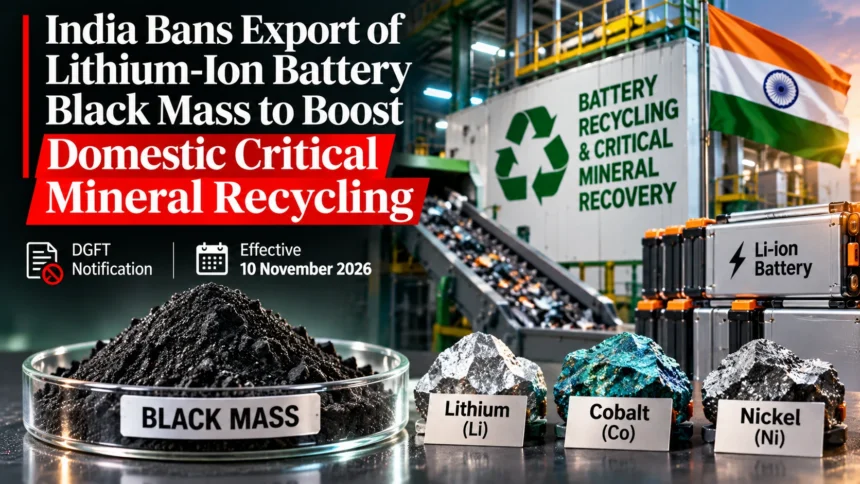
India’s export ban on lithium-ion battery black mass took effect on November 10, 2026, in a move designed to retain valuable minerals such as lithium, cobalt and nickel within the country and encourage investment in domestic recycling and refining infrastructure.
India has tightened control over a potentially valuable source of critical minerals by prohibiting the export of lithium-ion battery black mass. The Directorate General of Foreign Trade (DGFT), through Notification No. 49/2026-27, moved the relevant export category from the ‘Free’ list to ‘Prohibited’, with immediate effect.
The notification, issued on November 10, 2026, covers waste and scrap of primary cells, primary batteries and electric accumulators under ITC (HS) Code 85491400. The restriction will remain in place until further orders.
The policy is intended to ensure that minerals recovered from used lithium-ion batteries and manufacturing waste are processed within India rather than sent overseas for refining. It also supports the country’s wider ambition to strengthen domestic supply chains for minerals that are essential to electric vehicles, energy storage and clean-energy technologies.
DGFT notification brings immediate change to black mass exports
Black mass is the dark, powder-like material produced when used lithium-ion batteries and battery-manufacturing scrap are dismantled and shredded. It contains recoverable materials, including lithium, nickel, cobalt, manganese and graphite, alongside residual electrolytes and other components.
Until the policy change, Indian recyclers could export black mass under the free export category. Some companies relied on overseas buyers because domestic facilities capable of extracting and refining individual critical minerals were not available at sufficient scale.
The new DGFT notification removes that export route. The government’s stated objective is to strengthen domestic recycling and critical mineral recovery by encouraging more of the value chain to operate within India.
The restriction is effective immediately and does not specify a transition period. The supplied policy details also indicate that imports of black mass for domestic processing remain a separate activity and are not covered by this export prohibition.
For recyclers, the change creates a significant commercial and operational question: whether India’s existing and planned refining facilities can process the material that can no longer be shipped to overseas facilities.
Why lithium-ion battery black mass matters to India’s mineral security
India’s demand for lithium-ion batteries is growing alongside electric mobility, renewable energy storage and the wider electrification of industrial and consumer applications. Yet the country remains dependent on external sources for several minerals used in battery production, including lithium, cobalt and nickel.
This makes end-of-life batteries an increasingly important secondary source of raw materials. Instead of relying entirely on newly mined minerals or imported processed materials, India can potentially recover a portion of its requirements from batteries already in circulation.
However, collecting and shredding batteries is only one part of the recycling process. Black mass must undergo further chemical and metallurgical treatment to separate and recover individual materials in forms that can be reused by battery manufacturers.
That refining stage requires specialised technology, capital investment and processing capacity. The gap between black mass generation and domestic refining has therefore emerged as a key challenge for India’s battery recycling ecosystem.
By prohibiting exports, the government is seeking to retain this mineral-rich intermediate material within the country and create stronger incentives for domestic processing.
Attero and Lohum highlight the importance of domestic recycling capacity
The scale of India’s domestic recycling infrastructure will be central to the success of the policy.
According to the industry estimates cited in the supplied material, Attero has recycling capacity of approximately 15,000 tonnes per annum. Lohum is reported to account for more than 90% of India’s integrated lithium-ion battery recycling market.
These figures point to the importance of a relatively concentrated group of companies in the country’s existing recycling ecosystem. They also underline the need for additional investment and wider participation if India is to process increasing volumes of end-of-life batteries domestically.
The distinction between recycling capacity and refining capability is particularly important. Producing black mass does not automatically mean that a facility can recover battery-grade lithium, nickel and cobalt compounds. The latter requires additional processing infrastructure and technical capabilities.
As the export restriction takes effect, companies may need to accelerate investments in downstream recovery facilities, partnerships and technologies that can convert black mass into reusable materials.
₹1,500-crore incentive scheme aims to support critical mineral recovery
The export ban forms part of a broader policy push to build domestic critical mineral capabilities.
In October 2025, the government approved a ₹1,500-crore incentive scheme for critical mineral recycling under the National Critical Mineral Mission. The programme is intended to encourage investment in recycling and recovery infrastructure, including facilities that can extract valuable minerals from secondary sources.
The incentive scheme could help address one of the industry’s biggest constraints: the high investment and technical requirements associated with refining black mass.
For the policy to deliver its intended benefits, however, incentives will need to translate into operational facilities. Recyclers will require reliable access to processing capacity, viable commercial arrangements and buyers for the recovered materials.
The timing and scale of new investments will therefore influence how smoothly the industry adjusts to the export prohibition.
The challenge: keeping black mass in India is not the same as refining it
India’s battery recycling ecosystem has made progress in collecting used batteries and converting them into black mass. The more complex step is separating the material into individual minerals that meet the quality requirements of battery and industrial manufacturers.
This is the central infrastructure challenge behind the new policy.
If domestic refining capacity expands in line with the supply of black mass, the export restriction could support a more integrated battery recycling value chain. It could also help retain more economic value from discarded batteries and reduce dependence on imported refined materials.
But if processing facilities do not expand quickly enough, recyclers could face difficulties finding domestic outlets for their material. Black mass may accumulate in storage, creating working-capital pressures and disrupting recycling operations.
The policy therefore places greater importance on the speed of investment in chemical recovery and refining facilities. A trade restriction can retain feedstock within the country, but it cannot by itself create the infrastructure needed to process it.
Key figures behind India’s black mass export ban
- November 10, 2026: Effective date of DGFT Notification No. 49/2026-27.
- ITC (HS) Code 85491400: Export category moved from ‘Free’ to ‘Prohibited’.
- 15,000 tonnes per annum: Approximate recycling capacity attributed to Attero in the supplied industry estimates.
- More than 90%: Lohum’s reported share of India’s integrated lithium-ion battery recycling market.
- ₹1,500 crore: Critical mineral recycling incentive scheme approved in October 2025 under the National Critical Mineral Mission.
- Five key recoverable materials: Lithium, nickel, cobalt, manganese and graphite.
What the export restriction means for India’s clean-energy transition
The policy connects battery waste management with India’s broader energy-transition and industrial strategy.
As electric vehicle adoption and battery deployment increase, the country will eventually have to manage a growing stream of used batteries. Recovering materials from these products could help create a domestic secondary supply of minerals and support a more circular battery economy.
Retaining black mass within India may also encourage companies to invest in higher-value activities beyond collection and shredding. A stronger domestic refining industry could create new opportunities across recycling, materials processing and battery manufacturing.
The outcome, however, will depend on whether the policy is accompanied by sufficient investment, technology development and commercial demand for recovered minerals.
What to watch: refining investments and black mass stockpiles
The next phase will be determined by how quickly the industry responds.
Announcements from established recyclers such as Attero and Lohum, as well as new market entrants, could provide an early indication of whether domestic refining capacity is expanding. Particular attention will need to be paid to facilities capable of recovering battery-grade lithium, nickel and cobalt compounds rather than simply producing black mass.
Another important indicator will be whether recyclers report an accumulation of unprocessed material. A growing stockpile could signal that domestic processing capacity is not keeping pace with the volume of black mass being generated.
The implementation of the ₹1,500-crore incentive scheme will also be worth monitoring, especially the extent to which it supports new processing facilities and commercial-scale mineral recovery.
India’s black mass export ban is a significant intervention in the battery recycling market. Its long-term success will depend not only on keeping critical minerals within the country, but also on building the industrial capacity to recover and reuse them.
Sachin Tendulkar Invests in Recykal: Waste-Tech Startup’s Growth