

My father had one rule about buying land. Before you build a house, he’d say, find out whether that area will have enough water for the next hundred years. Everything else you can fix. Water you cannot.
He was talking about a plot of land. Bundelkhand is the same question asked of 20 million people at once — and the answer arriving in slow motion.
Spread across 14 districts of southern Uttar Pradesh and northern Madhya Pradesh, Bundelkhand occupies roughly 2.42 per cent of India’s land area. It is not a desert. It receives an average of 1,071.7 mm of rainfall a year — more than Delhi, more than Pune. The problem is not how much water falls. It is how little of it stays.
The arithmetic underneath
Bundelkhand sits on hard rock — granite, basalt, fractured sandstone. Water does not sink into it easily. According to the Central Ground Water Board, nearly 85 per cent of annual precipitation in parts of Bundelkhand runs off as surface water, leaving only about 15 per cent to recharge the aquifers below.
That was survivable when the region banked its monsoon in thousands of ponds, tanks and open wells built precisely because the rock would not do the job. It stopped being survivable when those systems silted up, were encroached on, or were simply abandoned in favour of the borewell.
The numbers that follow are what happens when a region withdraws from a bank account it stopped depositing into:
- 60 per cent of Bundelkhand’s wells recorded a groundwater fall of 4 metres between 2006 and 2016.
- In Mahoba, Chitrakoot, Lalitpur and Hamirpur, groundwater extraction now exceeds 70 per cent of annual recharge.
- In Panna, a November 2021 CGWB monitoring report found well water levels down by as much as 72 per cent against the decadal mean.
- 12 of 13 districts studied show a declining annual rainfall trend across 1981–2020. Rainfall is also shifting out of the monsoon window, when it can be stored, into the pre- and post-monsoon months, when it mostly evaporates.
- Drought struck Bundelkhand roughly once every 16 years in the 18th and 19th centuries. That frequency tripled between 1968 and 1992. Hamirpur and Jalaun now face drought every 4–5 years.
The CGWB’s 2024 Dynamic Assessment, cited by the Union Jal Shakti Ministry in July 2026, classifies ten Bundelkhand districts as “safe”, three as “critical” and one as “semi-critical.” A “safe” classification measures extraction against recharge in a given year. It does not measure how far the water table has already fallen, or whether the household at the end of the lane can reach it.
In May 2026, Banda district crossed 47°C repeatedly and touched nearly 48°C — hotter, on several days, than most of Rajasthan. Dry ground heats faster and holds heat longer. The water crisis and the heat crisis are now feeding each other.
The taps arrived. The water didn’t always follow.
Under the Jal Jeevan Mission, over 15 crore rural households nationally have received tap connections since 2019. Uttar Pradesh set a December 2025 deadline for full coverage in Bundelkhand and Vindhya.
A pipe, however, is only as useful as the aquifer at the other end.
A 2026 Centre for Science and Environment study across 15 villages in four blocks of Banda district found:
| Finding | Share |
|---|---|
| Households facing water shortage in summer | ~50% |
| Households facing shortage on a daily basis | 32% |
| Households reporting JJM supply insufficient, still dependent on groundwater | 51% |
| Groundwater sources surveyed found defunct (hand pumps, borewells, open wells) | 34% |
In Acchharaundh village, residents still travel up to 5 km and spend 45–60 minutes per trip fetching water from the river when local sources fail. A national Functionality Assessment Survey in 2024 found that only 83 per cent of households with a tap connection had actually received water through it at least once in the previous seven days.
Meanwhile the surface storage keeps shrinking. Satellite imagery of the pond at Tindwara village shows it fell from about 2.0 hectares in 2012 to 1.64 hectares in 2026 — an 18 per cent loss in 14 years.
When scarcity reaches the marriage market
Here is where the data stops being hydrological and starts being social.
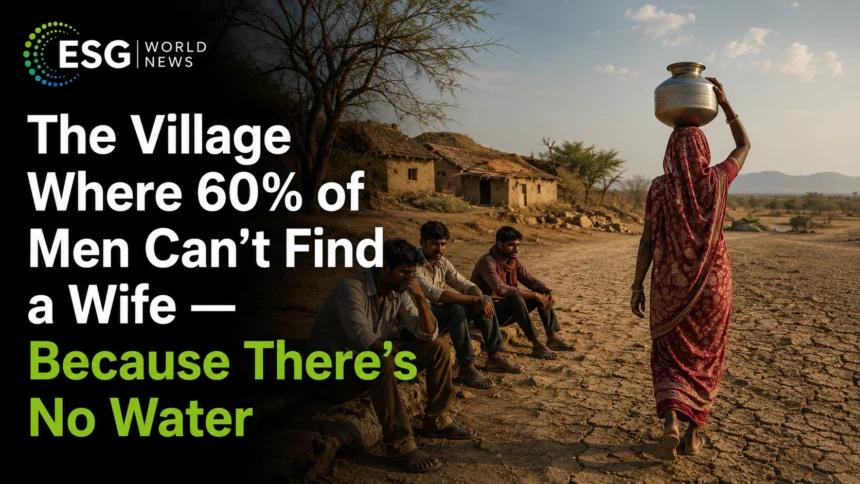
Across rural Bundelkhand, families have begun refusing marriage proposals from villages known to be dry. The calculation is brutally simple: a daughter married into a waterless village will spend her life carrying water. In reporting from the region, one farm labourer summarised what he hears from prospective in-laws: “No water, no daughter.”
In one village in Madhya Pradesh’s Chhatarpur district, residents told news agency ANI in May 2024 that roughly 60 per cent of local youth remain unmarried because families will not send their daughters there. Villagers trek through forest to reach small, contaminated sources.
The men who cannot marry frequently leave. A 2024 study in GeoJournal mapping Bundelkhand’s migration landscape found that over 85 per cent of migration from the region is interstate, that over 60 per cent of migrants are young men from marginal, small-scale farming or landless households, and that more than half head to Delhi and Punjab. Water scarcity does not only empty aquifers. It empties villages of exactly the age cohort that might have rebuilt them.
There is a debt loop underneath. Farmers spend ₹2–5 lakh drilling a borewell that can run dry within a few years — then borrow to drill again, deeper.
A separate case, 600 km away: the “water wives” of Denganmal
A related practice is often attributed to Bundelkhand in social media retellings. It belongs, in the documented record, to Maharashtra.
In Denganmal, a village of roughly 500 people in Shahapur taluka of Thane district, about 185 km from Mumbai, men have taken second and third wives whose principal role is fetching water. The village has no piped supply. Its drinking water comes from two wells at the foot of a rocky hill, and a single round trip can consume much of a day. The women who take on this role — often widows, or women whose families could not afford a dowry — typically receive food, shelter and social standing, but not conjugal rights or a claim on property.
The bitter detail is geographic: pipelines carrying water to Mumbai run past the village. None of them stop.
Bundelkhand and Denganmal are different states, different geologies and different social arrangements. They are the same underlying fact — when a household’s water has to be carried, a woman’s body becomes the infrastructure.
What has been spent
₹7,266 crore — the 2009 Bundelkhand Special Package (₹3,506 crore for UP, ₹3,760 crore for MP), intended for three years of watershed development, check dams, dug wells and afforestation. Actual releases through 2018-19: ₹3,107.87 crore to UP and just ₹704.5 crore to MP — a little over half the sanctioned amount, disbursed over nine years instead of three.
₹44,605 crore — the Ken-Betwa Link Project, India’s first interlinking scheme. Foundation stone laid 25 December 2024; excavation and river diversion began February 2026; completion targeted for March 2030. It promises annual irrigation across 10.62 lakh hectares and drinking water for 6.2 million people in Panna, Tikamgarh, Chhatarpur, Banda, Mahoba, Jhansi and Datia, via the Daudhan Dam and 221 km of canals. It also faces sustained protest over submergence in the Panna Tiger Reserve and scientific dispute over whether the Ken genuinely has surplus water to transfer.
Neither figure addresses the incentive that drains the aquifer. Minimum support prices and subsidised power still make wheat the financially safest crop in one of India’s most water-stressed regions. One kilogram of wheat takes roughly 1,654 litres of water; one kilogram of rice about 2,800. India, holding 18 per cent of the world’s population and 4 per cent of its freshwater, extracted 245.64 billion cubic metres of groundwater in 2024 — 87 per cent of it for agriculture.
What is actually working
The most credible gains in Bundelkhand have not come from megaprojects. They have come from the Jal Sahelis — village women’s collectives that repair check dams, desilt ponds, revive traditional tanks and hold panchayats accountable for water supply. The network now reaches close to 500 villages, with active groups in 27 villages of Chhatarpur alone.
It is unglamorous work: catchment protection, pond restoration, tree cover, maintenance of the structures that already exist. The CSE study makes the case bluntly — in several Banda villages, water conservation structures were built and groundwater still fell, because the structures were poorly sited, poorly maintained, or designed without reference to local hydrogeology. Building is not the same as recharging.
The hundred-year question
My father’s rule was not sentimental. It was an investment test: does this place have a future measured in generations, or only in seasons?
Bundelkhand is what it looks like when a region fails that test and keeps living there anyway. The rainfall did not collapse. The storage did. The wells went deeper, the ponds got smaller, the young men left, and the last people holding the region together are the women walking five kilometres before sunrise for water that arrives by pipe everywhere else in India.
The heatwave is the headline. The falling water table is the story. And the marriages that are no longer happening are the region telling us, in the plainest language available, what it thinks its own hundred-year forecast looks like.
Reported from published data. Sources: Central Ground Water Board Dynamic Groundwater Assessment 2024; Centre for Science and Environment, “Sustainability of Drinking Water Sources in Pali and Banda” (2026); GeoJournal (2024); Down To Earth; ANI; Thomson Reuters Foundation; Ministry of Jal Shakti; Ministry of Agriculture.