

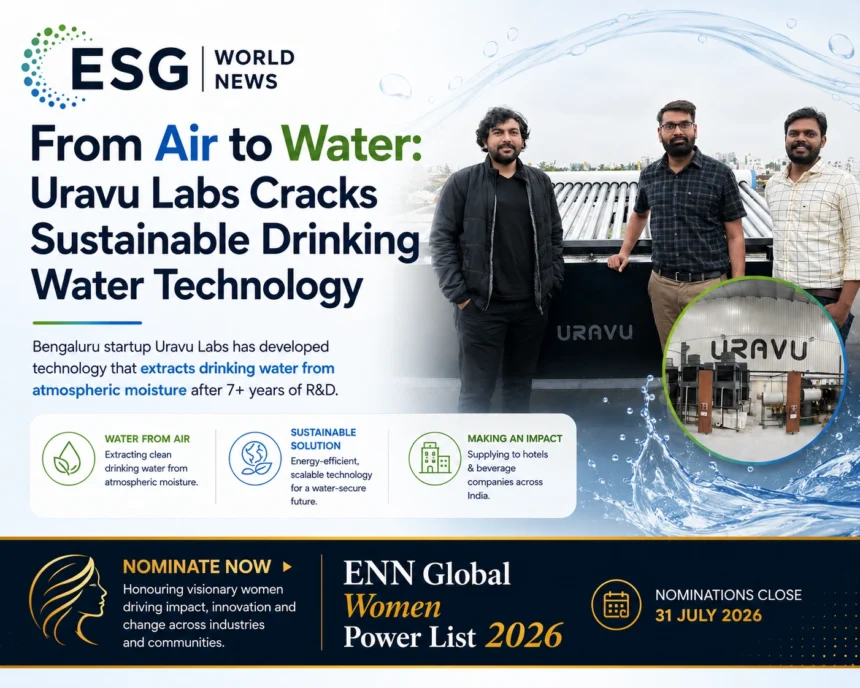
Bengaluru, India: What started as a college innovation project has evolved into one of India’s most promising climate-tech ventures. Bengaluru-based Uravu Labs is developing technology that extracts clean drinking water directly from the atmosphere, offering a potential solution to one of the world’s most pressing challenges — access to safe and sustainable water.
Founded by Swapnil Shrivastav and his team, Uravu Labs has spent more than seven years researching and refining atmospheric water generation technology. The startup’s proprietary system captures moisture from the air using a specially engineered liquid salt solution and converts it into potable water using low-temperature heat.
Tackling a Growing Global Water Crisis
According to the United Nations, nearly 2 billion people worldwide lack access to safely managed drinking water, while climate change, groundwater depletion, and rapid urbanisation continue to intensify water stress across regions.
India is among the countries facing significant water challenges. NITI Aayog estimates that hundreds of millions of Indians experience high to extreme water stress, creating an urgent need for alternative and sustainable water sources.
Uravu Labs believes the atmosphere itself can become a reliable water source.

From Millilitres to Thousands of Litres
The journey began with small experimental prototypes capable of generating only a few hundred millilitres of water per day. Through continuous engineering improvements and product development, the company has scaled its systems significantly.
Today, Uravu’s commercial atmospheric water generators can produce thousands of litres of drinking water daily, making the technology suitable for hospitality businesses, commercial establishments, and industrial applications.
The startup is already supplying air-derived drinking water to hotels, restaurants, and beverage brands that are looking to reduce dependence on traditional water sources while improving sustainability performance.
How the Technology Works
Unlike conventional water supply systems that rely on rivers, lakes, reservoirs, or groundwater extraction, Uravu Labs harvests moisture directly from ambient air.
The process involves:
- Capturing humidity using a proprietary liquid salt solution.
- Absorbing water vapour from the atmosphere.
- Applying low-grade heat to release the collected moisture.
- Condensing and purifying the water for drinking purposes.
This approach allows water production even in regions where traditional freshwater resources are limited or unreliable.
Building Climate-Resilient Infrastructure
Atmospheric water generation is increasingly gaining attention as governments and businesses search for climate-resilient infrastructure solutions.
As extreme weather events, prolonged droughts, and declining groundwater levels become more common, decentralised water-generation technologies are emerging as a complementary source of drinking water.
Industry experts believe such systems could play a critical role in hospitality, remote locations, disaster relief operations, industrial facilities, and water-scarce urban regions.
Backed by Funding and Scale
Uravu Labs has raised more than ₹40 crore in funding from investors supporting climate and sustainability-focused innovations. The company also operates a 15,000-square-foot manufacturing and research facility in Bengaluru, providing the capacity needed for commercial-scale production.
The startup is now focused on expanding its footprint internationally and positioning atmospheric water generation as a viable global solution for water security.
Looking Ahead
With growing concerns around freshwater availability, technologies that diversify water sources are expected to become increasingly important. Uravu Labs’ air-to-water innovation demonstrates how deep technology, sustainability, and climate resilience can intersect to solve real-world problems.
As demand for sustainable water infrastructure rises worldwide, the Bengaluru-based startup is aiming to transform atmospheric moisture into a dependable source of clean drinking water — proving that the future of water may quite literally be in the air.
Exclusive Interview: Viktoriia Betina on Green Hydrogen, SAF and the Future of Decarbonisation