
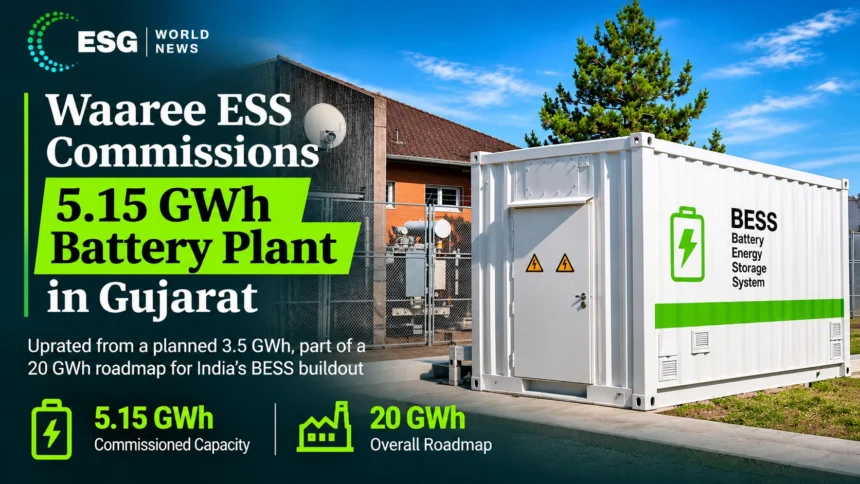
Environment | India | November 15, 2026 – Waaree Energy Storage Solutions Private Limited (Waaree ESS), a subsidiary of Waaree Energies, has commissioned a battery pack manufacturing line with an annual installed capacity of 5.15 GWh at Rola in Valsad, Gujarat. The facility became operational on November 14, 2026, with its capacity increased from the originally planned 3.5 GWh.
- Waaree increases planned battery pack capacity from 3.5 GWh to 5.15 GWh
- Commissioning supports Waaree ESS’s 20 GWh manufacturing roadmap
- India’s battery energy storage market enters a critical growth phase
- Domestic manufacturing and India’s energy security ambitions
- Waaree ESS BESS manufacturing: Key figures
- Why the Valsad facility matters for India’s energy transition
- What to watch next
The upgrade represents an approximately 47% increase over the initial capacity plan. According to the supplied company-related information, the improvement follows production-line debottlenecking and gains in battery cell energy density, allowing the facility to deliver higher output.
The commissioning marks another step in Waaree’s expansion beyond solar manufacturing into battery energy storage systems (BESS). Energy storage is becoming increasingly important to India’s power sector as renewable generation grows and grid operators seek ways to store electricity and make it available when demand rises or solar and wind generation falls.
Waaree increases planned battery pack capacity from 3.5 GWh to 5.15 GWh
The increase in the Valsad plant’s planned annual capacity is a notable feature of the commissioning. Rather than simply announcing a new facility, Waaree has raised the expected output of an existing manufacturing line.
The company attributes the improvement to higher production throughput and better battery cell energy density. These gains can allow more storage capacity to be manufactured within the same production footprint.
The facility incorporates Industry 4.0-oriented manufacturing systems, including automated guided vehicles, automated assembly lines and advanced testing and quality-assurance processes. Such technologies are intended to support production efficiency, consistency and quality control.
The resulting 5.15 GWh annual capacity is around 47% above the original 3.5 GWh plan, strengthening Waaree ESS’s battery pack manufacturing capability.
Commissioning supports Waaree ESS’s 20 GWh manufacturing roadmap
The Valsad facility is part of Waaree ESS’s wider plan to build up to 20 GWh of manufacturing capacity.
For the current financial year, the company is targeting 5.15 GWh of battery pack manufacturing capacity alongside 3.5 GWh of lithium cell manufacturing capacity. Developing capabilities across both cell production and battery pack manufacturing could help the company build a more integrated position in the energy storage value chain.
Sunil Rathi, Director at Waaree, described battery energy storage systems as central to a renewable-powered future. He said the start of the advanced BESS container manufacturing facility was an important step towards establishing an integrated energy storage ecosystem.
The facility is designed to cater to utility-scale energy storage projects as well as commercial and industrial customers. These applications can include storing renewable electricity, supporting grid operations and helping businesses manage their energy requirements.
India’s battery energy storage market enters a critical growth phase
Waaree’s expansion comes as India works to scale up energy storage alongside its renewable power capacity.
Solar and wind generation are variable by nature. Electricity production can fluctuate with weather conditions and the time of day, while power demand continues throughout the day and night. Battery energy storage systems can help bridge this gap by storing electricity when generation is available and discharging it when required.
India’s grid-connected BESS ambitions are substantial. The targets cited in the supplied material point to approximately 47 GWh by 2030, increasing to 236 GWh by 2032.
However, the country’s installed storage base remains at an early stage relative to these ambitions. The supplied draft puts operational grid-scale BESS capacity below 1 GW, while approximately 35.8 GWh of projects are under construction nationally. This highlights the scale of deployment and execution still required.
Market projections also indicate significant growth potential. Mordor Intelligence estimates that India’s BESS market could expand from approximately US$2.05 billion in 2026 to US$8.59 billion by 2031, representing an annual compound growth rate of nearly 27%.
Government support, renewable energy expansion and the need for more flexible electricity grids are among the factors expected to drive demand.
Domestic manufacturing and India’s energy security ambitions
The development of local battery manufacturing capacity is closely linked to India’s Make in India and Atmanirbhar Bharat priorities.
A large-scale shift towards renewable energy and battery storage will require dependable access to cells, packs, components and critical minerals. Heavy reliance on imported battery products could expose projects to global supply-chain disruptions, price fluctuations and concentrated sourcing risks.
Domestic manufacturing investments can help build local industrial capabilities and strengthen the supply chain supporting India’s energy transition.
The policy environment also includes incentives for advanced battery manufacturing. The supplied material cites ₹18,100 crore in production-linked incentive support for the battery manufacturing sector, alongside measures intended to encourage domestic energy storage deployment.
Waaree’s move into BESS manufacturing therefore reflects a wider industry opportunity: developing the equipment and supply-chain capabilities needed to support a power system with a growing share of renewable electricity.
Waaree ESS BESS manufacturing: Key figures
- 5.15 GWh: Annual battery pack manufacturing capacity at the newly commissioned Valsad facility.
- 3.5 GWh: Original planned annual capacity before the upgrade.
- Approximately 47%: Increase over the initial capacity plan.
- 20 GWh: Waaree ESS’s broader manufacturing roadmap.
- 3.5 GWh: Lithium cell manufacturing capacity targeted for the current financial year.
- 47 GWh: India’s cited grid-connected BESS target for 2030.
- 236 GWh: India’s cited grid-connected BESS target for 2032.
- US$8.59 billion: Projected value of India’s BESS market by 2031.
Why the Valsad facility matters for India’s energy transition
India’s renewable energy expansion increasingly depends on its ability to store and dispatch electricity reliably. Without sufficient storage, periods of high solar or wind generation may not align with periods of peak demand. Battery systems can help address this mismatch and support a more flexible electricity network.
Manufacturing capacity is an important part of that transition. Building battery packs and cells domestically can strengthen the industrial base behind storage deployment, although manufacturing announcements alone do not guarantee that projects will be delivered or that supply chains will be fully localised.
Waaree ESS’s 5.15 GWh facility is a tangible addition to India’s battery manufacturing landscape. Its increase over the original capacity plan also puts a spotlight on the role that process improvements, automation and manufacturing efficiency can play in scaling output.
What to watch next
The next important milestone will be the execution of Waaree ESS’s wider 20 GWh roadmap. Progress towards the company’s 3.5 GWh lithium cell manufacturing target will also help show how quickly its manufacturing ambitions are translating into operating capacity.
For India’s broader BESS sector, the pace at which projects move from the pipeline and construction stages into commercial operation will be just as important as the growth in announced manufacturing capacity.
As renewable generation expands, the ability to manufacture, deploy and operate energy storage systems at scale will be a key factor in building a more reliable and flexible electricity system.
India Bans Export of Lithium-Ion Battery Black Mass to Boost Domestic Critical Mineral Recycling